p.4 抽出テキスト
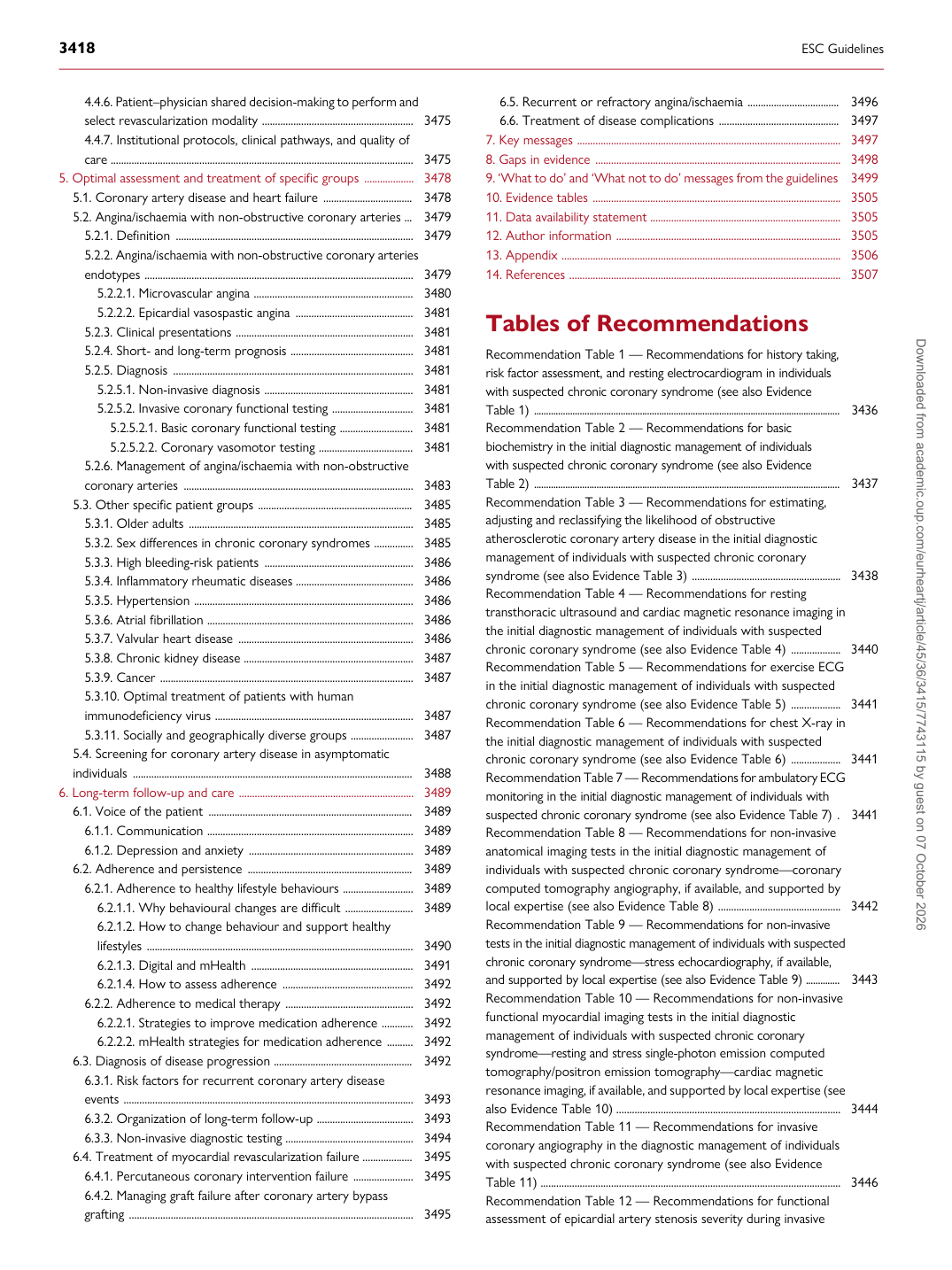
4.4.6. Patient–physician shared decision-making to perform and select revascularization modality .......................................................... 3475 4.4.7. Institutional protocols, clinical pathways, and quality of care .................................................................................................................... 3475 5. Optimal assessment and treatment of specific groups ................... 3478 5.1. Coronary artery disease and heart failure .................................. 3478 5.2. Angina/ischaemia with non-obstructive coronary arteries ... 3479 5.2.1. Definition ........................................................................................... 3479 5.2.2. Angina/ischaemia with non-obstructive coronary arteries endotypes ....................................................................................................... 3479 5.2.2.1. Microvascular angina ............................................................. 3480 5.2.2.2. Epicardial vasospastic angina ............................................. 3481 5.2.3. Clinical presentations .................................................................... 3481 5.2.4. Short- and long-term prognosis ............................................... 3481 5.2.5. Diagnosis ............................................................................................ 3481 5.2.5.1. Non-invasive diagnosis ......................................................... 3481 5.2.5.2. Invasive coronary functional testing ............................... 3481 5.2.5.2.1. Basic coronary functional testing ............................ 3481 5.2.5.2.2. Coronary vasomotor testing .................................... 3481 5.2.6. Management of angina/ischaemia with non-obstructive coronary arteries ........................................................................................ 3483 5.3. Other specific patient groups ........................................................... 3485 5.3.1. Older adults ...................................................................................... 3485 5.3.2. Sex differences in chronic coronary syndromes ............... 3485 5.3.3. High bleeding-risk patients ......................................................... 3486 5.3.4. Inflammatory rheumatic diseases ............................................. 3486 5.3.5. Hypertension .................................................................................... 3486 5.3.6. Atrial fibrillation ............................................................................... 3486 5.3.7. Valvular heart disease ................................................................... 3486 5.3.8. Chronic kidney disease ................................................................. 3487 5.3.9. Cancer ................................................................................................. 3487 5.3.10. Optimal treatment of patients with human immunodeficiency virus ............................................................................ 3487 5.3.11. Socially and geographically diverse groups ........................ 3487 5.4. Screening for coronary artery disease in asymptomatic individuals ........................................................................................................... 3488 6. Long-term follow-up and care ................................................................... 3489 6.1. Voice of the patient .............................................................................. 3489 6.1.1. Communication ............................................................................... 3489 6.1.2. Depression and anxiety ............................................................... 3489 6.2. Adherence and persistence ............................................................... 3489 6.2.1. Adherence to healthy lifestyle behaviours ........................... 3489 6.2.1.1. Why behavioural changes are difficult .......................... 3489 6.2.1.2. How to change behaviour and support healthy lifestyles ...................................................................................................... 3490 6.2.1.3. Digital and mHealth .............................................................. 3491 6.2.1.4. How to assess adherence .................................................. 3492 6.2.2. Adherence to medical therapy ................................................. 3492 6.2.2.1. Strategies to improve medication adherence ............ 3492 6.2.2.2. mHealth strategies for medication adherence .......... 3492 6.3. Diagnosis of disease progression ..................................................... 3492 6.3.1. Risk factors for recurrent coronary artery disease events ............................................................................................................... 3493 6.3.2. Organization of long-term follow-up ..................................... 3493 6.3.3. Non-invasive diagnostic testing ................................................. 3494 6.4. Treatment of myocardial revascularization failure ................... 3495 6.4.1. Percutaneous coronary intervention failure ....................... 3495 6.4.2. Managing graft failure after coronary artery bypass grafting ............................................................................................................. 3495 6.5. Recurrent or refractory angina/ischaemia ................................... 3496 6.6. Treatment of disease complications .............................................. 3497 7. Key messages ..................................................................................................... 3497 8. Gaps in evidence .............................................................................................. 3498 9. ‘What to do’ and ‘What not to do’ messages from the guidelines 3499 10. Evidence tables ............................................................................................... 3505 11. Data availability statement ......................................................................... 3505 12. Author information ...................................................................................... 3505 13. Appendix ........................................................................................................... 3506 14. References ........................................................................................................ 3507

Tables of Recommendations

Recommendation Table 1 — Recommendations for history taking, risk factor assessment, and resting electrocardiogram in individuals with suspected chronic coronary syndrome (see also Evidence Table 1) ............................................................................................................................... 3436 Recommendation Table 2 — Recommendations for basic biochemistry in the initial diagnostic management of individuals with suspected chronic coronary syndrome (see also Evidence Table 2) ............................................................................................................................... 3437 Recommendation Table 3 — Recommendations for estimating, adjusting and reclassifying the likelihood of obstructive atherosclerotic coronary artery disease in the initial diagnostic management of individuals with suspected chronic coronary syndrome (see also Evidence Table 3) ......................................................... 3438 Recommendation Table 4 — Recommendations for resting transthoracic ultrasound and cardiac magnetic resonance imaging in the initial diagnostic management of individuals with suspected chronic coronary syndrome (see also Evidence Table 4) ................... 3440 Recommendation Table 5 — Recommendations for exercise ECG in the initial diagnostic management of individuals with suspected chronic coronary syndrome (see also Evidence Table 5) ................... 3441 Recommendation Table 6 — Recommendations for chest X-ray in the initial diagnostic management of individuals with suspected chronic coronary syndrome (see also Evidence Table 6) ................... 3441 Recommendation Table 7 — Recommendations for ambulatory ECG monitoring in the initial diagnostic management of individuals with suspected chronic coronary syndrome (see also Evidence Table 7) . 3441 Recommendation Table 8 — Recommendations for non-invasive anatomical imaging tests in the initial diagnostic management of individuals with suspected chronic coronary syndrome—coronary computed tomography angiography, if available, and supported by local expertise (see also Evidence Table 8) ............................................... 3442 Recommendation Table 9 — Recommendations for non-invasive tests in the initial diagnostic management of individuals with suspected chronic coronary syndrome—stress echocardiography, if available, and supported by local expertise (see also Evidence Table 9) .............. 3443 Recommendation Table 10 — Recommendations for non-invasive functional myocardial imaging tests in the initial diagnostic management of individuals with suspected chronic coronary syndrome—resting and stress single-photon emission computed tomography/positron emission tomography—cardiac magnetic resonance imaging, if available, and supported by local expertise (see also Evidence Table 10) ...................................................................................... 3444 Recommendation Table 11 — Recommendations for invasive coronary angiography in the diagnostic management of individuals with suspected chronic coronary syndrome (see also Evidence Table 11) ................................................................................................................... 3446 Recommendation Table 12 — Recommendations for functional assessment of epicardial artery stenosis severity during invasive Downloaded from academic.oup.com/eurheartj/article/45/36/3415/7743115 by guest on 07 October 2026