p.39 抽出テキスト
After confirmation of diagnosis with the first line of testing, all patients should receive lifestyle and risk-factor modification recommendations, and disease-modifying and antianginal therapy should be prescribed. The ISCHEMIA trial (Initial Invasive or Conservative Strategy for Stable Coronary Disease)47 showed that an early revascularization strategy did not yield a short-term survival benefit in patients without left main disease nor reduced LVEF and with moderate-severe ischaemia at non-invasive testing, suggesting that most such patients should initially be treated conservatively with optimized GDMT. Patients can be referred for ICA if CCTA detects a ≥50% stenosis of the left main stem, three-vessel or two-vessel disease including the proximal LAD artery with ≥70% stenosis, or if functional imaging shows moderate or severe ischaemia encompassing an extensive perfusion territory.

For patients with obstructive CAD and refractory symptoms despite optimized GDMT, a referral for ICA may be considered to improve symptoms through revascularization. Optimization of medical therapy by combining two or more antianginal drugs can safely be obtained over 6 weeks in almost all patients and should be awaited before referral to ICA.402,403 It is worth noting that in the Objective Randomised Blinded Investigation with optimal medical Therapy of Angioplasty in stable angina (ORBITA) trial, PCI did not provide short-term advantages compared with GDMT in terms of reducing anginal frequency or physical limitations.402 In the CLARIFY registry, anginal symptoms resolved in many CCS patients over time without requiring revascularization or changes in antianginal therapy.404 Combined anatomical and functional imaging before ICA facilitates its planning by orientating the invasive cardiologist to perform, in the same session, haemodynamic assessment of coronary stenoses and ICFT to detect microvascular disease or vasospasm in individuals suspected of ANOCA/INOCA, performing these tests in a single session rather than in staged procedures.

3.3.5 Adverse-event risk assessment

Chronic coronary syndromes can be complicated by cardiovascular death, ischaemic and haemorrhagic events, HF, arrhythmic events, the development of valvular heart disease, and other comorbidities, which are further discussed in the Supplementary data, available at European Heart Journal online. It is recommended that all patients with newly diagnosed obstructive CAD or myocardial ischaemia undergo an adverserisk event assessment to identify those at high risk of adverse outcomes who could benefit from revascularization beyond symptom relief. Based on large registries and historical RCTs, a high event risk has been defined as a cardiac mortality rate of >3% per year, intermediate event risk as between ≥1% and ≤3% per year, and low event risk as <1% per year.405 Adverse-event risk stratification is usually based on the same clinical, non-invasive and invasive investigations used to diagnose obstructive CAD (see Table 14). Clinical history, physical examination, 12-lead ECG and laboratory tests can provide important prognostic information. Assessment of risk factors such as advanced age, diabetes mellitus (DM), or renal failure allows the identification of patients at high risk of events.406–408 Left ventricular function is the strongest predictor of long-term survival; a patient with an LVEF of <50% is already at high risk for all-cause and cardiovascular death.409,410 Although the diagnostic value of an exercise ECG is limited, the occurrence of ST-segment depression at a low workload combined with exertional symptoms (angina or dyspnoea), low exercise capacity, complex ventricular ectopy, or other arrhythmias and abnormal BP response are markers of a high risk of cardiac mortality.411–414 High plaque burden and coronary stenoses are well-known prognostic markers. The ISCHEMIA trial using a cut-off of 70% stenosis on CCTA317 confirms the very old observations of the Coronary Artery Surgery Study182 that the prognosis of obstructive CAD-related CCS is mainly determined by the number of >70% obstructed coronary arteries or by the presence of a left main stenosis (using for the latter a cut-off of >50% diameter stenosis on coronary angiography).317 More recently, the classical paradigm that the severity of stenoses and the number of diseased vessels are the main determinants of prognosis has been challenged by post hoc analyses of the SCOT-HEART trial and other CCTA-based

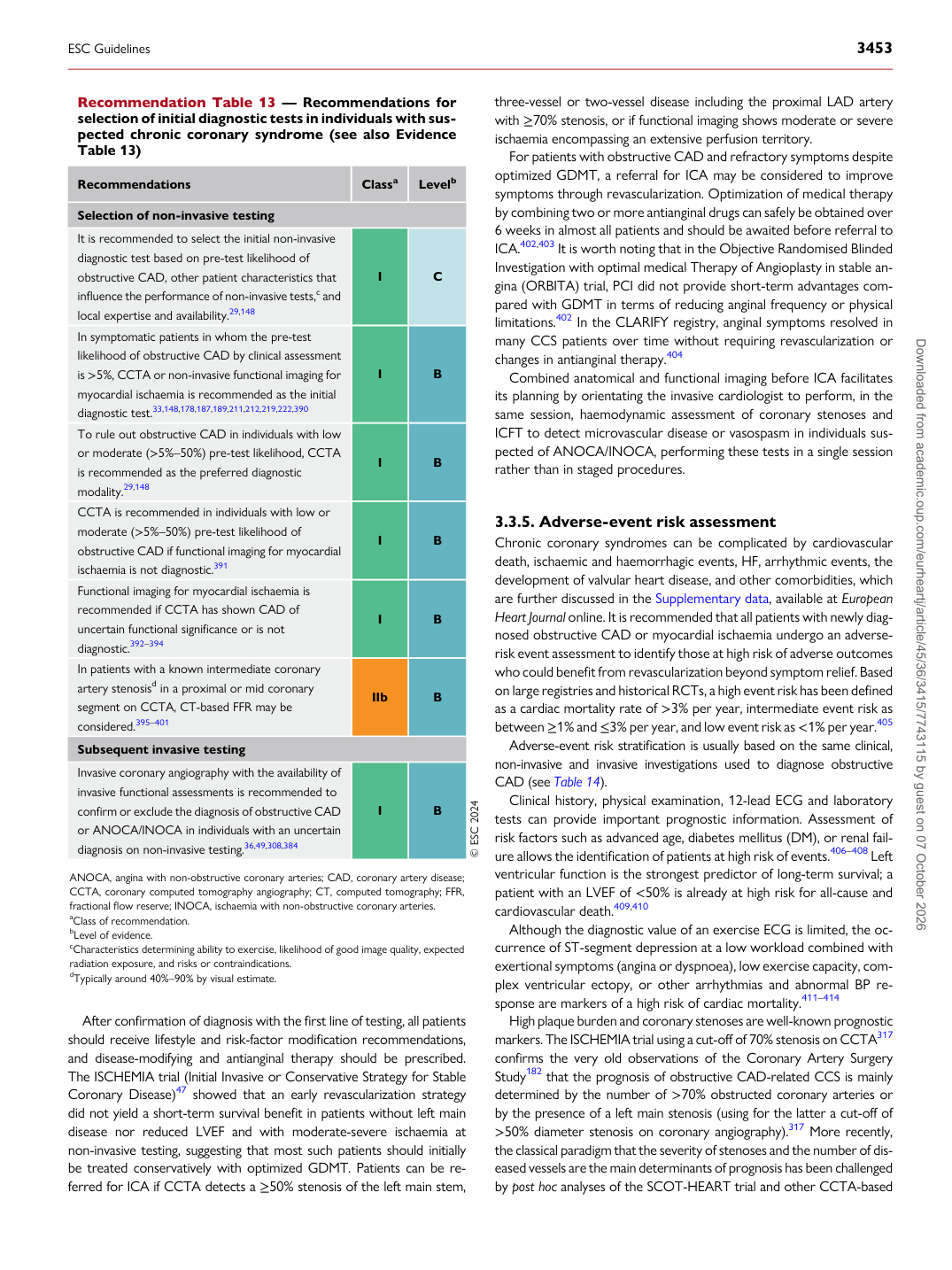
Recommendation Table 13 — Recommendations for selection of initial diagnostic tests in individuals with suspected chronic coronary syndrome (see also Evidence Table 13)

Recommendations Classa Levelb

Selection of non-invasive testing It is recommended to select the initial non-invasive diagnostic test based on pre-test likelihood of obstructive CAD, other patient characteristics that influence the performance of non-invasive tests,c and local expertise and availability.29,148 I C In symptomatic patients in whom the pre-test likelihood of obstructive CAD by clinical assessment is >5%, CCTA or non-invasive functional imaging for myocardial ischaemia is recommended as the initial diagnostic test.33,148,178,187,189,211,212,219,222,390 I B To rule out obstructive CAD in individuals with low or moderate (>5%–50%) pre-test likelihood, CCTA is recommended as the preferred diagnostic modality.29,148 I B CCTA is recommended in individuals with low or moderate (>5%–50%) pre-test likelihood of obstructive CAD if functional imaging for myocardial ischaemia is not diagnostic.391 I B Functional imaging for myocardial ischaemia is recommended if CCTA has shown CAD of uncertain functional significance or is not diagnostic.392–394 I B In patients with a known intermediate coronary artery stenosisd in a proximal or mid coronary segment on CCTA, CT-based FFR may be considered.395–401 IIb B Subsequent invasive testing Invasive coronary angiography with the availability of invasive functional assessments is recommended to confirm or exclude the diagnosis of obstructive CAD or ANOCA/INOCA in individuals with an uncertain diagnosis on non-invasive testing.36,49,308,384 I B © ESC 2024

ANOCA, angina with non-obstructive coronary arteries; CAD, coronary artery disease; CCTA, coronary computed tomography angiography; CT, computed tomography; FFR, fractional flow reserve; INOCA, ischaemia with non-obstructive coronary arteries. aClass of recommendation. bLevel of evidence. cCharacteristics determining ability to exercise, likelihood of good image quality, expected radiation exposure, and risks or contraindications. dTypically around 40%–90% by visual estimate.

ESC Guidelines                                                                                                                                                                                          3453

Downloaded from academic.oup.com/eurheartj/article/45/36/3415/7743115 by guest on 07 October 2026