p.37 抽出テキスト
The discussion about which modality to use as a first-line test has been heavily focused on the detection of obstructive epicardial stenoses, neglecting the relatively high prevalence of non-obstructive coronary disease and ANOCA/INOCA, especially in female patients. The current rationale behind choosing a first-line test should be to assess the anatomical severity and functional consequences of coronary disease, whether obstructive or not. In this regard, PET-CT should be more frequently considered and its availability increased as it combines calcium scoring with accurate operator-independent detection of myocardial ischaemia and CMD with a low irradiation dose.45 Individuals in the moderate likelihood group, except older men with all three CCS symptom characteristics, will have a likelihood of obstructive CAD around 20%. In these, anatomical and functional testing will each result in an intermediate positive predictive value with eventually many false positives, especially with CCTA  easily overestimating stenosis severity. Sequential testing (i.e. functional testing after CCTA, or vice versa) will therefore be needed in many individuals to establish an accurate diagnosis of obstructive, ischaemia-inducing CAD  (Figure 8). Sequential or combined anatomical and functional testing is also useful for the non-invasive diagnosis of ANOCA/INOCA.41 Moreover, combined testing, e.g. combining CCTA and PET, may result in improved prognostication of CCS patients.387

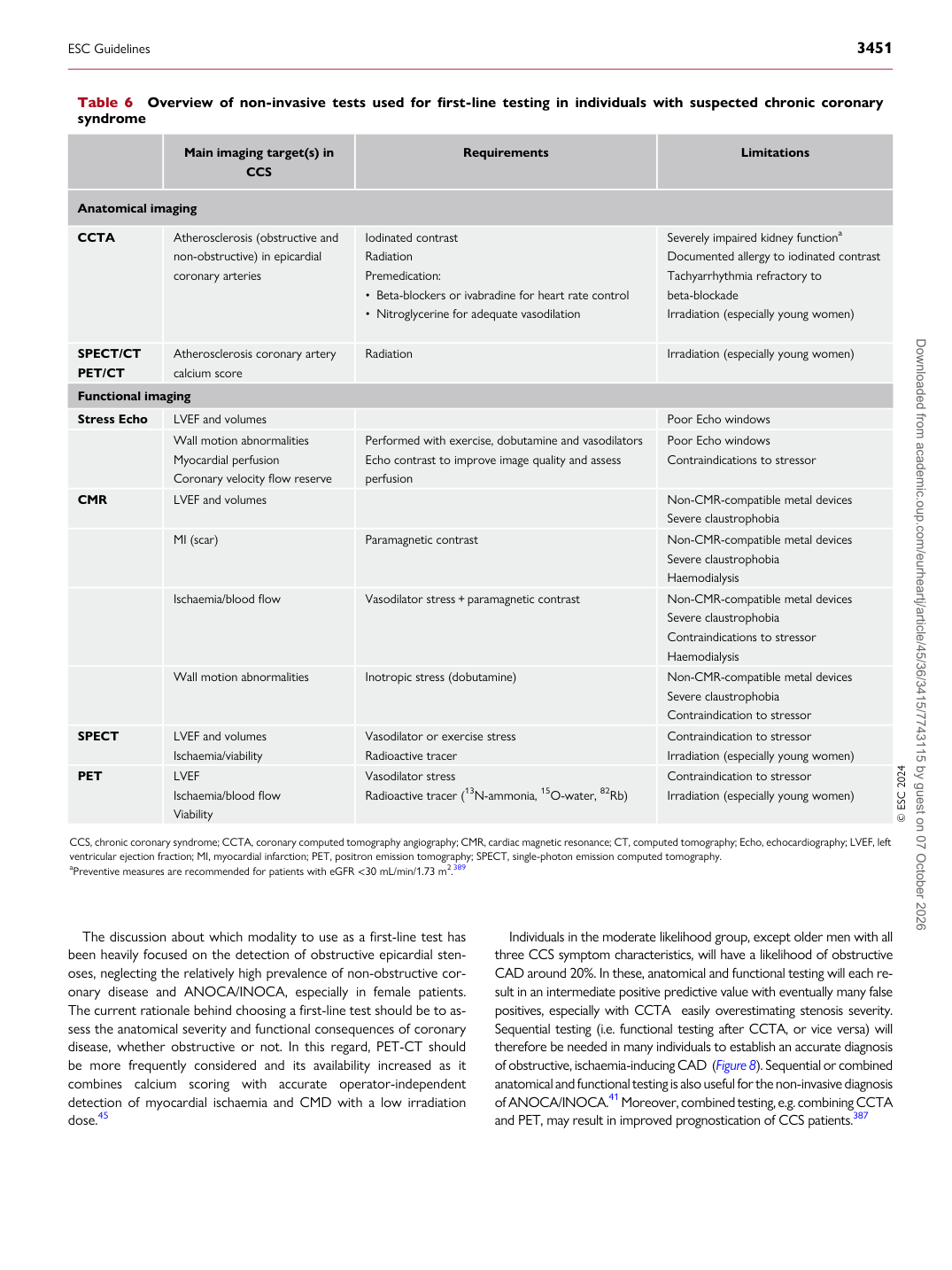
Table 6 Overview of non-invasive tests used for first-line testing in individuals with suspected chronic coronary syndrome

Main imaging target(s) in

CCS Requirements Limitations

Anatomical imaging

CCTA Atherosclerosis (obstructive and

non-obstructive) in epicardial coronary arteries Iodinated contrast

Radiation Premedication: • Beta-blockers or ivabradine for heart rate control • Nitroglycerine for adequate vasodilation Severely impaired kidney functiona

Documented allergy to iodinated contrast Tachyarrhythmia refractory to beta-blockade Irradiation (especially young women)

SPECT/CT PET/CT Atherosclerosis coronary artery

calcium score Radiation Irradiation (especially young women)

Functional imaging Stress Echo LVEF and volumes Poor Echo windows

Wall motion abnormalities Myocardial perfusion Coronary velocity flow reserve Performed with exercise, dobutamine and vasodilators Echo contrast to improve image quality and assess

perfusion Poor Echo windows Contraindications to stressor

CMR LVEF and volumes Non-CMR-compatible metal devices

Severe claustrophobia

MI (scar) Paramagnetic contrast Non-CMR-compatible metal devices

Severe claustrophobia Haemodialysis

Ischaemia/blood flow Vasodilator stress + paramagnetic contrast Non-CMR-compatible metal devices

Severe claustrophobia Contraindications to stressor Haemodialysis

Wall motion abnormalities Inotropic stress (dobutamine) Non-CMR-compatible metal devices

Severe claustrophobia Contraindication to stressor

SPECT LVEF and volumes Ischaemia/viability Vasodilator or exercise stress Radioactive tracer Contraindication to stressor Irradiation (especially young women) PET LVEF Ischaemia/blood flow

Viability Vasodilator stress Radioactive tracer (13N-ammonia, 15O-water, 82Rb) Contraindication to stressor Irradiation (especially young women) © ESC 2024

CCS, chronic coronary syndrome; CCTA, coronary computed tomography angiography; CMR, cardiac magnetic resonance; CT, computed tomography; Echo, echocardiography; LVEF, left ventricular ejection fraction; MI, myocardial infarction; PET, positron emission tomography; SPECT, single-photon emission computed tomography. aPreventive measures are recommended for patients with eGFR <30 mL/min/1.73 m2.389

ESC Guidelines                                                                                                                                                                                          3451

Downloaded from academic.oup.com/eurheartj/article/45/36/3415/7743115 by guest on 07 October 2026