p.36 抽出テキスト
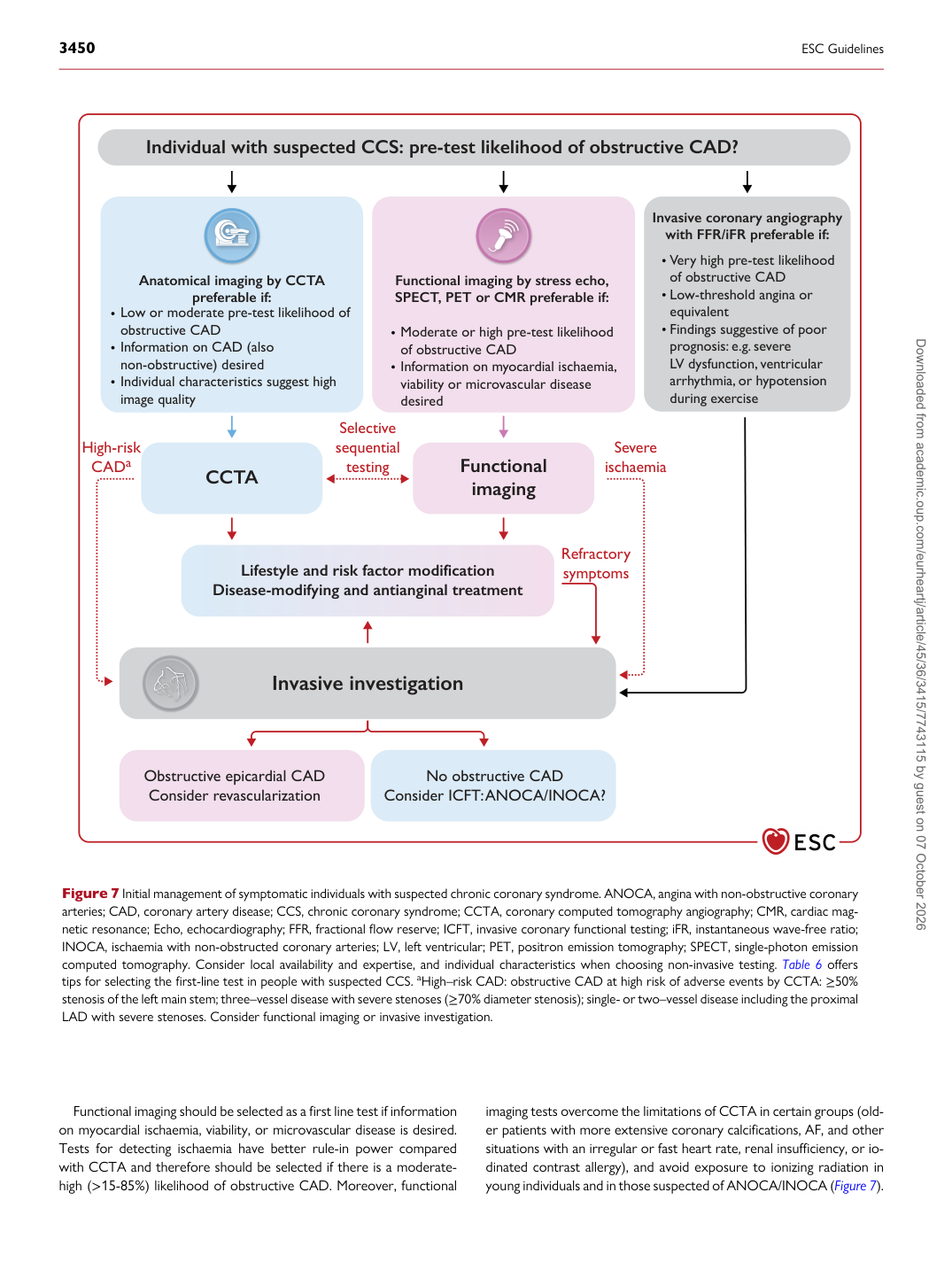
Functional imaging should be selected as a first line test if information on myocardial ischaemia, viability, or microvascular disease is desired. Tests for detecting ischaemia have better rule-in power compared with CCTA and therefore should be selected if there is a moderatehigh (>15-85%) likelihood of obstructive CAD. Moreover, functional imaging tests overcome the limitations of CCTA in certain groups (older patients with more extensive coronary calcifications, AF, and other situations with an irregular or fast heart rate, renal insufficiency, or iodinated contrast allergy), and avoid exposure to ionizing radiation in young individuals and in those suspected of ANOCA/INOCA (Figure 7).

Anatomical imaging by CCTA preferable if: Low or moderate pre-test likelihood of obstructive CAD Information on CAD (also non-obstructive) desired Individual characteristics suggest high image quality Invasive coronary angiography

with FFR/iFR preferable if: Very high pre-test likelihood of obstructive CAD Low-threshold angina or equivalent Findings suggestive of poor prognosis: e.g. severe LV dysfunction, ventricular arrhythmia, or hypotension during exercise

Functional imaging by stress echo, SPECT, PET or CMR preferable if:

Moderate or high pre-test likelihood of obstructive CAD Information on myocardial ischaemia, viability or microvascular disease desired

Individual with suspected CCS: pre-test likelihood of obstructive CAD?

CCTA Functional

imaging

Lifestyle and risk factor modification Disease-modifying and antianginal treatment

Selective sequential

testing

Severe ischaemia High-risk

CADa

Refractory symptoms

Obstructive epicardial CAD Consider revascularization No obstructive CAD Consider ICFT: ANOCA/INOCA?

Invasive investigation

Figure 7 Initial management of symptomatic individuals with suspected chronic coronary syndrome. ANOCA, angina with non-obstructive coronary arteries; CAD, coronary artery disease; CCS, chronic coronary syndrome; CCTA, coronary computed tomography angiography; CMR, cardiac magnetic resonance; Echo, echocardiography; FFR, fractional flow reserve; ICFT, invasive coronary functional testing; iFR, instantaneous wave-free ratio; INOCA, ischaemia with non-obstructed coronary arteries; LV, left ventricular; PET, positron emission tomography; SPECT, single-photon emission computed tomography. Consider local availability and expertise, and individual characteristics when choosing non-invasive testing. Table 6 offers tips for selecting the first-line test in people with suspected CCS. aHigh–risk CAD: obstructive CAD at high risk of adverse events by CCTA: ≥50% stenosis of the left main stem; three–vessel disease with severe stenoses (≥70% diameter stenosis); single- or two–vessel disease including the proximal LAD with severe stenoses. Consider functional imaging or invasive investigation. Downloaded from academic.oup.com/eurheartj/article/45/36/3415/7743115 by guest on 07 October 2026