p.33 抽出テキスト
recent studies (RIPCORD2 and FUTURE) did not demonstrate any clinical outcome improvement compared with angiography alone.346,347 Therefore, intracoronary pressure measurement in patients with multivessel CAD should only be performed on intermediate lesions. Several recent studies using either FFR or iFR suggest that the pattern of pressure drop along the coronary artery (focal vs. progressive) recorded during a pullback is important to select patients who will benefit more from PCI.2,348–352 Longitudinal functional vessel interrogation can therefore be helpful in patients with serial lesions or diffuse CAD. New 3D angiographically derived wireless coronary pressure parameters, such as quantitative flow ratio (QFR) or vessel fractional flow reserve (vFFR), are at different stages of clinical investigation325,353,354 (NCT03729739) and have important features that may help to increase the use of coronary pressure measurement during ICA significantly. These technologies have indeed the unique advantage of providing both distal coronary pressure measures and a coronary pressure map along the coronary vessel without requiring the use of any pressure wire. The lack of benefits shown in some recent FFR trials demonstrates that it is not sufficient to validate such new coronary pressure indexes against FFR alone to demonstrate their clinical value, and it is important to also show benefit in a direct comparative trial vs. angiography. In that context, the results of the FAVOR III China study355 are important, demonstrating an improved clinical outcome in the QFR-guided group compared with the angiography-guided group, driven by fewer MIs and ischaemia-driven revascularizations. The combined measurements of pressure and flow (measured by Doppler or thermodilution) may further reduce the number of interventions. Patients with lesions and concordant normal FFR and CFR have an excellent prognosis. Patients with lesions and discordant results between FFR and CFR have a similar prognosis to that of patients with lesions and concordant abnormal FFR and CFR, treated with PCI. Lesions with an abnormal FFR but normal CFR pertain to a good clinical outcome up to 5 years of follow-up if left untreated.356–358 Moreover, hyperaemic stenosis resistance (HSR), by measuring the pressure gradient across a lesion divided by flow, is an excellent index for both diagnostic and prognostic purposes.359,360 The recently introduced continuous thermodilution technique for measuring absolute coronary flow presents an alternative method for determining CFR. Additionally, this method allows for evaluation of the microvascular resistance reserve (MRR), a novel index for assessing coronary microvascular function.361–364 Coronary flow capacity (CFC) integrates hyperaemic flow and CFR and is useful for both diagnostic purposes as well as the evaluation of the result after PCI.365–368 Intravascular imaging techniques [e.g. intravascular ultrasound (IVUS) or optical coherence tomography (OCT)] have demonstrated good diagnostic accuracy in predicting FFR, especially in stenoses located in the left main stem.369,370 They are reasonable options to assess left main stenosis severity and prognosis; increasing left main plaque burden was associated with long-term all-cause and cardiac mortality in patients not undergoing revascularization.371 While coronary pressure thresholds, specifically 0.80 for FFR and 0.89 for iFR, are crucial in aiding clinical decision-making, particularly in the case of deferring revascularization when FFR/iFR exceeds the ischaemic threshold,310,372 they must be considered alongside other parameters. These include a careful assessment of the patient’s symptoms and the results of non-invasive stress testing to determine the need for revascularization. 3.3.3.3 Assessment of microvascular dysfunction

Detailed discussion of microvascular dysfunction by invasive coronary functional testing is provided in Section 5.2.5.2. After nitroglycerine, adenosine is administered to assess endothelium-independent vasodilation [CFR, IMR, and hyperaemic myocardial velocity resistance (HMR)]. Coronary flow reserve can be calculated using bolus thermodilution (as baseline transit time divided by hyperaemic transit time) or continuous thermodilution (as the ratio of hyperaemic and resting absolute coronary flow), or Doppler flow velocity (hyperaemic flow velocity divided by baseline flow velocity).307,378,379 The IMR is calculated as the product of distal coronary pressure at maximal hyperaemia multiplied by the hyperaemic mean transit time. Increased IMR (≥25 U) indicates microvascular dysfunction.380,381 It is important to note that continuous thermodilution-derived measurements have shown higher reproducibility than similar measurements derived from bolus thermodilution.382 Angiography-derived index of coronary microcirculatory resistance (angio-IMR) allows microcirculation assessment without using intracoronary wires.383

3.3.3.4 Testing for coronary vasospasm

Vasoreactivity testing explores endothelium-dependent mechanisms of CMD and epicardial and microvascular vasomotor tone disorders.36,73,384 The most established approach for coronary vasoreactivity testing is by intracoronary infusion of Ach, although other substances like ergonovine have been proposed.384,385 The methodology is described in detail in Section 5.2.5.2.2.

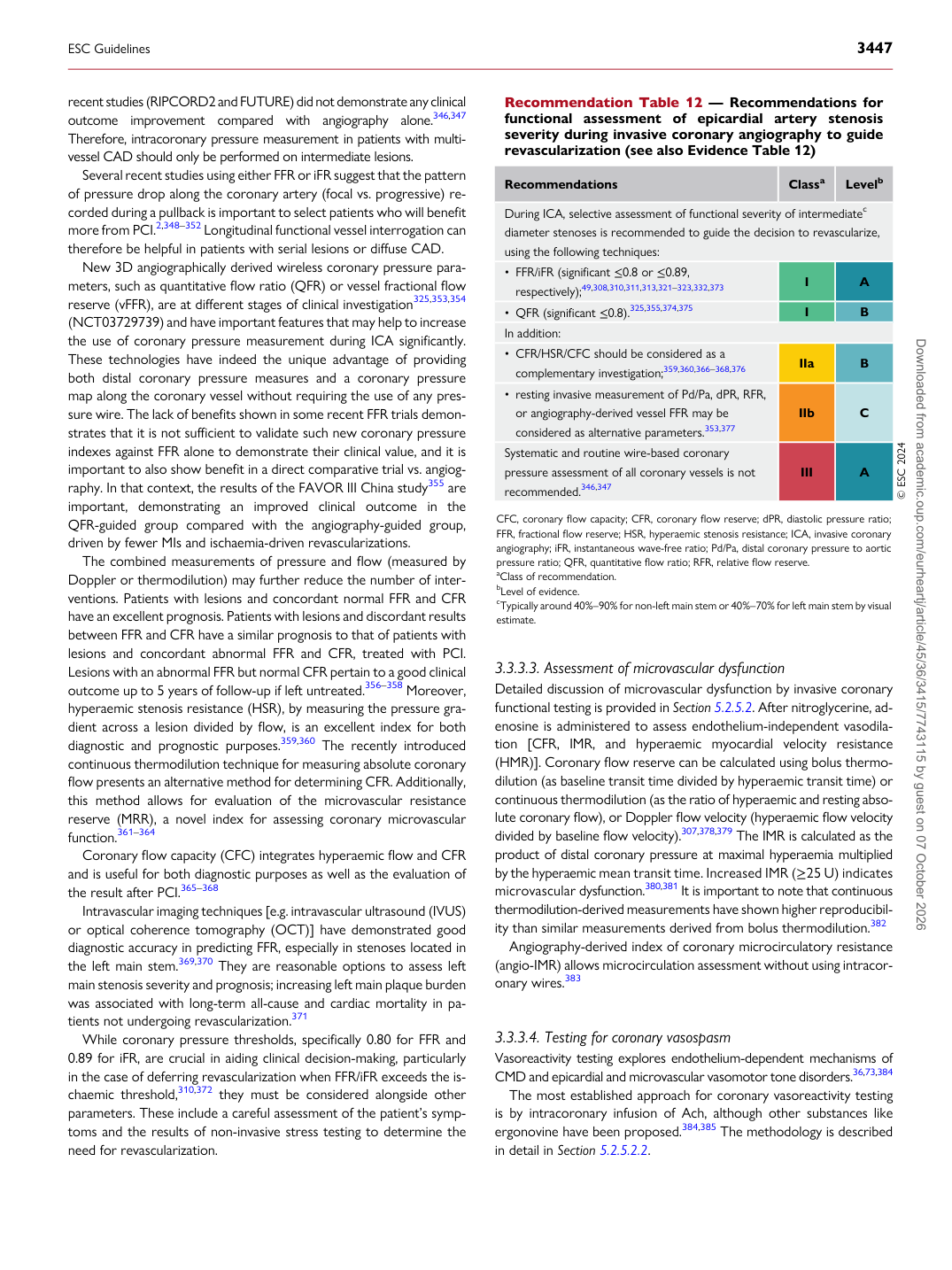
Recommendation Table 12 — Recommendations for functional assessment of epicardial artery stenosis severity during invasive coronary angiography to guide revascularization (see also Evidence Table 12)

Recommendations Classa Levelb During ICA, selective assessment of functional severity of intermediatec diameter stenoses is recommended to guide the decision to revascularize, using the following techniques: • FFR/iFR (significant ≤0.8 or ≤0.89, respectively);49,308,310,311,313,321–323,332,373 I A • QFR (significant ≤0.8).325,355,374,375 I B In addition: • CFR/HSR/CFC should be considered as a

complementary investigation;359,360,366–368,376 IIa B • resting invasive measurement of Pd/Pa, dPR, RFR,

or angiography-derived vessel FFR may be considered as alternative parameters.353,377 IIb C Systematic and routine wire-based coronary pressure assessment of all coronary vessels is not recommended.346,347 III A © ESC 2024

CFC, coronary flow capacity; CFR, coronary flow reserve; dPR, diastolic pressure ratio; FFR, fractional flow reserve; HSR, hyperaemic stenosis resistance; ICA, invasive coronary angiography; iFR, instantaneous wave-free ratio; Pd/Pa, distal coronary pressure to aortic pressure ratio; QFR, quantitative flow ratio; RFR, relative flow reserve. aClass of recommendation. bLevel of evidence. cTypically around 40%–90% for non-left main stem or 40%–70% for left main stem by visual estimate.

ESC Guidelines                                                                                                                                                                                          3447

Downloaded from academic.oup.com/eurheartj/article/45/36/3415/7743115 by guest on 07 October 2026