p.28 抽出テキスト
invasive FFR. It has shown adequate diagnostic performance in selected cohorts,205,206 and a potential to reduce the number of unnecessary downstream invasive angiography procedures, when compared with functional tests (mostly symptom-limited exercise ECG).153 While CT perfusion imaging could complement CCTA during the same visit, this technique requires the administration of a pharmacological stressor, contrast agent, and further patient irradiation. Imaging techniques and analysis methods are not yet widely standardized (e.g. static and dynamic imaging techniques, visual and quantitative assessment).207–209

3.3.1.2 Prognosis, plaque features, and opportunity to improve

outcomes The SCOT-HEART trial demonstrated a small but significant decrease of the combined endpoint of cardiovascular death or non-fatal MI (from 3.9% to 2.3% during 5-year follow-up) in patients in whom CCTA was performed in addition to routine testing (exercise ECG).34 In a post hoc analysis of this trial, CCTA features (lowattenuation plaque, positive remodelling, spotty calcifications, and napkin-ring sign) conferred an increased risk of death or non-fatal MI, although these plaque features were not independent of CACS.210 Systematically evaluating adverse plaque features by CCTA can be challenging due to technical limitations (spatial resolution) and patient characteristics (calcifications). A network meta-analysis of randomized trials suggested that diagnostic testing with CCTA was associated with clinical outcomes similar to those with functional imaging in patients with suspected stable CAD.197 In another pairwise meta-analysis, CCTA showed a lower rate of MI compared with functional testing, but the absolute per cent risk difference was small (0.4%).211 In the available randomized trials comparing CCTA and functional testing (all testing a diagnostic strategy),33,210,212 test reporting and patient management variability could in part help explain the improved outcomes observed in the CCTA arm of SCOT-HEART. In this trial, CCTA findings, including non-obstructive atherosclerosis, emphasized the need to trigger the start or intensification of medical treatment. Increased standardization in reporting CCTA to encompass key plaque features (accepting inherent limitations) will be warranted to systematically harvest prognostic information and help fine-tune risk management strategies.213

3.3.1.3 Recognized pre-requisites for coronary computed

tomography angiography Generally, a slow and regular heart rate, and compliance with breathholding instructions are necessary to achieve good image quality. This includes suitability to receive pre-medication (typically oral or i.v. beta-blockers) when needed. Kidney function and allergy to contrast agents should be assessed prior to referral. Temporal and spatial resolution remain technical limitations and can hinder precision in adjudicating coronary stenosis severity. This is most problematic in older patients with heavily calcified coronary arteries, in whom functional testing may be more appropriate than CCTA. Contemporary CT technology (64-slice technology or above) and a well-trained imaging team can help mitigate these limitations and must be considered a pre-requisite for CCTA. 3.3.2 Functional imaging

3.3.2.1. Stress echocardiography Stress echocardiography is used to detect myocardial ischaemia by assessing regional systolic wall-thickening abnormalities (RWTA) during stress. It relies on inducing myocardial ischaemia by increasing myocardial oxygen demand beyond the myocardial blood supply. Because ischaemia starts in the subendocardium, which contributes to more than 50% of systolic myocardial wall thickening, stress testing will precipitate wall-thickening abnormalities in the perfusion territory of narrowed coronary arteries. Stress modalities used to increase myocardial oxygen demand are exercise (treadmill or bicycle), or i.v. administration of dobutamine, or vasodilators (adenosine, dipyridamole, regadenoson) combined with atropine (to increase heart rate adequately—a major determinant of oxygen demand). Stress echocardiography using demand stress has provided diagnostic accuracy and risk-stratification capabilities similar to those obtained with other contemporary functional imaging testing modalities.148,223 The advantages of stress echocardiography are that it is widely available, low-cost, can be performed and interpreted at the bedside, rapid, free of ionizing radiation, and can be repeated without safety concerns.224–227 Although stress echocardiography is operator-dependent, which may compromise reproducibility, the technique is within reach of every cardiology department or office. Compromised image quality, especially in obese and chronic obstructive pulmonary disease subjects, is a significant

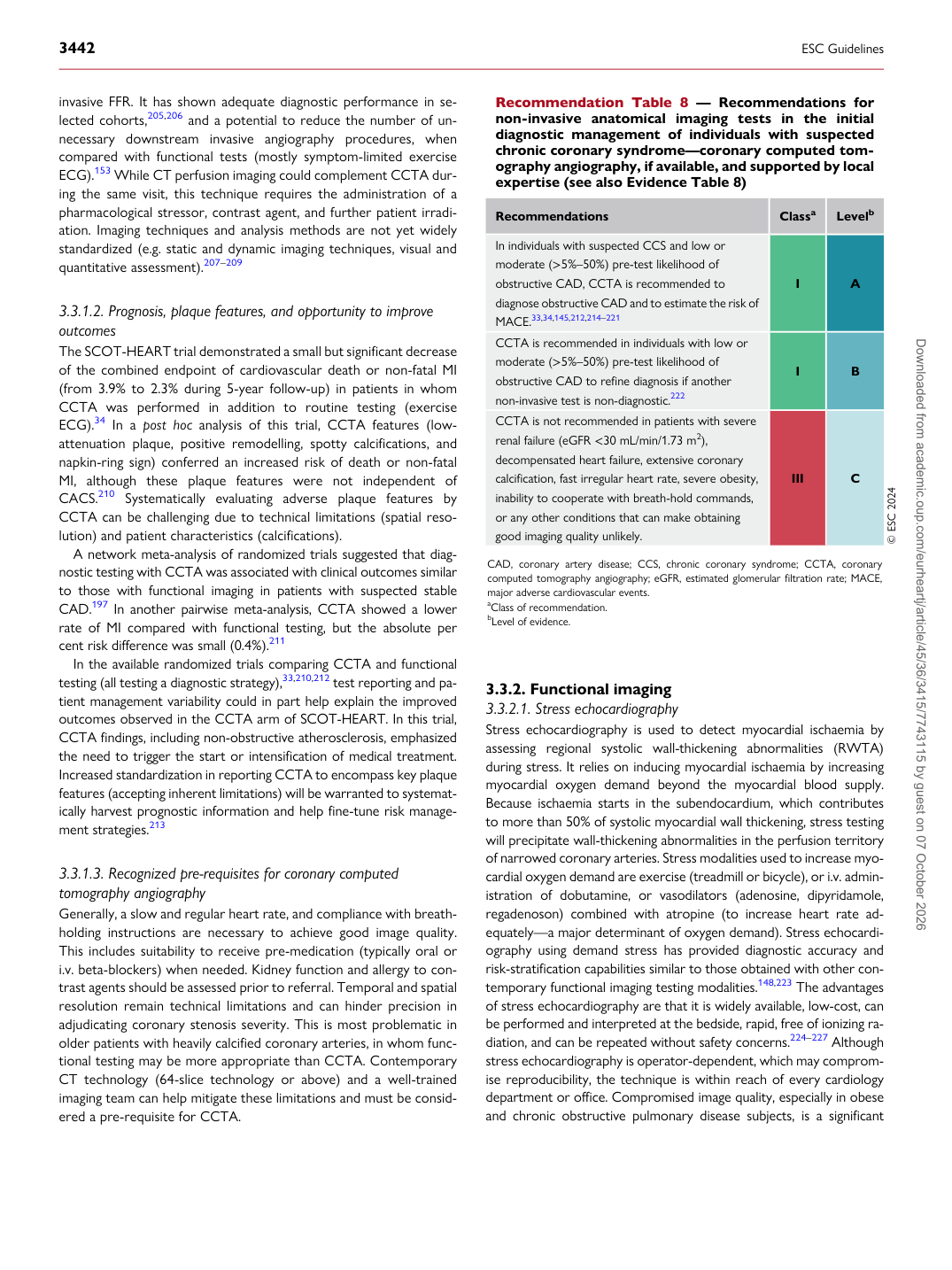
Recommendation Table 8 — Recommendations for non-invasive anatomical imaging tests in the initial diagnostic management of individuals with suspected chronic coronary syndrome—coronary computed tomography angiography, if available, and supported by local expertise (see also Evidence Table 8)

Recommendations Classa Levelb

In individuals with suspected CCS and low or moderate (>5%–50%) pre-test likelihood of obstructive CAD, CCTA is recommended to diagnose obstructive CAD and to estimate the risk of MACE.33,34,145,212,214–221 I A CCTA is recommended in individuals with low or moderate (>5%–50%) pre-test likelihood of obstructive CAD to refine diagnosis if another non-invasive test is non-diagnostic.222 I B CCTA is not recommended in patients with severe renal failure (eGFR <30 mL/min/1.73 m2), decompensated heart failure, extensive coronary calcification, fast irregular heart rate, severe obesity, inability to cooperate with breath-hold commands, or any other conditions that can make obtaining good imaging quality unlikely. III C © ESC 2024

CAD, coronary artery disease; CCS, chronic coronary syndrome; CCTA, coronary computed tomography angiography; eGFR, estimated glomerular filtration rate; MACE, major adverse cardiovascular events. aClass of recommendation. bLevel of evidence. Downloaded from academic.oup.com/eurheartj/article/45/36/3415/7743115 by guest on 07 October 2026