p.24 抽出テキスト
symptoms) leads to improved prediction of obstructive CAD, downclassifies more individuals to very low and low likelihood of disease, and maintains high calibration.30,139,140 The Risk-Factor-weighted Clinical Likelihood (RF-CL) model includes sex, age, angina symptoms, and number of risk factors without losing diagnostic accuracy compared with more advanced models requiring computed calculation (Figure 4).139,141,142 The RF-CL model increases three-fold the number of subjects categorized as at very low (≤5%) likelihood of obstructive CAD compared with the ESC pretest probability (ESC-PTP) model (38% vs. 12%),139 while predicting annualized event rates of MI and death of 0.5%, 1.1%, and 2.1% for individuals having very low, low, and moderate likelihood of obstructive CAD, respectively.143 Individual adjustment of the likelihood may be necessary for individuals with severe single risk factors or comorbidities associated with an increased prevalence of obstructive CAD, which are not reflected in the RF-CL model, e.g. familial hypercholesterolaemia, severe kidney dysfunction, rheumatic/inflammatory diseases, and peripheral artery disease (PAD). Exercise ECG testing may modify the likelihood of obstructive CAD and can be used in patients with low (>5%–15%) clinical likelihood, in whom a negative test allows reclassification to the very low (≤5%) clinical likelihood group with a favourable prognosis.144 However, CCTA as a first-line diagnostic test can give more accurate information and has been associated with fewer angina symptoms during follow-up than a strategy with exercise ECG as the first investigation.145–148 In addition, more adverse events were observed in randomized trials with an exercise ECG than with a CCTA-based diagnostic strategy.34,146 However, exercise ECG remains clinically useful for reproducing anginal symptoms, which have a prognostic value.149,150 In contrast to exercise ECG, visualization of calcified atherosclerotic plaque in the coronary artery significantly impacts the clinical likelihood of atherosclerotic obstructive CAD. Coronary artery calcification (CAC) can be measured using the coronary artery calcium score (CACS), which is derived from an ECG-gated non-contrast-enhanced computed tomography (CT) scan. Alternatively, the presence of CAC can be evaluated qualitatively by visually inspecting the coronary arteries on a previous non-cardiac chest CT scan, if available. The absence of CAC (CACS = 0) has a very high negative predictive value (>95%) for obstructive CAD.151 Of note, in younger patients, obstructive CAD is rare, but when present, a higher percentage (58% of those younger than 40 years) have a CACS of 0 compared with older patients with obstructive CAD (9% among those aged 60 to 69 years).152 Small, randomized studies have shown that further testing can safely be deferred in patients without CAC, without increased event rates during follow-up.146,153 Finally, in a larger prospective observational study, absence of CAC alone was sufficient to define a low-risk group with no need for further testing with improved accuracy compared with basic clinical prediction models.154 The combination of CACS with the RF-CL model [CACS + RF-CL (the Coronary Artery Calcium Score-Weighted Clinical Likelihood—CACS-CL)] showed the strongest potential to effectively defer cardiac testing compared with other clinical prediction models or CACS alone (adjustment of the estimation of the clinical likelihood of obstructive CAD).139,154 With the CACS-CL model, substantially more individuals (54%) compared with the RF-CL model (38%) were categorized as having a very low clinical likelihood of obstructive CAD in the external validation cohorts.139 Finally, the CACS-CL model was superior to other clinical prediction models in predicting MI and death during follow-up.143 Detection of atherosclerotic disease in non-coronary arteries with ultrasound or CT scans of, e.g. the aorta, and the carotid or femoral arteries, may increase the clinical likelihood of obstructive CAD,155–158

and the risk for future CVD events.159,160 However, how accurately the detection of non-coronary atherosclerotic disease impacts the likelihood estimation of obstructive CAD needs further investigation. In general, individuals with a very low (≤5%) likelihood of obstructive CAD do not require further diagnostic testing unless symptoms persist and non-cardiac causes have been excluded. In patients with a low (>5%–15%) likelihood of obstructive CAD, the benefit of diagnostic testing is uncertain but may be performed if symptoms are limiting and require clarification. Patients with moderate (>15%–50%), high (>50%–85%), and very high (>85%) likelihood of obstructive CAD are encouraged to undergo further diagnostic testing. By using pre-test likelihood estimates and diagnostic imaging-test positive and negative likelihood ratios, it is possible to calculate the post-test probability of obstructive CAD. Hence, pre-test likelihood estimation is useful to guide non-invasive diagnostic test strategies for detecting obstructive CAD (Section 3.3.4).

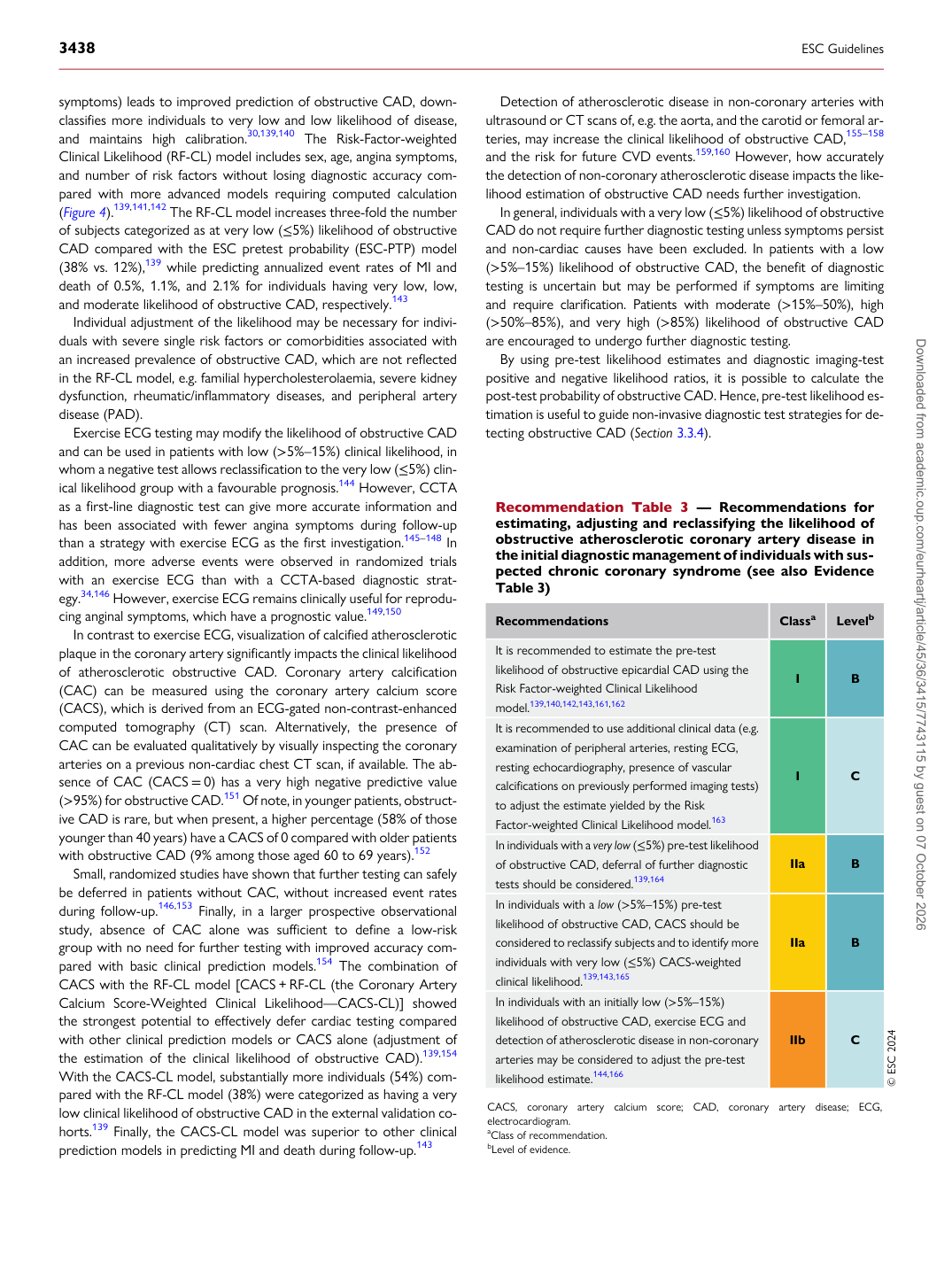
Recommendation Table 3 — Recommendations for estimating, adjusting and reclassifying the likelihood of obstructive atherosclerotic coronary artery disease in the initial diagnostic management of individuals with suspected chronic coronary syndrome (see also Evidence Table 3)

Recommendations Classa Levelb

It is recommended to estimate the pre-test likelihood of obstructive epicardial CAD using the Risk Factor-weighted Clinical Likelihood model.139,140,142,143,161,162 I B It is recommended to use additional clinical data (e.g. examination of peripheral arteries, resting ECG, resting echocardiography, presence of vascular calcifications on previously performed imaging tests) to adjust the estimate yielded by the Risk Factor-weighted Clinical Likelihood model.163 I C In individuals with a very low (≤5%) pre-test likelihood of obstructive CAD, deferral of further diagnostic tests should be considered.139,164 IIa B In individuals with a low (>5%–15%) pre-test likelihood of obstructive CAD, CACS should be considered to reclassify subjects and to identify more individuals with very low (≤5%) CACS-weighted clinical likelihood.139,143,165 IIa B In individuals with an initially low (>5%–15%) likelihood of obstructive CAD, exercise ECG and detection of atherosclerotic disease in non-coronary arteries may be considered to adjust the pre-test likelihood estimate.144,166 IIb C © ESC 2024

CACS, coronary artery calcium score; CAD, coronary artery disease; ECG, electrocardiogram. aClass of recommendation. bLevel of evidence. Downloaded from academic.oup.com/eurheartj/article/45/36/3415/7743115 by guest on 07 October 2026