p.23 抽出テキスト
3.1.2.2 Biochemical tests

Laboratory blood tests identify potential causes of ischaemia (e.g. severe anaemia, hyperthyroidism), cardiovascular risk factors (e.g. lipids, fasting glucose), and yield prognostic information (e.g. renal disease, inflammation). When fasting plasma glucose and glycated haemoglobin (HbA1c) are both inconclusive, an additional oral glucose tolerance test is useful.85,86 A lipid profile, including total cholesterol, high-density lipoprotein cholesterol (HDL-C), and triglycerides, allowing calculation of lowdensity lipoprotein cholesterol (LDL-C), is necessary in every person with suspected CCS to refine his/her risk profile and guide treatment.16,64 Fasting values are needed to characterize severe dyslipidaemia or follow-up hypertriglyceridaemia,64 but not in other situations.87 Elevated lipoprotein(a) is a marker of cardiovascular risk, particularly early-onset atherosclerotic disease;88 lipoprotein(a)lowering strategies are currently being investigated in phase 3 cardiovascular outcomes trials.89–91 Given that circulating lipoprotein(a) levels are genetically determined and do not fluctuate substantially over a lifetime,89,91 a single measure is sufficient in persons with suspected CCS.92 Renal dysfunction increases the likelihood of CAD and has a negative impact on prognosis.93–95 Glomerular filtration rate (GFR) also impacts renally cleared drugs. It is reasonable to also measure uric acid levels, as hyperuricaemia is frequent, and may affect renal function. If there is a clinical suspicion of CAD instability, biochemical markers of myocardial injury—such as troponin T or troponin I—should be measured, preferably using high-sensitivity assays, and management should follow the 2023 ESC Guidelines for the management of patients with acute coronary syndromes.65 If high-sensitivity assays are employed, low troponin levels can be detected in many patients with stable angina. Increased troponin levels are associated with adverse outcomes,96–100 and small studies have indicated a possible incremental value in diagnosing obstructive CAD,101–104 but larger trials are needed to verify the utility of systematic assessment in individuals suspected of CCS. While multiple biomarkers may be useful for prognostication, they do not yet have a role in diagnosing obstructive CAD, but some promising results have been published.105–108 Measuring NT-proBNP helps confirm or exclude suspected HF. Markers of inflammation such as C-reactive protein109–113 and fibrinogen114–118 are predictors of an individual’s risk of CAD and can predict cardiovascular event risk in CCS patients,99,111 but their value is limited beyond traditional risk factors.111 However, in patients taking contemporary statins, high-sensitivity C-reactive protein (hs-CRP) was a stronger predictor for future cardiovascular events and death than LDL-C.119,120 These patients may benefit from additional LDL-C reduction through adjunctive lipid-lowering therapies, such as ezetimibe, proprotein convertase subtilisin/kexin type 9 (PCSK9) inhibition,121 inclisiran, and bempedoic acid.122–124 Elevated hs-CRP levels in patients taking statins and PCSK9 inhibitors may indicate residual inflammatory risk that could be further reduced through inflammation modulation.119,125,126 Experimental inhibition of interleukin-6, a pivotal factor in atherothrombosis, resulted in a marked parallel reduction of C-reactive protein and fibrinogen in patients with chronic kidney disease (CKD) and high cardiovascular risk.127 3.2 STEP 2: Further evaluation

3.2.1. Pre-test clinical likelihood of obstructive atherosclerotic coronary artery disease The diagnosis of CCS is based on interpreting the individual’s symptoms, balancing the impact of age, sex, risk factors, and comorbidities on the likelihood that CCS is present, and choosing the most appropriate diagnostic test to confirm the clinically suspected diagnosis. To aid diagnosis, prediction tables for obstructive CAD can be used that integrate these clinical factors and provide guidance on selecting diagnostic tests based on their capacities to rule in and rule out obstructive atherosclerotic CAD. Importantly, these models do not include the probability of ANOCA/INOCA, which always needs to be considered if symptoms persist after deferral of further testing or diagnostic testing that excludes obstructive CAD. The tables used to estimate the likelihood of obstructive CAD as confirmed by ICA were initially based on the Diamond–Forrester approach, which considered sex, age, and angina symptoms.25 However, these tables have had to be updated several times owing to the declining prevalence of obstructive CAD at invasive angiography in contemporary Western cohorts.26,29 The overestimation of obstructive CAD prevalence has limited the utility of these tables in clinical routine and in accurately estimating the post-test likelihood of obstructive CAD by diagnostic imaging methods.1,29,30 The 2019 ESC Guidelines for the diagnosis and management of CCS introduced the concept of clinical likelihood as a more comprehensive and individualized assessment of the probability of obstructive CAD.1 Compared with a basic pre-test probability model, incorporation of risk factors in the basic pre-test likelihood model (based on age, sex, and

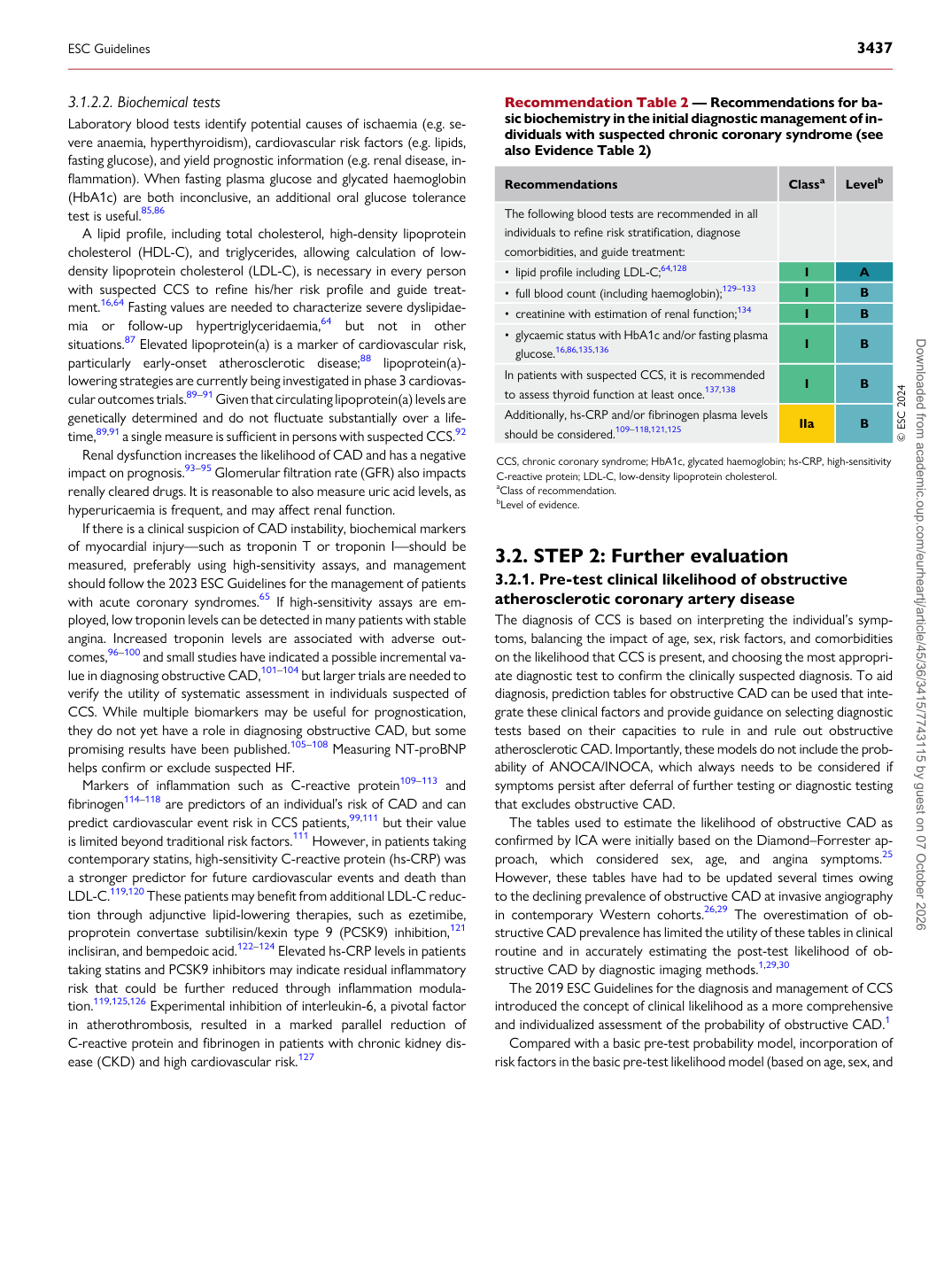
Recommendation Table 2 — Recommendations for basic biochemistry in the initial diagnostic management of individuals with suspected chronic coronary syndrome (see also Evidence Table 2)

Recommendations Classa Levelb

The following blood tests are recommended in all individuals to refine risk stratification, diagnose comorbidities, and guide treatment: • lipid profile including LDL-C;64,128 I A • full blood count (including haemoglobin);129–133 I B • creatinine with estimation of renal function;134 I B • glycaemic status with HbA1c and/or fasting plasma

glucose.16,86,135,136 I B In patients with suspected CCS, it is recommended to assess thyroid function at least once.137,138 I B Additionally, hs-CRP and/or fibrinogen plasma levels should be considered.109–118,121,125 IIa B © ESC 2024

CCS, chronic coronary syndrome; HbA1c, glycated haemoglobin; hs-CRP, high-sensitivity C-reactive protein; LDL-C, low-density lipoprotein cholesterol. aClass of recommendation. bLevel of evidence.

ESC Guidelines                                                                                                                                                                                          3437

Downloaded from academic.oup.com/eurheartj/article/45/36/3415/7743115 by guest on 07 October 2026