p.21 抽出テキスト
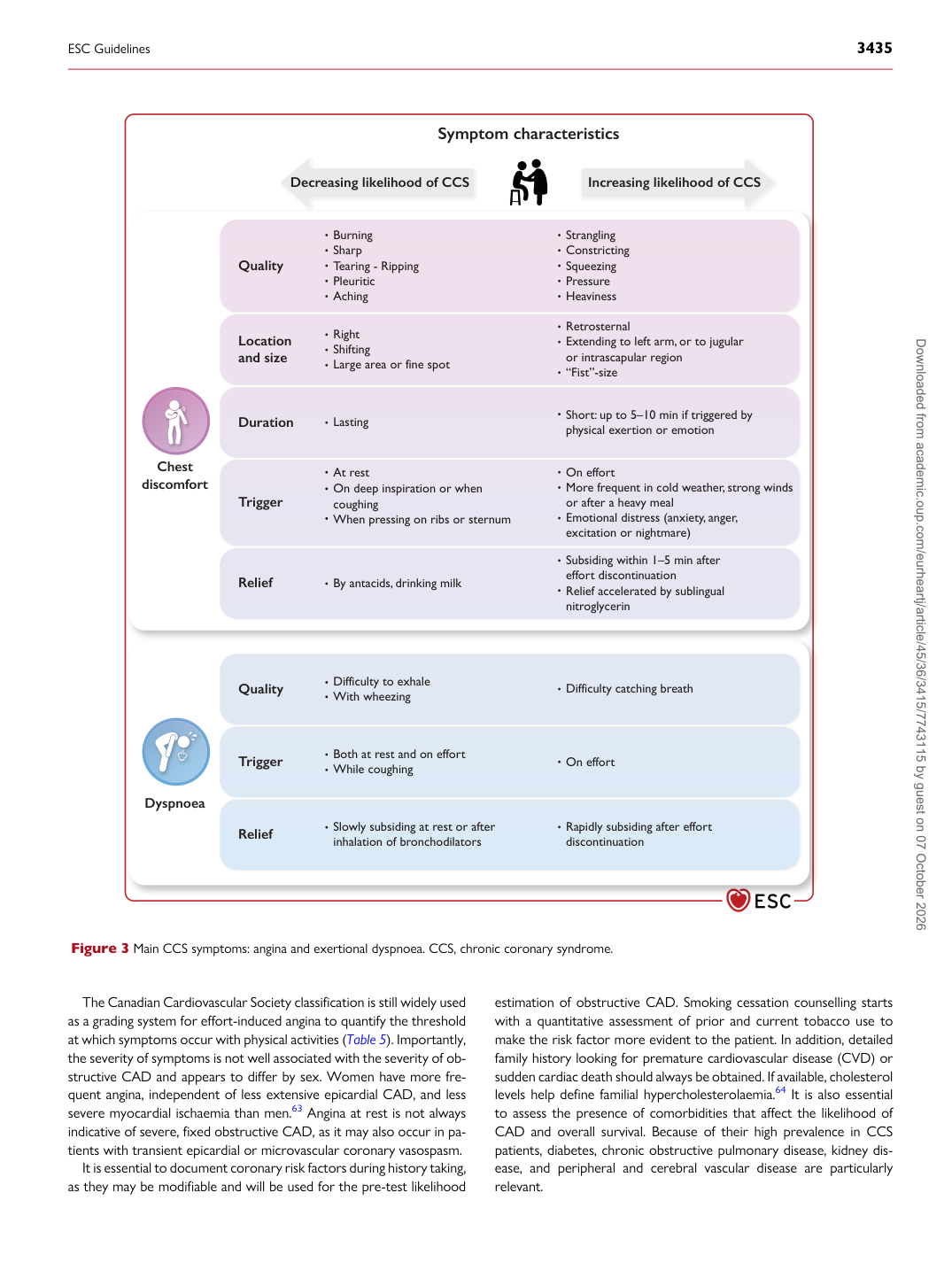
The Canadian Cardiovascular Society classification is still widely used as a grading system for effort-induced angina to quantify the threshold at which symptoms occur with physical activities (Table 5). Importantly, the severity of symptoms is not well associated with the severity of obstructive CAD and appears to differ by sex. Women have more frequent angina, independent of less extensive epicardial CAD, and less severe myocardial ischaemia than men.63 Angina at rest is not always indicative of severe, fixed obstructive CAD, as it may also occur in patients with transient epicardial or microvascular coronary vasospasm. It is essential to document coronary risk factors during history taking, as they may be modifiable and will be used for the pre-test likelihood estimation of obstructive CAD. Smoking cessation counselling starts with a quantitative assessment of prior and current tobacco use to make the risk factor more evident to the patient. In addition, detailed family history looking for premature cardiovascular disease (CVD) or sudden cardiac death should always be obtained. If available, cholesterol levels help define familial hypercholesterolaemia.64 It is also essential to assess the presence of comorbidities that affect the likelihood of CAD and overall survival. Because of their high prevalence in CCS patients, diabetes, chronic obstructive pulmonary disease, kidney disease, and peripheral and cerebral vascular disease are particularly relevant.

Quality

Chest discomfort

Dyspnoea Location and size Decreasing likelihood of CCS Increasing likelihood of CCS

Strangling Constricting Squeezing Pressure Heaviness

Retrosternal Extending to left arm, or to jugular or intrascapular region “Fist”-size

Burning Sharp Tearing - Ripping Pleuritic Aching

Right Shifting Large area or fine spot

Duration Short: up to 5–10 min if triggered by physical exertion or emotion Lasting

Trigger On effort More frequent in cold weather, strong winds or after a heavy meal Emotional distress (anxiety, anger, excitation or nightmare)

On deep inspiration or when coughing When pressing on ribs or sternum

Relief Subsiding within 1–5 min after effort discontinuation Relief accelerated by sublingual nitroglycerin

Quality Difficulty catching breath Difficulty to exhale With wheezing

Trigger On effort Both at rest and on effort While coughing

Slowly subsiding at rest or after inhalation of bronchodilators Relief Rapidly subsiding after effort discontinuation

Symptom characteristics

At rest

By antacids, drinking milk

Figure 3 Main CCS symptoms: angina and exertional dyspnoea. CCS, chronic coronary syndrome.

ESC Guidelines                                                                                                                                                                                          3435

Downloaded from academic.oup.com/eurheartj/article/45/36/3415/7743115 by guest on 07 October 2026