p.19 抽出テキスト
3 Stepwise approach to the initial

management of individuals with suspected chronic coronary syndrome

Managing individuals with suspected CCS involves four steps (Figure 2): STEP 1. The first step is a general clinical evaluation that focuses on assessing symptoms and signs of CCS, differentiating non-cardiac causes of chest pain and ruling out ACS. This initial clinical evaluation requires recording a 12-lead resting electrocardiogram (ECG), basic blood tests, and in selected individuals, chest X-ray imaging and pulmonary function testing. This evaluation can be done by the general practitioner. STEP 2. The second step is a further cardiac examination, including echocardiography at rest to rule out left ventricular (LV) dysfunction and valvular heart disease. After that, it is recommended to estimate the clinical likelihood of obstructive CAD to guide deferral or referral to further non-invasive and invasive testing. STEP 3. The third step involves diagnostic testing to establish the diagnosis of CCS and determine the patient’s risk of future events. STEP 4. The final step includes lifestyle and risk-factor modification

combined with disease-modifying medications. A combination of antianginal medications is frequently needed, and coronary revascularization is considered if symptoms are refractory to medical treatment or if high-risk CAD is present. If symptoms persist after obstructive CAD is ruled out, coronary microvascular disease and vasospasm should be considered.

3.1 STEP 1: General clinical examination

3.1.1. History, differential diagnosis, and physical examination Careful and detailed history taking is the initial step in diagnostic management for all clinical scenarios within the spectrum of CCS. Although chest pain or discomfort (Figure 3) is the most cardinal symptom of CCS, it must be emphasized that many patients do not present with characteristic anginal symptoms and that the symptomatology may vary with age, sex, race, socioeconomic class, and geographical location. In contemporary studies, only 10% to 25% of patients with suspected CCS present with angina with classic aggravating and relieving factors, while 57% to 78% have symptoms less characteristic of angina and 10% to 15% have dyspnoea on exertion.33,57

While older studies suggested that women were more likely to experience less characteristic chest pain symptoms,58 recent data show that anginal chest pain is equally prevalent in both men and women, albeit with slightly different characteristics.59 Symptoms were classified as non-characteristic angina in over two-thirds of the patients of both sexes.21,60 Of note, the absence of anginal symptoms does not preclude CCS, as it may be absent in patients with diabetes with autonomic neuropathy or in elderly patients with a very sedentary lifestyle despite very severe obstructive CAD. Of course, chest pain is not always angina (i.e. of ischaemic origin), since it can be related to non-coronary (e.g. pericarditis) or non-cardiovascular conditions.61,62 Anginal pain symptoms have been traditionally classified as “typical, atypical, or non-anginal/non-cardiac” based on the location of the pain, as well as precipitating and relieving factors. Although angina that meets all three characteristics, with retrosternal chest discomfort provoked by exertion or emotional stress and relieved by rest or nitroglycerine, is highly suggestive of ischaemia caused by obstructive CAD, these characteristics are rarely all present when ischaemia is caused by microvascular dysfunction and vasospasm. Furthermore, patients with “typical” vs. “atypical” angina included in the PRECISE study had similar 1-year outcomes,57 highlighting the limited prognostic value of symptom classification on typicality of angina used in obstructive CAD prediction models. Because this terminology to describe anginal symptoms no longer aligns with current concepts of CCS, it should be replaced by a detailed description of symptoms (Figure 3). It is important to thoroughly evaluate chest pain, including an objective exclusion of myocardial ischaemia caused by obstructive CAD, microvascular disease, and/or coronary vasospasm, before classifying it as non-cardiac.

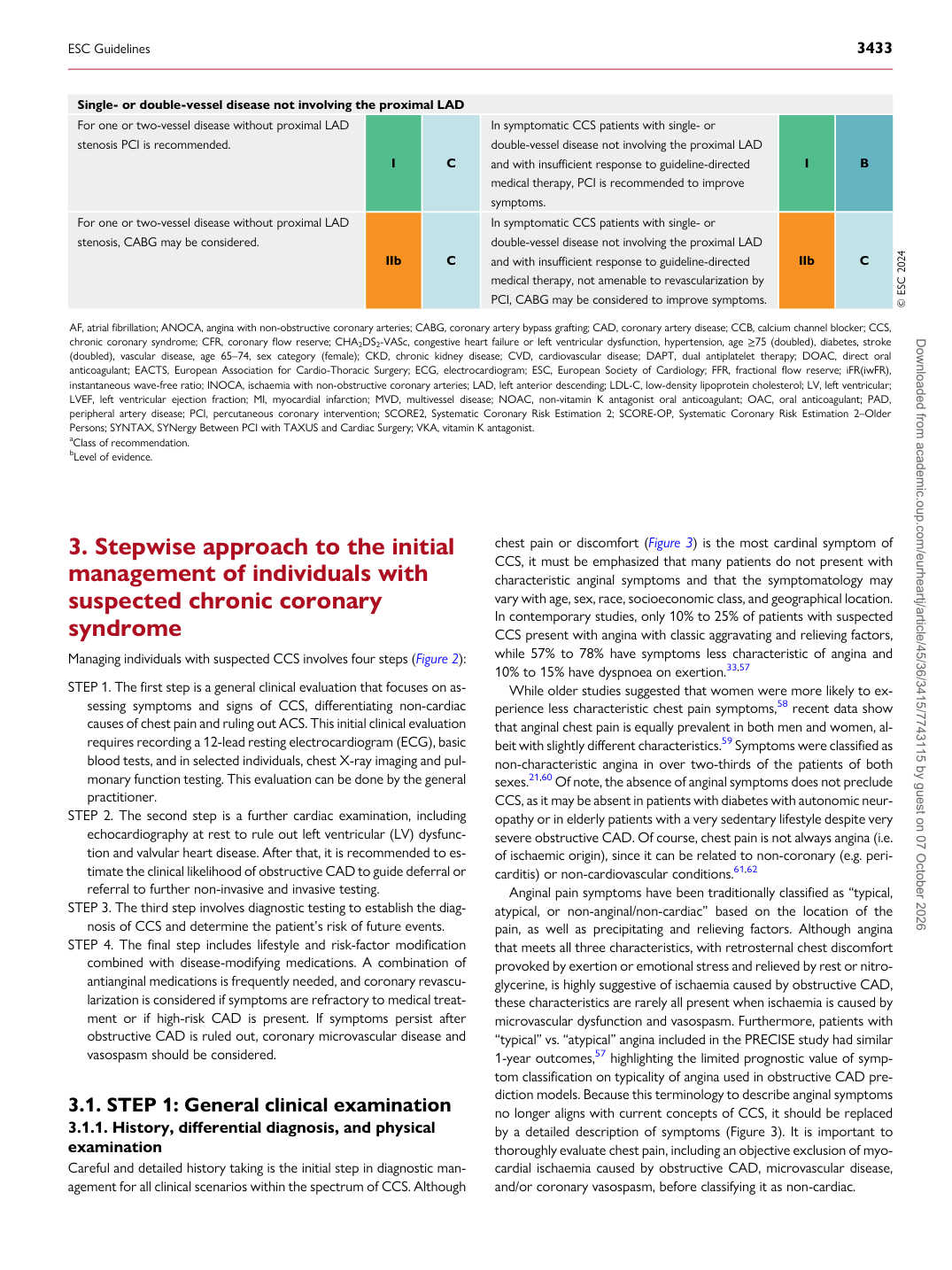
Single- or double-vessel disease not involving the proximal LAD For one or two-vessel disease without proximal LAD stenosis PCI is recommended.

I C In symptomatic CCS patients with single- or double-vessel disease not involving the proximal LAD

and with insufficient response to guideline-directed medical therapy, PCI is recommended to improve symptoms. I B

For one or two-vessel disease without proximal LAD stenosis, CABG may be considered.

IIb C In symptomatic CCS patients with single- or double-vessel disease not involving the proximal LAD

and with insufficient response to guideline-directed medical therapy, not amenable to revascularization by PCI, CABG may be considered to improve symptoms. IIb C © ESC 2024

AF, atrial fibrillation; ANOCA, angina with non-obstructive coronary arteries; CABG, coronary artery bypass grafting; CAD, coronary artery disease; CCB, calcium channel blocker; CCS, chronic coronary syndrome; CFR, coronary flow reserve; CHA2DS2-VASc, congestive heart failure or left ventricular dysfunction, hypertension, age ≥75 (doubled), diabetes, stroke (doubled), vascular disease, age 65–74, sex category (female); CKD, chronic kidney disease; CVD, cardiovascular disease; DAPT, dual antiplatelet therapy; DOAC, direct oral anticoagulant; EACTS, European Association for Cardio-Thoracic Surgery; ECG, electrocardiogram; ESC, European Society of Cardiology; FFR, fractional flow reserve; iFR(iwFR), instantaneous wave-free ratio; INOCA, ischaemia with non-obstructive coronary arteries; LAD, left anterior descending; LDL-C, low-density lipoprotein cholesterol; LV, left ventricular; LVEF, left ventricular ejection fraction; MI, myocardial infarction; MVD, multivessel disease; NOAC, non-vitamin K antagonist oral anticoagulant; OAC, oral anticoagulant; PAD, peripheral artery disease; PCI, percutaneous coronary intervention; SCORE2, Systematic Coronary Risk Estimation 2; SCORE-OP, Systematic Coronary Risk Estimation 2–Older Persons; SYNTAX, SYNergy Between PCI with TAXUS and Cardiac Surgery; VKA, vitamin K antagonist. aClass of recommendation. bLevel of evidence.

ESC Guidelines                                                                                                                                                                                          3433

Downloaded from academic.oup.com/eurheartj/article/45/36/3415/7743115 by guest on 07 October 2026