p.18 抽出テキスト
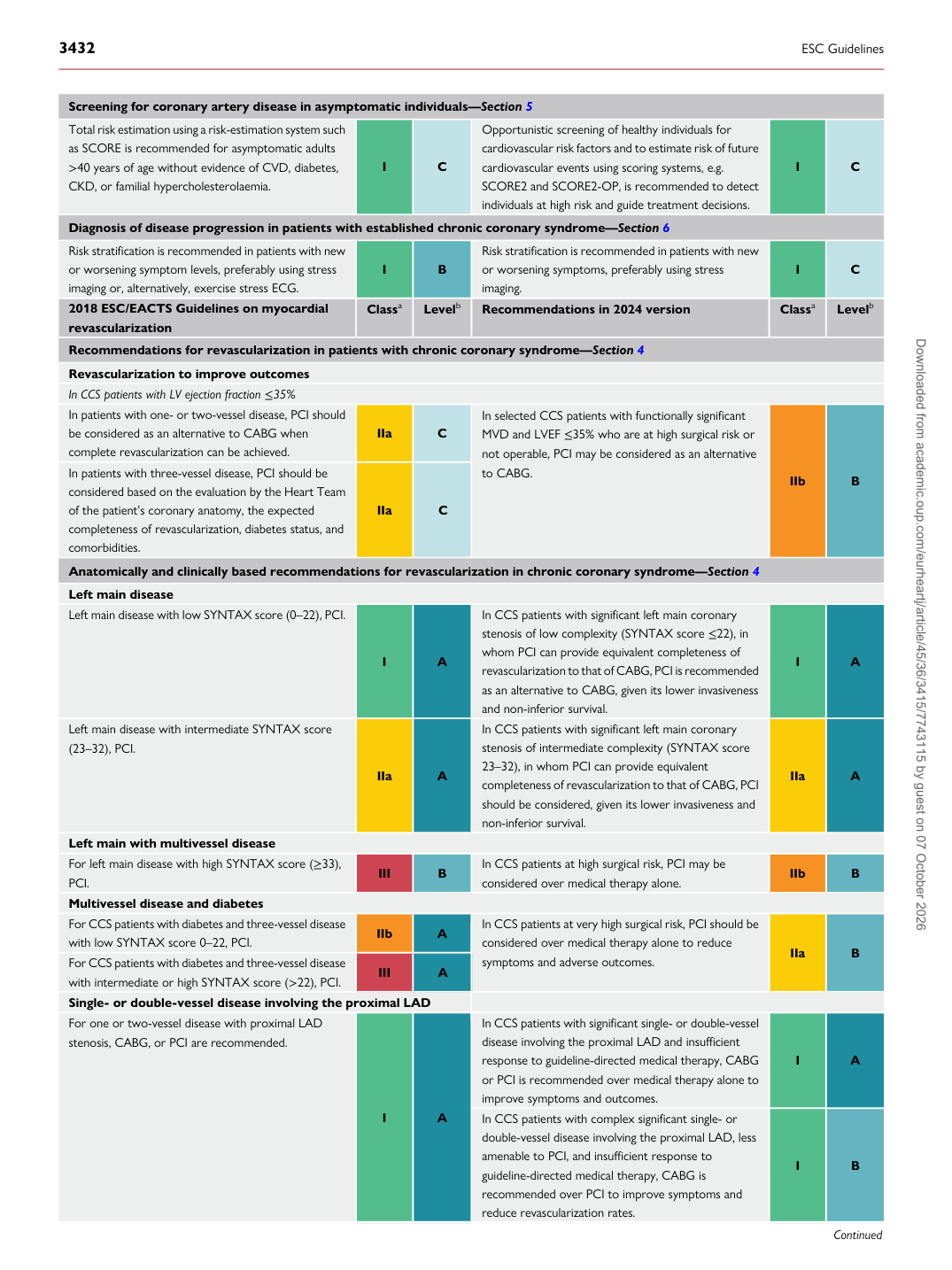
Screening for coronary artery disease in asymptomatic individuals—Section 5 Total risk estimation using a risk-estimation system such as SCORE is recommended for asymptomatic adults >40 years of age without evidence of CVD, diabetes, CKD, or familial hypercholesterolaemia. I C Opportunistic screening of healthy individuals for cardiovascular risk factors and to estimate risk of future cardiovascular events using scoring systems, e.g. SCORE2 and SCORE2-OP, is recommended to detect individuals at high risk and guide treatment decisions. I C Diagnosis of disease progression in patients with established chronic coronary syndrome—Section 6 Risk stratification is recommended in patients with new or worsening symptom levels, preferably using stress imaging or, alternatively, exercise stress ECG. I B Risk stratification is recommended in patients with new or worsening symptoms, preferably using stress imaging. I C 2018 ESC/EACTS Guidelines on myocardial revascularization Classa Levelb Recommendations in 2024 version Classa Levelb Recommendations for revascularization in patients with chronic coronary syndrome—Section 4 Revascularization to improve outcomes In CCS patients with LV ejection fraction ≤35% In patients with one- or two-vessel disease, PCI should be considered as an alternative to CABG when complete revascularization can be achieved. IIa C In selected CCS patients with functionally significant MVD and LVEF ≤35% who are at high surgical risk or

not operable, PCI may be considered as an alternative

to CABG. IIb B In patients with three-vessel disease, PCI should be considered based on the evaluation by the Heart Team of the patient’s coronary anatomy, the expected completeness of revascularization, diabetes status, and comorbidities.

IIa C

Anatomically and clinically based recommendations for revascularization in chronic coronary syndrome—Section 4 Left main disease Left main disease with low SYNTAX score (0–22), PCI.

I A In CCS patients with significant left main coronary stenosis of low complexity (SYNTAX score ≤22), in whom PCI can provide equivalent completeness of revascularization to that of CABG, PCI is recommended as an alternative to CABG, given its lower invasiveness and non-inferior survival. I A

Left main disease with intermediate SYNTAX score (23–32), PCI.

IIa A In CCS patients with significant left main coronary stenosis of intermediate complexity (SYNTAX score 23–32), in whom PCI can provide equivalent completeness of revascularization to that of CABG, PCI should be considered, given its lower invasiveness and non-inferior survival. IIa A

Left main with multivessel disease For left main disease with high SYNTAX score (≥33), PCI. III B In CCS patients at high surgical risk, PCI may be considered over medical therapy alone. IIb B Multivessel disease and diabetes For CCS patients with diabetes and three-vessel disease with low SYNTAX score 0–22, PCI. IIb A In CCS patients at very high surgical risk, PCI should be considered over medical therapy alone to reduce symptoms and adverse outcomes. IIa B For CCS patients with diabetes and three-vessel disease with intermediate or high SYNTAX score (>22), PCI. III A Single- or double-vessel disease involving the proximal LAD For one or two-vessel disease with proximal LAD stenosis, CABG, or PCI are recommended.

I A In CCS patients with significant single- or double-vessel disease involving the proximal LAD and insufficient response to guideline-directed medical therapy, CABG or PCI is recommended over medical therapy alone to improve symptoms and outcomes. I A

In CCS patients with complex significant single- or double-vessel disease involving the proximal LAD, less amenable to PCI, and insufficient response to guideline-directed medical therapy, CABG is recommended over PCI to improve symptoms and reduce revascularization rates. I B

Downloaded from academic.oup.com/eurheartj/article/45/36/3415/7743115 by guest on 07 October 2026