p.17 抽出テキスト
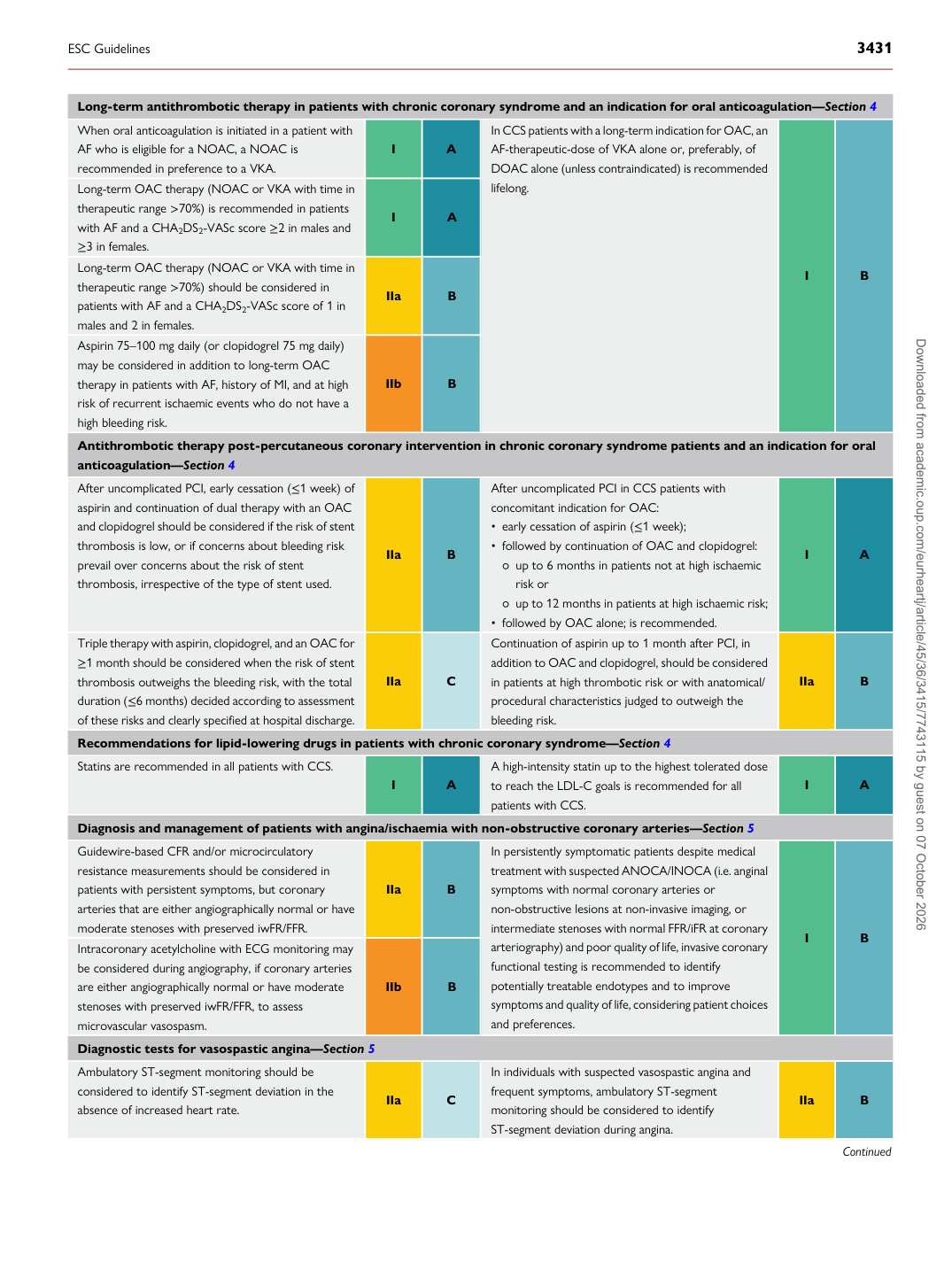
Long-term antithrombotic therapy in patients with chronic coronary syndrome and an indication for oral anticoagulation—Section 4 When oral anticoagulation is initiated in a patient with AF who is eligible for a NOAC, a NOAC is recommended in preference to a VKA. I A In CCS patients with a long-term indication for OAC, an AF-therapeutic-dose of VKA alone or, preferably, of

DOAC alone (unless contraindicated) is recommended lifelong.

I B

Long-term OAC therapy (NOAC or VKA with time in therapeutic range >70%) is recommended in patients with AF and a CHA2DS2-VASc score ≥2 in males and ≥3 in females. I A Long-term OAC therapy (NOAC or VKA with time in therapeutic range >70%) should be considered in patients with AF and a CHA2DS2-VASc score of 1 in males and 2 in females. IIa B Aspirin 75–100 mg daily (or clopidogrel 75 mg daily) may be considered in addition to long-term OAC therapy in patients with AF, history of MI, and at high risk of recurrent ischaemic events who do not have a high bleeding risk. IIb B Antithrombotic therapy post-percutaneous coronary intervention in chronic coronary syndrome patients and an indication for oral anticoagulation—Section 4 After uncomplicated PCI, early cessation (≤1 week) of aspirin and continuation of dual therapy with an OAC and clopidogrel should be considered if the risk of stent thrombosis is low, or if concerns about bleeding risk prevail over concerns about the risk of stent thrombosis, irrespective of the type of stent used. IIa B After uncomplicated PCI in CCS patients with concomitant indication for OAC:

• early cessation of aspirin (≤1 week); • followed by continuation of OAC and clopidogrel: ⚬up to 6 months in patients not at high ischaemic

risk or ⚬up to 12 months in patients at high ischaemic risk; • followed by OAC alone; is recommended. I A

Triple therapy with aspirin, clopidogrel, and an OAC for ≥1 month should be considered when the risk of stent thrombosis outweighs the bleeding risk, with the total duration (≤6 months) decided according to assessment of these risks and clearly specified at hospital discharge. IIa C Continuation of aspirin up to 1 month after PCI, in addition to OAC and clopidogrel, should be considered

in patients at high thrombotic risk or with anatomical/ procedural characteristics judged to outweigh the bleeding risk. IIa B

Recommendations for lipid-lowering drugs in patients with chronic coronary syndrome—Section 4 Statins are recommended in all patients with CCS.

I A A high-intensity statin up to the highest tolerated dose

to reach the LDL-C goals is recommended for all patients with CCS. I A

Diagnosis and management of patients with angina/ischaemia with non-obstructive coronary arteries—Section 5 Guidewire-based CFR and/or microcirculatory resistance measurements should be considered in patients with persistent symptoms, but coronary arteries that are either angiographically normal or have moderate stenoses with preserved iwFR/FFR. IIa B In persistently symptomatic patients despite medical treatment with suspected ANOCA/INOCA (i.e. anginal

symptoms with normal coronary arteries or non-obstructive lesions at non-invasive imaging, or intermediate stenoses with normal FFR/iFR at coronary arteriography) and poor quality of life, invasive coronary functional testing is recommended to identify potentially treatable endotypes and to improve symptoms and quality of life, considering patient choices and preferences.

I B Intracoronary acetylcholine with ECG monitoring may be considered during angiography, if coronary arteries are either angiographically normal or have moderate stenoses with preserved iwFR/FFR, to assess microvascular vasospasm. IIb B Diagnostic tests for vasospastic angina—Section 5 Ambulatory ST-segment monitoring should be considered to identify ST-segment deviation in the absence of increased heart rate. IIa C In individuals with suspected vasospastic angina and

frequent symptoms, ambulatory ST-segment monitoring should be considered to identify ST-segment deviation during angina. IIa B

Continued

ESC Guidelines                                                                                                                                                                                          3431

Downloaded from academic.oup.com/eurheartj/article/45/36/3415/7743115 by guest on 07 October 2026