p.16 抽出テキスト
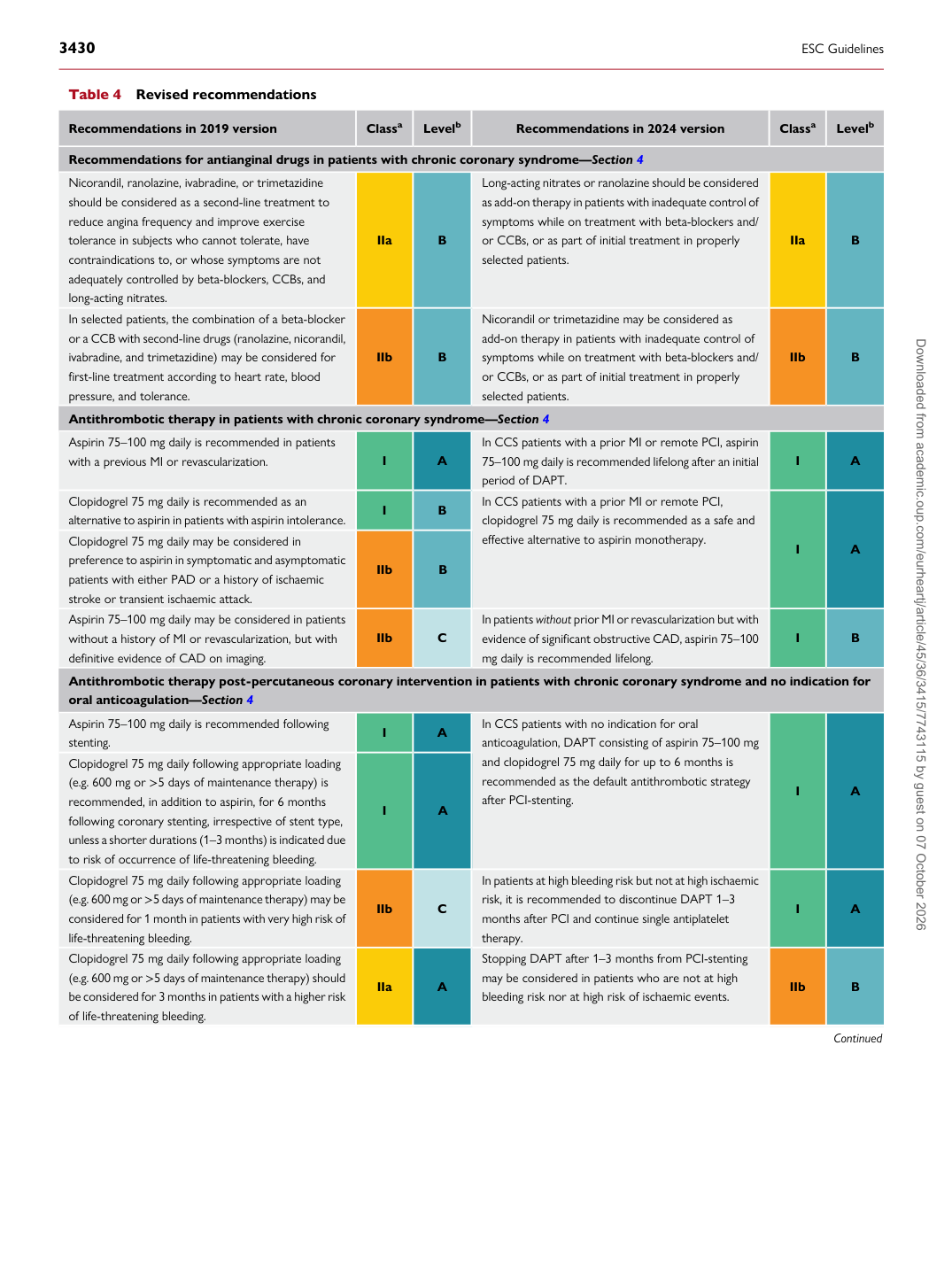
Table 4 Revised recommendations

Recommendations in 2019 version Classa Levelb Recommendations in 2024 version Classa Levelb

Recommendations for antianginal drugs in patients with chronic coronary syndrome—Section 4 Nicorandil, ranolazine, ivabradine, or trimetazidine should be considered as a second-line treatment to reduce angina frequency and improve exercise tolerance in subjects who cannot tolerate, have contraindications to, or whose symptoms are not adequately controlled by beta-blockers, CCBs, and long-acting nitrates. IIa B Long-acting nitrates or ranolazine should be considered as add-on therapy in patients with inadequate control of

symptoms while on treatment with beta-blockers and/ or CCBs, or as part of initial treatment in properly selected patients. IIa B

In selected patients, the combination of a beta-blocker or a CCB with second-line drugs (ranolazine, nicorandil, ivabradine, and trimetazidine) may be considered for first-line treatment according to heart rate, blood pressure, and tolerance. IIb B Nicorandil or trimetazidine may be considered as

add-on therapy in patients with inadequate control of symptoms while on treatment with beta-blockers and/ or CCBs, or as part of initial treatment in properly selected patients. IIb B

Antithrombotic therapy in patients with chronic coronary syndrome—Section 4 Aspirin 75–100 mg daily is recommended in patients with a previous MI or revascularization. I A In CCS patients with a prior MI or remote PCI, aspirin

75–100 mg daily is recommended lifelong after an initial period of DAPT. I A

Clopidogrel 75 mg daily is recommended as an alternative to aspirin in patients with aspirin intolerance. I B In CCS patients with a prior MI or remote PCI, clopidogrel 75 mg daily is recommended as a safe and effective alternative to aspirin monotherapy. I A Clopidogrel 75 mg daily may be considered in preference to aspirin in symptomatic and asymptomatic patients with either PAD or a history of ischaemic stroke or transient ischaemic attack. IIb B Aspirin 75–100 mg daily may be considered in patients without a history of MI or revascularization, but with definitive evidence of CAD on imaging. IIb C In patients without prior MI or revascularization but with

evidence of significant obstructive CAD, aspirin 75–100 mg daily is recommended lifelong. I B

Antithrombotic therapy post-percutaneous coronary intervention in patients with chronic coronary syndrome and no indication for oral anticoagulation—Section 4 Aspirin 75–100 mg daily is recommended following stenting. I A In CCS patients with no indication for oral anticoagulation, DAPT consisting of aspirin 75–100 mg

and clopidogrel 75 mg daily for up to 6 months is recommended as the default antithrombotic strategy after PCI-stenting. I A

Clopidogrel 75 mg daily following appropriate loading (e.g. 600 mg or >5 days of maintenance therapy) is recommended, in addition to aspirin, for 6 months following coronary stenting, irrespective of stent type, unless a shorter durations (1–3 months) is indicated due to risk of occurrence of life-threatening bleeding. I A Clopidogrel 75 mg daily following appropriate loading (e.g. 600 mg or >5 days of maintenance therapy) may be considered for 1 month in patients with very high risk of life-threatening bleeding. IIb C In patients at high bleeding risk but not at high ischaemic

risk, it is recommended to discontinue DAPT 1–3 months after PCI and continue single antiplatelet therapy. I A

Clopidogrel 75 mg daily following appropriate loading (e.g. 600 mg or >5 days of maintenance therapy) should be considered for 3 months in patients with a higher risk of life-threatening bleeding. IIa A Stopping DAPT after 1–3 months from PCI-stenting may be considered in patients who are not at high

bleeding risk nor at high risk of ischaemic events. IIb B

Continued Downloaded from academic.oup.com/eurheartj/article/45/36/3415/7743115 by guest on 07 October 2026