p.15 抽出テキスト
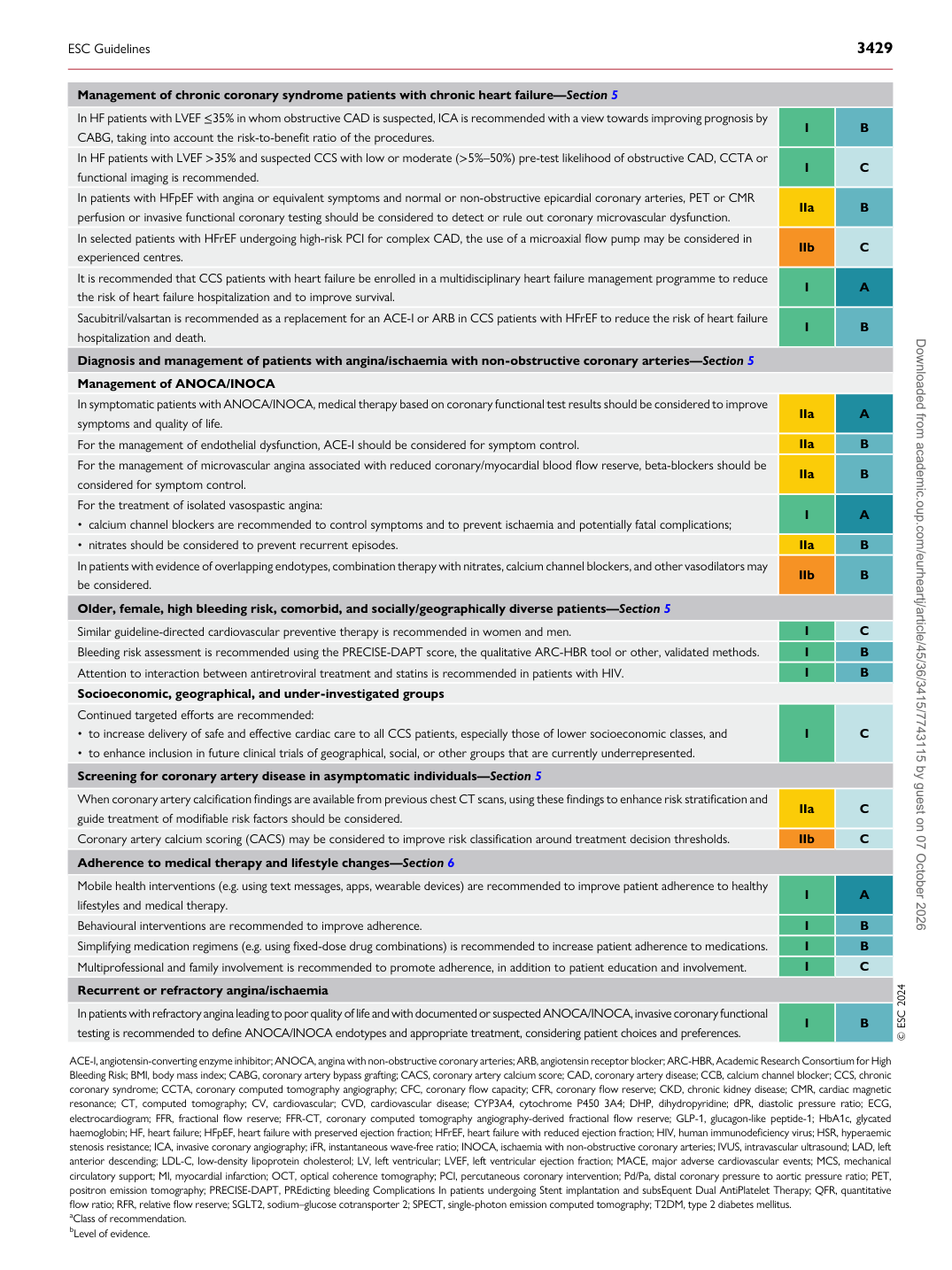
Management of chronic coronary syndrome patients with chronic heart failure—Section 5 In HF patients with LVEF ≤35% in whom obstructive CAD is suspected, ICA is recommended with a view towards improving prognosis by CABG, taking into account the risk-to-benefit ratio of the procedures. I B In HF patients with LVEF >35% and suspected CCS with low or moderate (>5%–50%) pre-test likelihood of obstructive CAD, CCTA or functional imaging is recommended. I C In patients with HFpEF with angina or equivalent symptoms and normal or non-obstructive epicardial coronary arteries, PET or CMR perfusion or invasive functional coronary testing should be considered to detect or rule out coronary microvascular dysfunction. IIa B In selected patients with HFrEF undergoing high-risk PCI for complex CAD, the use of a microaxial flow pump may be considered in experienced centres. IIb C It is recommended that CCS patients with heart failure be enrolled in a multidisciplinary heart failure management programme to reduce the risk of heart failure hospitalization and to improve survival. I A Sacubitril/valsartan is recommended as a replacement for an ACE-I or ARB in CCS patients with HFrEF to reduce the risk of heart failure hospitalization and death. I B Diagnosis and management of patients with angina/ischaemia with non-obstructive coronary arteries—Section 5 Management of ANOCA/INOCA In symptomatic patients with ANOCA/INOCA, medical therapy based on coronary functional test results should be considered to improve symptoms and quality of life. IIa A For the management of endothelial dysfunction, ACE-I should be considered for symptom control. IIa B For the management of microvascular angina associated with reduced coronary/myocardial blood flow reserve, beta-blockers should be considered for symptom control. IIa B For the treatment of isolated vasospastic angina: • calcium channel blockers are recommended to control symptoms and to prevent ischaemia and potentially fatal complications; I A • nitrates should be considered to prevent recurrent episodes. IIa B In patients with evidence of overlapping endotypes, combination therapy with nitrates, calcium channel blockers, and other vasodilators may be considered. IIb B Older, female, high bleeding risk, comorbid, and socially/geographically diverse patients—Section 5 Similar guideline-directed cardiovascular preventive therapy is recommended in women and men. I C Bleeding risk assessment is recommended using the PRECISE-DAPT score, the qualitative ARC-HBR tool or other, validated methods. I B Attention to interaction between antiretroviral treatment and statins is recommended in patients with HIV. I B Socioeconomic, geographical, and under-investigated groups Continued targeted efforts are recommended: • to increase delivery of safe and effective cardiac care to all CCS patients, especially those of lower socioeconomic classes, and • to enhance inclusion in future clinical trials of geographical, social, or other groups that are currently underrepresented. I C Screening for coronary artery disease in asymptomatic individuals—Section 5 When coronary artery calcification findings are available from previous chest CT scans, using these findings to enhance risk stratification and guide treatment of modifiable risk factors should be considered. IIa C Coronary artery calcium scoring (CACS) may be considered to improve risk classification around treatment decision thresholds. IIb C Adherence to medical therapy and lifestyle changes—Section 6 Mobile health interventions (e.g. using text messages, apps, wearable devices) are recommended to improve patient adherence to healthy lifestyles and medical therapy. I A Behavioural interventions are recommended to improve adherence. I B Simplifying medication regimens (e.g. using fixed-dose drug combinations) is recommended to increase patient adherence to medications. I B Multiprofessional and family involvement is recommended to promote adherence, in addition to patient education and involvement. I C Recurrent or refractory angina/ischaemia In patients with refractory angina leading to poor quality of life and with documented or suspected ANOCA/INOCA, invasive coronary functional testing is recommended to define ANOCA/INOCA endotypes and appropriate treatment, considering patient choices and preferences. I B © ESC 2024

ACE-I, angiotensin-converting enzyme inhibitor; ANOCA, angina with non-obstructive coronary arteries; ARB, angiotensin receptor blocker; ARC-HBR, Academic Research Consortium for High Bleeding Risk; BMI, body mass index; CABG, coronary artery bypass grafting; CACS, coronary artery calcium score; CAD, coronary artery disease; CCB, calcium channel blocker; CCS, chronic coronary syndrome; CCTA, coronary computed tomography angiography; CFC, coronary flow capacity; CFR, coronary flow reserve; CKD, chronic kidney disease; CMR, cardiac magnetic resonance; CT, computed tomography; CV, cardiovascular; CVD, cardiovascular disease; CYP3A4, cytochrome P450 3A4; DHP, dihydropyridine; dPR, diastolic pressure ratio; ECG, electrocardiogram; FFR, fractional flow reserve; FFR-CT, coronary computed tomography angiography-derived fractional flow reserve; GLP-1, glucagon-like peptide-1; HbA1c, glycated haemoglobin; HF, heart failure; HFpEF, heart failure with preserved ejection fraction; HFrEF, heart failure with reduced ejection fraction; HIV, human immunodeficiency virus; HSR, hyperaemic stenosis resistance; ICA, invasive coronary angiography; iFR, instantaneous wave-free ratio; INOCA, ischaemia with non-obstructive coronary arteries; IVUS, intravascular ultrasound; LAD, left anterior descending; LDL-C, low-density lipoprotein cholesterol; LV, left ventricular; LVEF, left ventricular ejection fraction; MACE, major adverse cardiovascular events; MCS, mechanical circulatory support; MI, myocardial infarction; OCT, optical coherence tomography; PCI, percutaneous coronary intervention; Pd/Pa, distal coronary pressure to aortic pressure ratio; PET, positron emission tomography; PRECISE-DAPT, PREdicting bleeding Complications In patients undergoing Stent implantation and subsEquent Dual AntiPlatelet Therapy; QFR, quantitative flow ratio; RFR, relative flow reserve; SGLT2, sodium–glucose cotransporter 2; SPECT, single-photon emission computed tomography; T2DM, type 2 diabetes mellitus. aClass of recommendation. bLevel of evidence.

ESC Guidelines                                                                                                                                                                                          3429

Downloaded from academic.oup.com/eurheartj/article/45/36/3415/7743115 by guest on 07 October 2026