p.14 抽出テキスト
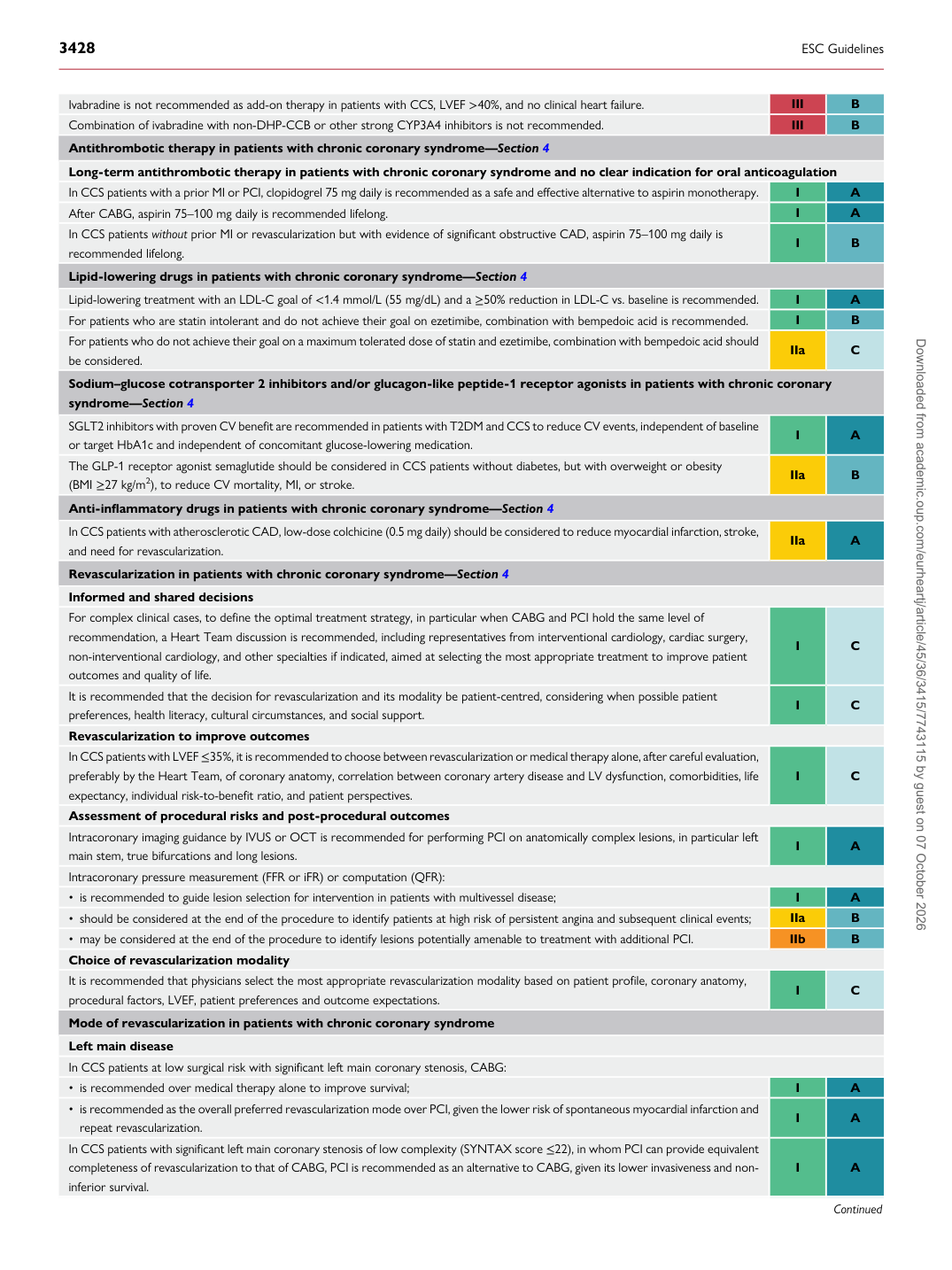
Ivabradine is not recommended as add-on therapy in patients with CCS, LVEF >40%, and no clinical heart failure. III B Combination of ivabradine with non-DHP-CCB or other strong CYP3A4 inhibitors is not recommended. III B Antithrombotic therapy in patients with chronic coronary syndrome—Section 4 Long-term antithrombotic therapy in patients with chronic coronary syndrome and no clear indication for oral anticoagulation In CCS patients with a prior MI or PCI, clopidogrel 75 mg daily is recommended as a safe and effective alternative to aspirin monotherapy. I A After CABG, aspirin 75–100 mg daily is recommended lifelong. I A In CCS patients without prior MI or revascularization but with evidence of significant obstructive CAD, aspirin 75–100 mg daily is recommended lifelong. I B Lipid-lowering drugs in patients with chronic coronary syndrome—Section 4 Lipid-lowering treatment with an LDL-C goal of <1.4 mmol/L (55 mg/dL) and a ≥50% reduction in LDL-C vs. baseline is recommended. I A For patients who are statin intolerant and do not achieve their goal on ezetimibe, combination with bempedoic acid is recommended. I B For patients who do not achieve their goal on a maximum tolerated dose of statin and ezetimibe, combination with bempedoic acid should be considered. IIa C Sodium–glucose cotransporter 2 inhibitors and/or glucagon-like peptide-1 receptor agonists in patients with chronic coronary syndrome—Section 4 SGLT2 inhibitors with proven CV benefit are recommended in patients with T2DM and CCS to reduce CV events, independent of baseline or target HbA1c and independent of concomitant glucose-lowering medication. I A The GLP-1 receptor agonist semaglutide should be considered in CCS patients without diabetes, but with overweight or obesity (BMI ≥27 kg/m2), to reduce CV mortality, MI, or stroke. IIa B Anti-inflammatory drugs in patients with chronic coronary syndrome—Section 4 In CCS patients with atherosclerotic CAD, low-dose colchicine (0.5 mg daily) should be considered to reduce myocardial infarction, stroke, and need for revascularization. IIa A Revascularization in patients with chronic coronary syndrome—Section 4 Informed and shared decisions For complex clinical cases, to define the optimal treatment strategy, in particular when CABG and PCI hold the same level of recommendation, a Heart Team discussion is recommended, including representatives from interventional cardiology, cardiac surgery, non-interventional cardiology, and other specialties if indicated, aimed at selecting the most appropriate treatment to improve patient outcomes and quality of life. I C It is recommended that the decision for revascularization and its modality be patient-centred, considering when possible patient preferences, health literacy, cultural circumstances, and social support. I C Revascularization to improve outcomes In CCS patients with LVEF ≤35%, it is recommended to choose between revascularization or medical therapy alone, after careful evaluation, preferably by the Heart Team, of coronary anatomy, correlation between coronary artery disease and LV dysfunction, comorbidities, life expectancy, individual risk-to-benefit ratio, and patient perspectives. I C Assessment of procedural risks and post-procedural outcomes Intracoronary imaging guidance by IVUS or OCT is recommended for performing PCI on anatomically complex lesions, in particular left main stem, true bifurcations and long lesions. I A Intracoronary pressure measurement (FFR or iFR) or computation (QFR): • is recommended to guide lesion selection for intervention in patients with multivessel disease; I A • should be considered at the end of the procedure to identify patients at high risk of persistent angina and subsequent clinical events; IIa B • may be considered at the end of the procedure to identify lesions potentially amenable to treatment with additional PCI. IIb B Choice of revascularization modality It is recommended that physicians select the most appropriate revascularization modality based on patient profile, coronary anatomy, procedural factors, LVEF, patient preferences and outcome expectations. I C Mode of revascularization in patients with chronic coronary syndrome Left main disease In CCS patients at low surgical risk with significant left main coronary stenosis, CABG: • is recommended over medical therapy alone to improve survival; I A • is recommended as the overall preferred revascularization mode over PCI, given the lower risk of spontaneous myocardial infarction and repeat revascularization. I A In CCS patients with significant left main coronary stenosis of low complexity (SYNTAX score ≤22), in whom PCI can provide equivalent completeness of revascularization to that of CABG, PCI is recommended as an alternative to CABG, given its lower invasiveness and noninferior survival. I A

Continued Downloaded from academic.oup.com/eurheartj/article/45/36/3415/7743115 by guest on 07 October 2026