p.13 抽出テキスト
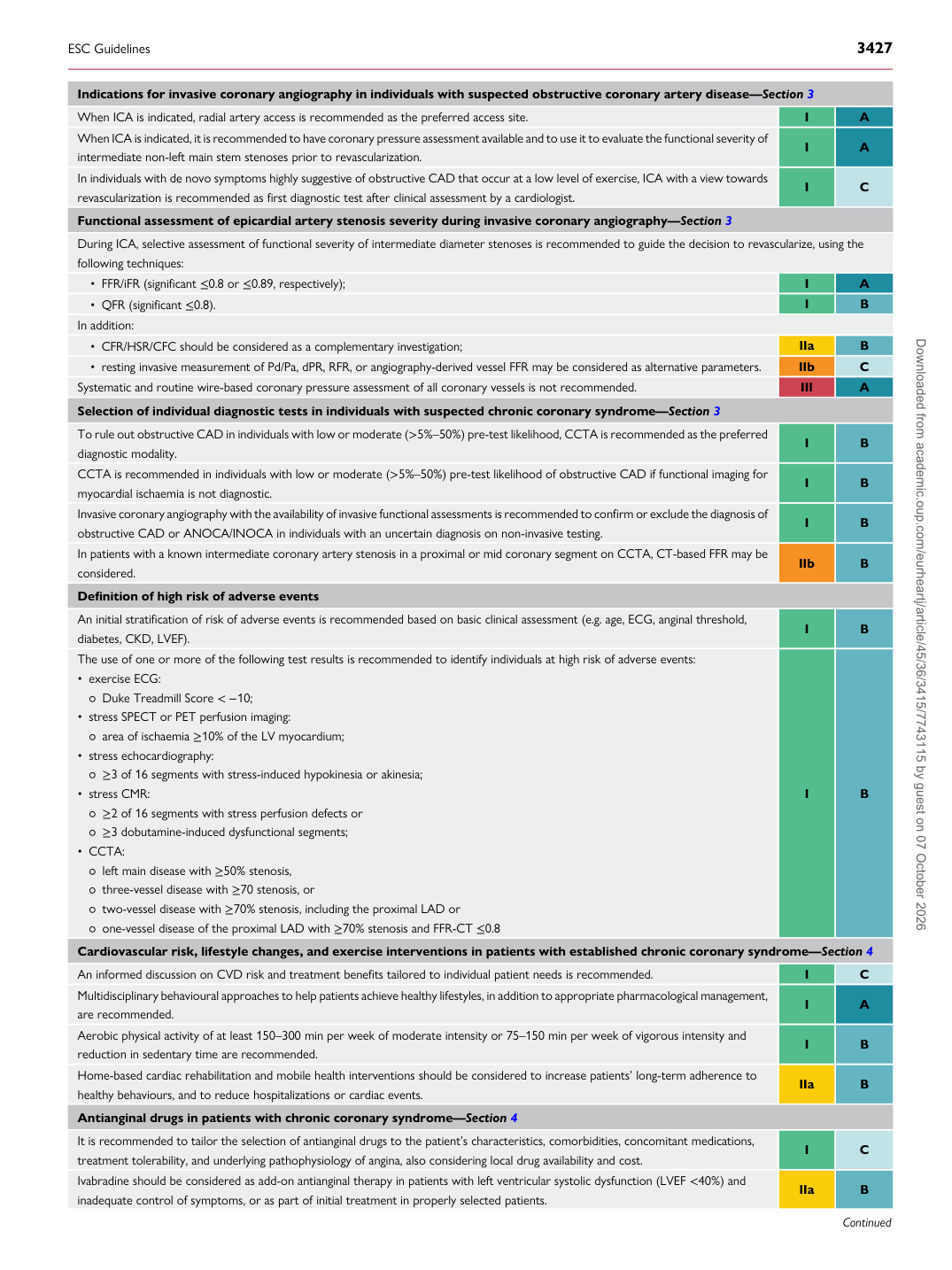
Indications for invasive coronary angiography in individuals with suspected obstructive coronary artery disease—Section 3 When ICA is indicated, radial artery access is recommended as the preferred access site. I A When ICA is indicated, it is recommended to have coronary pressure assessment available and to use it to evaluate the functional severity of intermediate non-left main stem stenoses prior to revascularization. I A In individuals with de novo symptoms highly suggestive of obstructive CAD that occur at a low level of exercise, ICA with a view towards revascularization is recommended as first diagnostic test after clinical assessment by a cardiologist. I C Functional assessment of epicardial artery stenosis severity during invasive coronary angiography—Section 3 During ICA, selective assessment of functional severity of intermediate diameter stenoses is recommended to guide the decision to revascularize, using the following techniques:

• FFR/iFR (significant ≤0.8 or ≤0.89, respectively); I A • QFR (significant ≤0.8). I B In addition:

• CFR/HSR/CFC should be considered as a complementary investigation; IIa B • resting invasive measurement of Pd/Pa, dPR, RFR, or angiography-derived vessel FFR may be considered as alternative parameters. IIb C Systematic and routine wire-based coronary pressure assessment of all coronary vessels is not recommended. III A Selection of individual diagnostic tests in individuals with suspected chronic coronary syndrome—Section 3 To rule out obstructive CAD in individuals with low or moderate (>5%–50%) pre-test likelihood, CCTA is recommended as the preferred diagnostic modality. I B CCTA is recommended in individuals with low or moderate (>5%–50%) pre-test likelihood of obstructive CAD if functional imaging for myocardial ischaemia is not diagnostic. I B Invasive coronary angiography with the availability of invasive functional assessments is recommended to confirm or exclude the diagnosis of obstructive CAD or ANOCA/INOCA in individuals with an uncertain diagnosis on non-invasive testing. I B In patients with a known intermediate coronary artery stenosis in a proximal or mid coronary segment on CCTA, CT-based FFR may be considered. IIb B Definition of high risk of adverse events An initial stratification of risk of adverse events is recommended based on basic clinical assessment (e.g. age, ECG, anginal threshold, diabetes, CKD, LVEF). I B The use of one or more of the following test results is recommended to identify individuals at high risk of adverse events: • exercise ECG: ⚬Duke Treadmill Score < −10; • stress SPECT or PET perfusion imaging: ⚬area of ischaemia ≥10% of the LV myocardium; • stress echocardiography:

⚬≥3 of 16 segments with stress-induced hypokinesia or akinesia; • stress CMR: ⚬≥2 of 16 segments with stress perfusion defects or

⚬≥3 dobutamine-induced dysfunctional segments; • CCTA: ⚬left main disease with ≥50% stenosis,

⚬three-vessel disease with ≥70 stenosis, or ⚬two-vessel disease with ≥70% stenosis, including the proximal LAD or ⚬one-vessel disease of the proximal LAD with ≥70% stenosis and FFR-CT ≤0.8 I B Cardiovascular risk, lifestyle changes, and exercise interventions in patients with established chronic coronary syndrome—Section 4 An informed discussion on CVD risk and treatment benefits tailored to individual patient needs is recommended. I C Multidisciplinary behavioural approaches to help patients achieve healthy lifestyles, in addition to appropriate pharmacological management, are recommended. I A Aerobic physical activity of at least 150–300 min per week of moderate intensity or 75–150 min per week of vigorous intensity and reduction in sedentary time are recommended. I B Home-based cardiac rehabilitation and mobile health interventions should be considered to increase patients’ long-term adherence to healthy behaviours, and to reduce hospitalizations or cardiac events. IIa B Antianginal drugs in patients with chronic coronary syndrome—Section 4 It is recommended to tailor the selection of antianginal drugs to the patient’s characteristics, comorbidities, concomitant medications, treatment tolerability, and underlying pathophysiology of angina, also considering local drug availability and cost. I C Ivabradine should be considered as add-on antianginal therapy in patients with left ventricular systolic dysfunction (LVEF <40%) and inadequate control of symptoms, or as part of initial treatment in properly selected patients. IIa B

ESC Guidelines                                                                                                                                                                                          3427

Downloaded from academic.oup.com/eurheartj/article/45/36/3415/7743115 by guest on 07 October 2026