p.11 抽出テキスト
Asymptomatic with abnormal

coronary anatomical

or functional test

Angina or equivalent with no obstructive CAD

(ANOCA/INOCA) Stabilized phase after ACS, PCI, or CABG

Stress-induced angina, or equivalent,

with obstructive CAD A

B LV dysfunction or heart failure of ischaemic origin

Structural Epicardial Microvascular

Main mechanisms of myocardial ischaemia

in chronic coronary syndromes

Functional Structural Functional

Atherosclerosis (focal or diffuse)

Stabilized intramural haematoma

Myocardial bridge

Coronary aneurysm Impaired vasodilation

Increased vasoconstriction

Epicardial vasospasm Inward arteriolar remodelling

Capillary rarefaction

Intravascular plugging

Perivascular fibrosis or infiltration

Extramural compression (myocardial hypertrophy, increased LVEDP)

Clinical spectrum of suspected, or confirmed, chronic coronary

syndromes

Autonomic dysregulation

Endothelial dysfunction and/or VSMC hyperreactivity

Autonomic dysregulation

Endothelial dysfunction and/or VSMC hyperreactivity

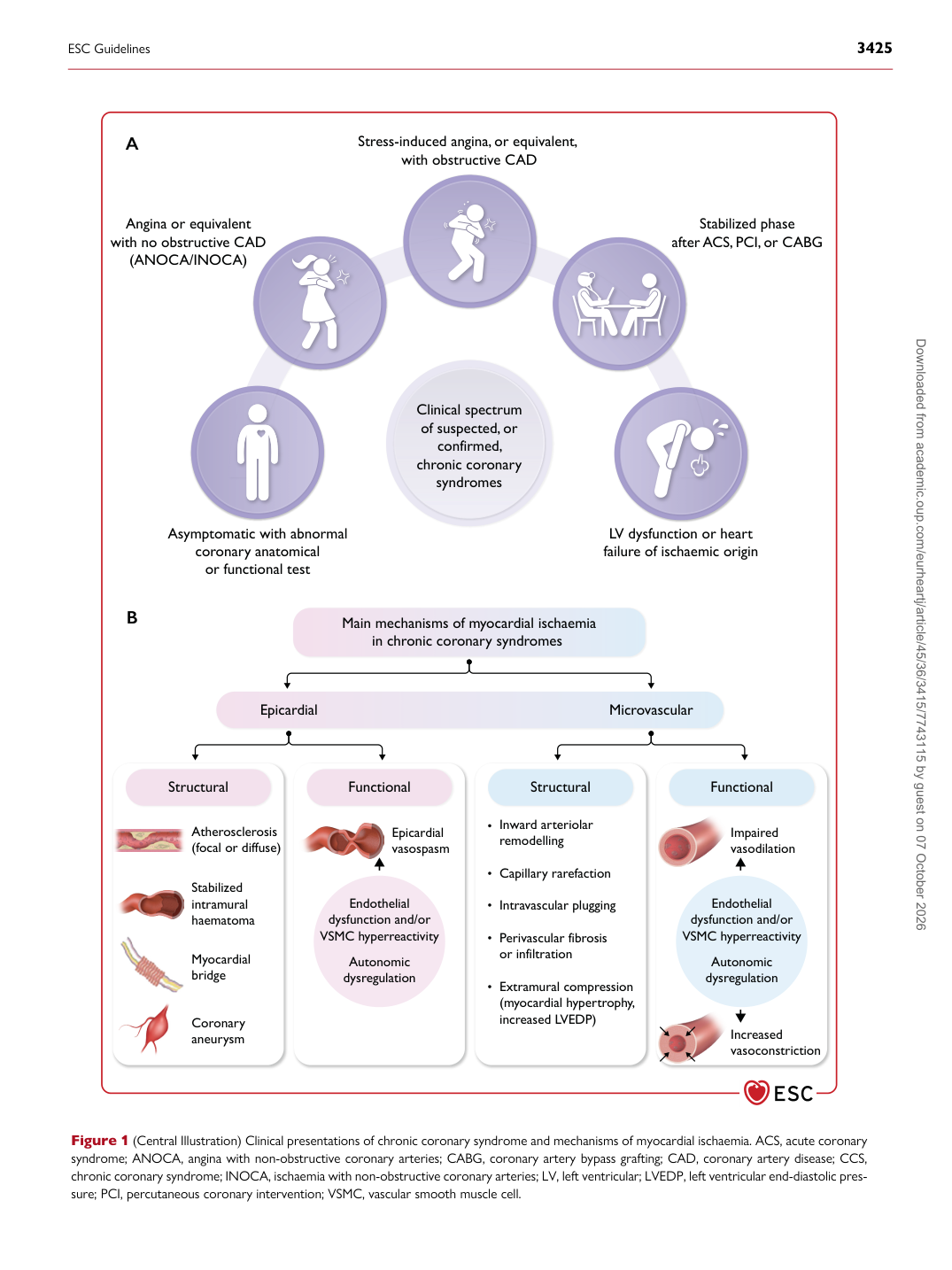
Figure 1 (Central Illustration) Clinical presentations of chronic coronary syndrome and mechanisms of myocardial ischaemia. ACS, acute coronary syndrome; ANOCA, angina with non-obstructive coronary arteries; CABG, coronary artery bypass grafting; CAD, coronary artery disease; CCS, chronic coronary syndrome; INOCA, ischaemia with non-obstructive coronary arteries; LV, left ventricular; LVEDP, left ventricular end-diastolic pressure; PCI, percutaneous coronary intervention; VSMC, vascular smooth muscle cell.

ESC Guidelines                                                                                                                                                                                          3425

Downloaded from academic.oup.com/eurheartj/article/45/36/3415/7743115 by guest on 07 October 2026