p.69 抽出テキスト
14 Evidence tables

Evidence tables are available at European Heart Journal online.

15 Data availability statement

No new data were generated or analysed in support of this research.

16 Author information

Author/Task Force Member Affiliations: Michiel Rienstra, Department of Cardiology, University of Groningen, University Medical Center Groningen, Groningen, Netherlands; Karina V. Bunting, Institute of Cardiovascular Sciences, University of Birmingham, Birmingham, United Kingdom, Cardiology Department, Queen Elizabeth Hospital, University Hospitals Birmingham NHS Foundation Trust, Birmingham, United Kingdom; Ruben Casado-Arroyo, Department of Cardiology, H.U.B.-Hôpital Erasme, Université Libre de Bruxelles, Brussels, Belgium; Valeria Caso, Stroke Unit, Santa della Misericordia Hospital, Perugia, Italy; Harry J.G.M. Crijns, Cardiology Maastricht University Medical Centre, Maastricht, Netherlands, Cardiology Cardiovascular Research Institute Maastricht, Maastricht University, Maastricht, Netherlands; Tom J. R. De Potter, Department of Cardiology, OLV Hospital,

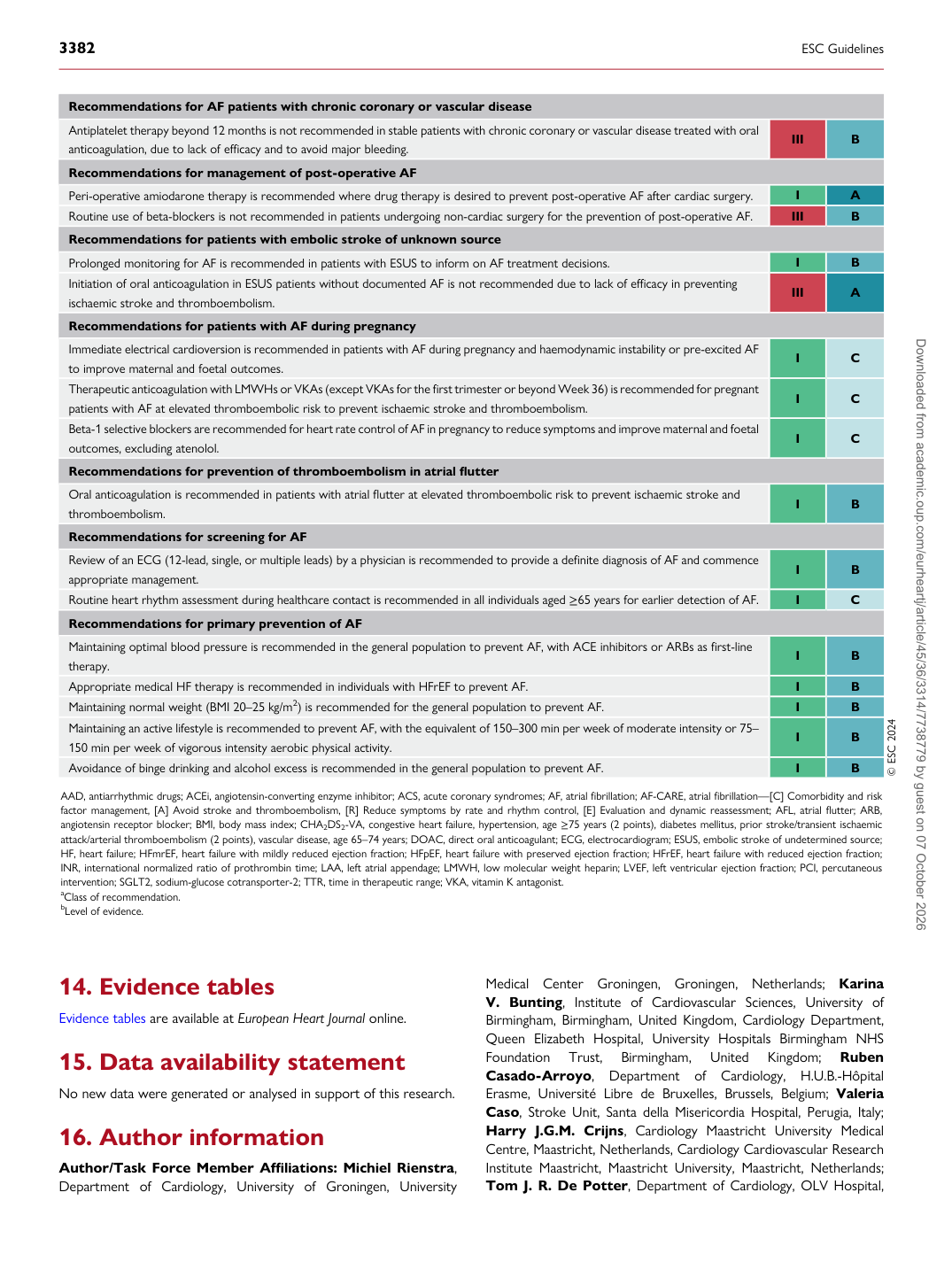
Recommendations for AF patients with chronic coronary or vascular disease Antiplatelet therapy beyond 12 months is not recommended in stable patients with chronic coronary or vascular disease treated with oral anticoagulation, due to lack of efficacy and to avoid major bleeding. III B Recommendations for management of post-operative AF Peri-operative amiodarone therapy is recommended where drug therapy is desired to prevent post-operative AF after cardiac surgery. I A Routine use of beta-blockers is not recommended in patients undergoing non-cardiac surgery for the prevention of post-operative AF. III B Recommendations for patients with embolic stroke of unknown source Prolonged monitoring for AF is recommended in patients with ESUS to inform on AF treatment decisions. I B Initiation of oral anticoagulation in ESUS patients without documented AF is not recommended due to lack of efficacy in preventing ischaemic stroke and thromboembolism. III A Recommendations for patients with AF during pregnancy Immediate electrical cardioversion is recommended in patients with AF during pregnancy and haemodynamic instability or pre-excited AF to improve maternal and foetal outcomes. I C Therapeutic anticoagulation with LMWHs or VKAs (except VKAs for the first trimester or beyond Week 36) is recommended for pregnant patients with AF at elevated thromboembolic risk to prevent ischaemic stroke and thromboembolism. I C Beta-1 selective blockers are recommended for heart rate control of AF in pregnancy to reduce symptoms and improve maternal and foetal outcomes, excluding atenolol. I C Recommendations for prevention of thromboembolism in atrial flutter Oral anticoagulation is recommended in patients with atrial flutter at elevated thromboembolic risk to prevent ischaemic stroke and thromboembolism. I B Recommendations for screening for AF Review of an ECG (12-lead, single, or multiple leads) by a physician is recommended to provide a definite diagnosis of AF and commence appropriate management. I B Routine heart rhythm assessment during healthcare contact is recommended in all individuals aged ≥65 years for earlier detection of AF. I C Recommendations for primary prevention of AF Maintaining optimal blood pressure is recommended in the general population to prevent AF, with ACE inhibitors or ARBs as first-line therapy. I B Appropriate medical HF therapy is recommended in individuals with HFrEF to prevent AF. I B Maintaining normal weight (BMI 20–25 kg/m2) is recommended for the general population to prevent AF. I B Maintaining an active lifestyle is recommended to prevent AF, with the equivalent of 150–300 min per week of moderate intensity or 75– 150 min per week of vigorous intensity aerobic physical activity. I B Avoidance of binge drinking and alcohol excess is recommended in the general population to prevent AF. I B © ESC 2024

AAD, antiarrhythmic drugs; ACEi, angiotensin-converting enzyme inhibitor; ACS, acute coronary syndromes; AF, atrial fibrillation; AF-CARE, atrial fibrillation—[C] Comorbidity and risk factor management, [A] Avoid stroke and thromboembolism, [R] Reduce symptoms by rate and rhythm control, [E] Evaluation and dynamic reassessment; AFL, atrial flutter; ARB, angiotensin receptor blocker; BMI, body mass index; CHA2DS2-VA, congestive heart failure, hypertension, age ≥75 years (2 points), diabetes mellitus, prior stroke/transient ischaemic attack/arterial thromboembolism (2 points), vascular disease, age 65–74 years; DOAC, direct oral anticoagulant; ECG, electrocardiogram; ESUS, embolic stroke of undetermined source; HF, heart failure; HFmrEF, heart failure with mildly reduced ejection fraction; HFpEF, heart failure with preserved ejection fraction; HFrEF, heart failure with reduced ejection fraction; INR, international normalized ratio of prothrombin time; LAA, left atrial appendage; LMWH, low molecular weight heparin; LVEF, left ventricular ejection fraction; PCI, percutaneous intervention; SGLT2, sodium-glucose cotransporter-2; TTR, time in therapeutic range; VKA, vitamin K antagonist. aClass of recommendation. bLevel of evidence. Downloaded from academic.oup.com/eurheartj/article/45/36/3314/7738779 by guest on 07 October 2026