p.68 抽出テキスト
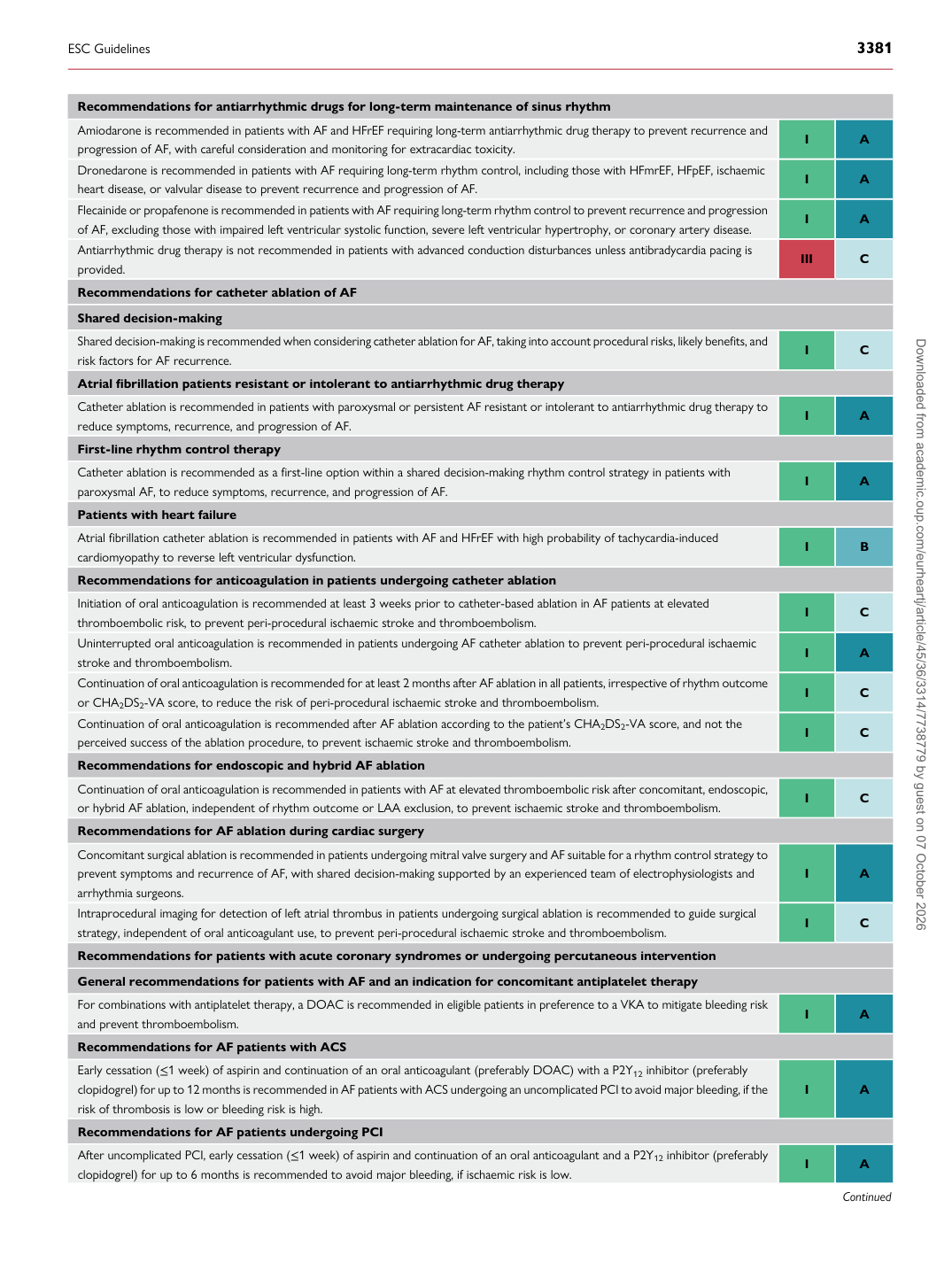
Recommendations for antiarrhythmic drugs for long-term maintenance of sinus rhythm Amiodarone is recommended in patients with AF and HFrEF requiring long-term antiarrhythmic drug therapy to prevent recurrence and progression of AF, with careful consideration and monitoring for extracardiac toxicity. I A Dronedarone is recommended in patients with AF requiring long-term rhythm control, including those with HFmrEF, HFpEF, ischaemic heart disease, or valvular disease to prevent recurrence and progression of AF. I A Flecainide or propafenone is recommended in patients with AF requiring long-term rhythm control to prevent recurrence and progression of AF, excluding those with impaired left ventricular systolic function, severe left ventricular hypertrophy, or coronary artery disease. I A Antiarrhythmic drug therapy is not recommended in patients with advanced conduction disturbances unless antibradycardia pacing is provided. III C Recommendations for catheter ablation of AF Shared decision-making Shared decision-making is recommended when considering catheter ablation for AF, taking into account procedural risks, likely benefits, and risk factors for AF recurrence. I C Atrial fibrillation patients resistant or intolerant to antiarrhythmic drug therapy Catheter ablation is recommended in patients with paroxysmal or persistent AF resistant or intolerant to antiarrhythmic drug therapy to reduce symptoms, recurrence, and progression of AF. I A First-line rhythm control therapy Catheter ablation is recommended as a first-line option within a shared decision-making rhythm control strategy in patients with paroxysmal AF, to reduce symptoms, recurrence, and progression of AF. I A Patients with heart failure Atrial fibrillation catheter ablation is recommended in patients with AF and HFrEF with high probability of tachycardia-induced cardiomyopathy to reverse left ventricular dysfunction. I B Recommendations for anticoagulation in patients undergoing catheter ablation Initiation of oral anticoagulation is recommended at least 3 weeks prior to catheter-based ablation in AF patients at elevated thromboembolic risk, to prevent peri-procedural ischaemic stroke and thromboembolism. I C Uninterrupted oral anticoagulation is recommended in patients undergoing AF catheter ablation to prevent peri-procedural ischaemic stroke and thromboembolism. I A Continuation of oral anticoagulation is recommended for at least 2 months after AF ablation in all patients, irrespective of rhythm outcome or CHA2DS2-VA score, to reduce the risk of peri-procedural ischaemic stroke and thromboembolism. I C Continuation of oral anticoagulation is recommended after AF ablation according to the patient’s CHA2DS2-VA score, and not the perceived success of the ablation procedure, to prevent ischaemic stroke and thromboembolism. I C Recommendations for endoscopic and hybrid AF ablation Continuation of oral anticoagulation is recommended in patients with AF at elevated thromboembolic risk after concomitant, endoscopic, or hybrid AF ablation, independent of rhythm outcome or LAA exclusion, to prevent ischaemic stroke and thromboembolism. I C Recommendations for AF ablation during cardiac surgery Concomitant surgical ablation is recommended in patients undergoing mitral valve surgery and AF suitable for a rhythm control strategy to prevent symptoms and recurrence of AF, with shared decision-making supported by an experienced team of electrophysiologists and arrhythmia surgeons. I A Intraprocedural imaging for detection of left atrial thrombus in patients undergoing surgical ablation is recommended to guide surgical strategy, independent of oral anticoagulant use, to prevent peri-procedural ischaemic stroke and thromboembolism. I C Recommendations for patients with acute coronary syndromes or undergoing percutaneous intervention General recommendations for patients with AF and an indication for concomitant antiplatelet therapy For combinations with antiplatelet therapy, a DOAC is recommended in eligible patients in preference to a VKA to mitigate bleeding risk and prevent thromboembolism. I A Recommendations for AF patients with ACS Early cessation (≤1 week) of aspirin and continuation of an oral anticoagulant (preferably DOAC) with a P2Y12 inhibitor (preferably clopidogrel) for up to 12 months is recommended in AF patients with ACS undergoing an uncomplicated PCI to avoid major bleeding, if the risk of thrombosis is low or bleeding risk is high. I A Recommendations for AF patients undergoing PCI After uncomplicated PCI, early cessation (≤1 week) of aspirin and continuation of an oral anticoagulant and a P2Y12 inhibitor (preferably clopidogrel) for up to 6 months is recommended to avoid major bleeding, if ischaemic risk is low. I A

Continued

ESC Guidelines                                                                                                                                                                                          3381

Downloaded from academic.oup.com/eurheartj/article/45/36/3314/7738779 by guest on 07 October 2026