p.67 抽出テキスト
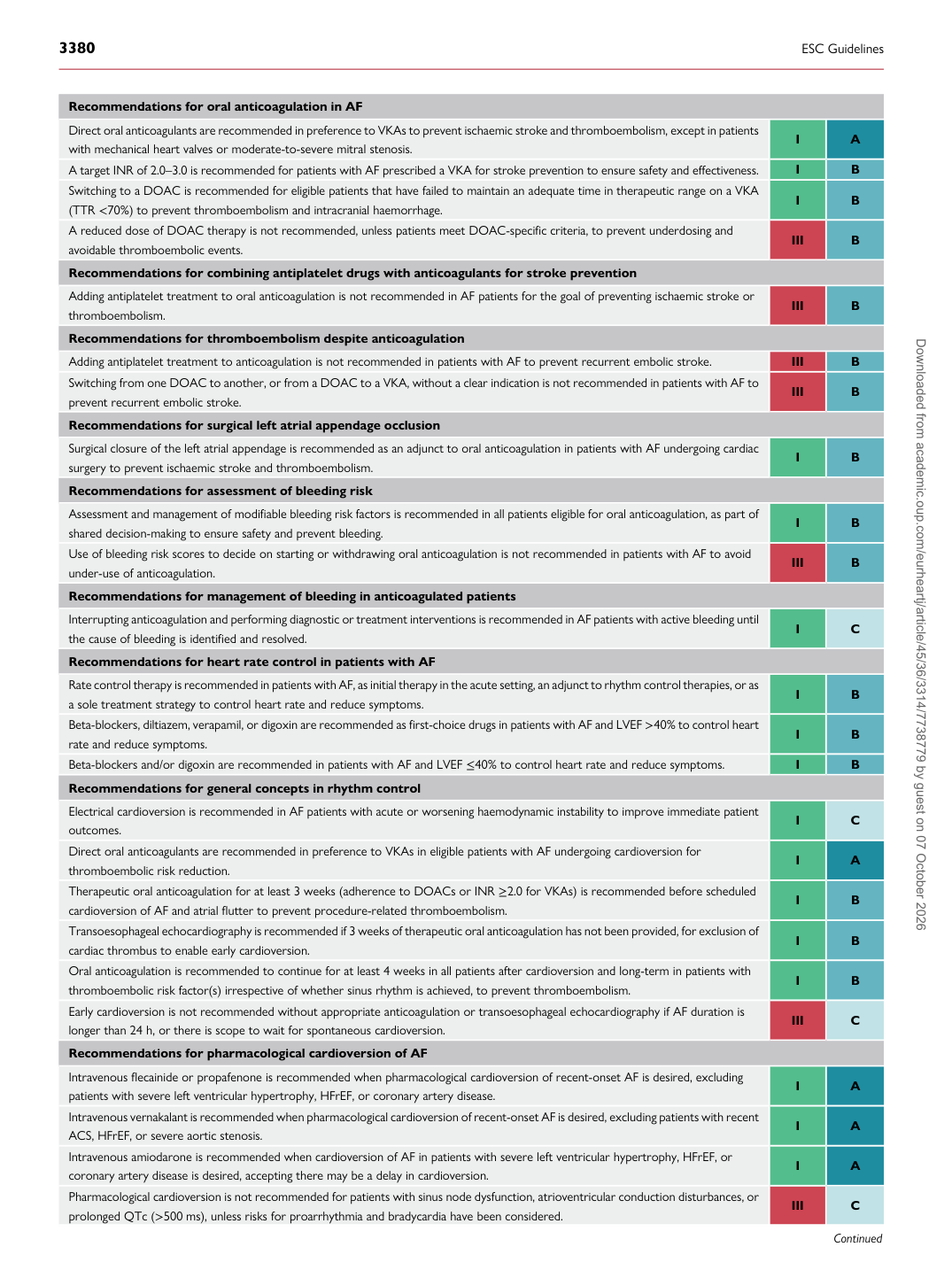
Recommendations for oral anticoagulation in AF Direct oral anticoagulants are recommended in preference to VKAs to prevent ischaemic stroke and thromboembolism, except in patients with mechanical heart valves or moderate-to-severe mitral stenosis. I A A target INR of 2.0–3.0 is recommended for patients with AF prescribed a VKA for stroke prevention to ensure safety and effectiveness. I B Switching to a DOAC is recommended for eligible patients that have failed to maintain an adequate time in therapeutic range on a VKA (TTR <70%) to prevent thromboembolism and intracranial haemorrhage. I B A reduced dose of DOAC therapy is not recommended, unless patients meet DOAC-specific criteria, to prevent underdosing and avoidable thromboembolic events. III B Recommendations for combining antiplatelet drugs with anticoagulants for stroke prevention Adding antiplatelet treatment to oral anticoagulation is not recommended in AF patients for the goal of preventing ischaemic stroke or thromboembolism. III B Recommendations for thromboembolism despite anticoagulation Adding antiplatelet treatment to anticoagulation is not recommended in patients with AF to prevent recurrent embolic stroke. III B Switching from one DOAC to another, or from a DOAC to a VKA, without a clear indication is not recommended in patients with AF to prevent recurrent embolic stroke. III B Recommendations for surgical left atrial appendage occlusion Surgical closure of the left atrial appendage is recommended as an adjunct to oral anticoagulation in patients with AF undergoing cardiac surgery to prevent ischaemic stroke and thromboembolism. I B Recommendations for assessment of bleeding risk Assessment and management of modifiable bleeding risk factors is recommended in all patients eligible for oral anticoagulation, as part of shared decision-making to ensure safety and prevent bleeding. I B Use of bleeding risk scores to decide on starting or withdrawing oral anticoagulation is not recommended in patients with AF to avoid under-use of anticoagulation. III B Recommendations for management of bleeding in anticoagulated patients Interrupting anticoagulation and performing diagnostic or treatment interventions is recommended in AF patients with active bleeding until the cause of bleeding is identified and resolved. I C Recommendations for heart rate control in patients with AF Rate control therapy is recommended in patients with AF, as initial therapy in the acute setting, an adjunct to rhythm control therapies, or as a sole treatment strategy to control heart rate and reduce symptoms. I B Beta-blockers, diltiazem, verapamil, or digoxin are recommended as first-choice drugs in patients with AF and LVEF >40% to control heart rate and reduce symptoms. I B Beta-blockers and/or digoxin are recommended in patients with AF and LVEF ≤40% to control heart rate and reduce symptoms. I B Recommendations for general concepts in rhythm control Electrical cardioversion is recommended in AF patients with acute or worsening haemodynamic instability to improve immediate patient outcomes. I C Direct oral anticoagulants are recommended in preference to VKAs in eligible patients with AF undergoing cardioversion for thromboembolic risk reduction. I A Therapeutic oral anticoagulation for at least 3 weeks (adherence to DOACs or INR ≥2.0 for VKAs) is recommended before scheduled cardioversion of AF and atrial flutter to prevent procedure-related thromboembolism. I B Transoesophageal echocardiography is recommended if 3 weeks of therapeutic oral anticoagulation has not been provided, for exclusion of cardiac thrombus to enable early cardioversion. I B Oral anticoagulation is recommended to continue for at least 4 weeks in all patients after cardioversion and long-term in patients with thromboembolic risk factor(s) irrespective of whether sinus rhythm is achieved, to prevent thromboembolism. I B Early cardioversion is not recommended without appropriate anticoagulation or transoesophageal echocardiography if AF duration is longer than 24 h, or there is scope to wait for spontaneous cardioversion. III C Recommendations for pharmacological cardioversion of AF Intravenous flecainide or propafenone is recommended when pharmacological cardioversion of recent-onset AF is desired, excluding patients with severe left ventricular hypertrophy, HFrEF, or coronary artery disease. I A Intravenous vernakalant is recommended when pharmacological cardioversion of recent-onset AF is desired, excluding patients with recent ACS, HFrEF, or severe aortic stenosis. I A Intravenous amiodarone is recommended when cardioversion of AF in patients with severe left ventricular hypertrophy, HFrEF, or coronary artery disease is desired, accepting there may be a delay in cardioversion. I A Pharmacological cardioversion is not recommended for patients with sinus node dysfunction, atrioventricular conduction disturbances, or prolonged QTc (>500 ms), unless risks for proarrhythmia and bradycardia have been considered. III C

Downloaded from academic.oup.com/eurheartj/article/45/36/3314/7738779 by guest on 07 October 2026