p.63 抽出テキスト
physical activity, and alcohol, although many other risk markers can also be targeted. Further information on each factor’s attributable risk for AF is provided in the Supplementary data online (see Supplementary data online, Evidence Table 32 and additional Evidence Tables S34–S39).

10.5.1 Hypertension

Management of hypertension has been associated with a reduction in incident AF.1205–1207,1232 In the LIFE (Losartan Intervention for End point reduction in hypertension) trial, a 10 mmHg reduction in systolic BP was associated with a 17% reduction in incident AF.1207 Secondary analysis of RCTs and observational studies suggest that ACE inhibitors or ARBs may be superior to beta-blockers, calcium channel blockers, or diuretics for the prevention of incident AF.1233–1236

10.5.2 Heart failure

Long-standing established pharmacological treatments for HFrEF have been associated with a reduction in incident AF. The use of ACE inhibitors or ARBs in patients with known HFrEF was associated with a 44% reduction in incidence of AF.1208 Similarly, beta-blockers in HFrEF led to a 33% reduction in the odds of incident AF.133 Mineralocorticoid receptor antagonists have also been shown to reduce the risk of new-onset AF by 42% in patients with HFrEF.1209 Although there have been variable effects of SGLT2 inhibitors on incident AF, several meta-analyses have demonstrated that there is an 18%–37% reduction in incident AF.136,1210,1211,1237 However, treatment of HFrEF with sacubitril/valsartan has not yet been shown to confer any adjunctive benefit in reducing new-onset AF when compared with ACE inhibitors/ARBs alone.1238 There is some evidence to suggest that effective CRT in eligible patients with HFrEF reduces the risk of incident AF.1239 To date, no treatments in HFpEF have been shown to reduce incident AF.

10.5.3 Type 2 diabetes mellitus

The integrated care of type 2 diabetes, based on lifestyle and pharmacological treatments for comorbidities such as obesity, hypertension, and dyslipidaemia, are useful steps in preventing atrial remodelling and subsequent AF. Intensive glucose-lowering therapy targeting an HbA1c level of <6.0% (<42 mmol/mol) failed to show a protective effect on incident AF.1240 More than glycaemic control per se, the class of glucose-lowering agent may influence the risk of AF.1240 Insulin promotes adipogenesis and cardiac fibrosis, and sulfonylureas have been consistently associated with an increased risk of AF.193 Observational studies have associated metformin with lower rates of incident AF.1224,1225,1241–1243 Various recent studies and meta-analyses point to the positive role of SGLT2 inhibitors to reduce the risk of incident AF in diabetic and non-diabetic patients.136,1226,1244–1246 Pooled data from 22 trials including 52 951 patients with type 2 diabetes and heart failure showed that SGLT2 inhibitors compared with placebo can significantly reduce the incidence of AF by 18% in studies on diabetes, and up to 37% in heart failure with or without type 2 diabetes.1210,1211

10.5.4 Obesity

Management of weight is important in the prevention of AF. In a large population-based cohort study, normal weight was associated with a reduced risk of incident AF compared with those who were obese (4.7% increase in the risk of incident AF for each 1 kg/m2 increase of BMI).208 In the Women’s Health Study, participants who became obese had a 41% increased risk of incident AF compared with those who maintained their BMI <30 kg/m2.1212 Similarly, observational studies in populations using bariatric surgery for weight loss in morbidly obese individuals (BMI ≥40 kg/m2) have observed a lower risk of incident AF.1227–1231

10.5.5 Sleep apnoea syndrome

Although it would seem rational to optimize sleep habits, to date there is no conclusive evidence to support this for the primary prevention of AF. The SAVE (Sleep Apnea cardioVascular Endpoints) trial failed to demonstrate a difference in clinical outcomes in those randomized to CPAP therapy or placebo.230 There was no difference in incident AF, albeit the analysis of AF was not based on systematic screening but rather on clinically documented AF.

10.5.6 Physical activity

Several studies have demonstrated beneficial effects of moderate physical activity on cardiovascular health.1247 Moderate aerobic exercise may also reduce the risk of new-onset AF.1214–1219 It should be noted that the incidence of AF appears to be increased among athletes, with a meta-analysis of observational studies showing a 2.5-fold increased risk of AF compared with non-athlete controls.1248

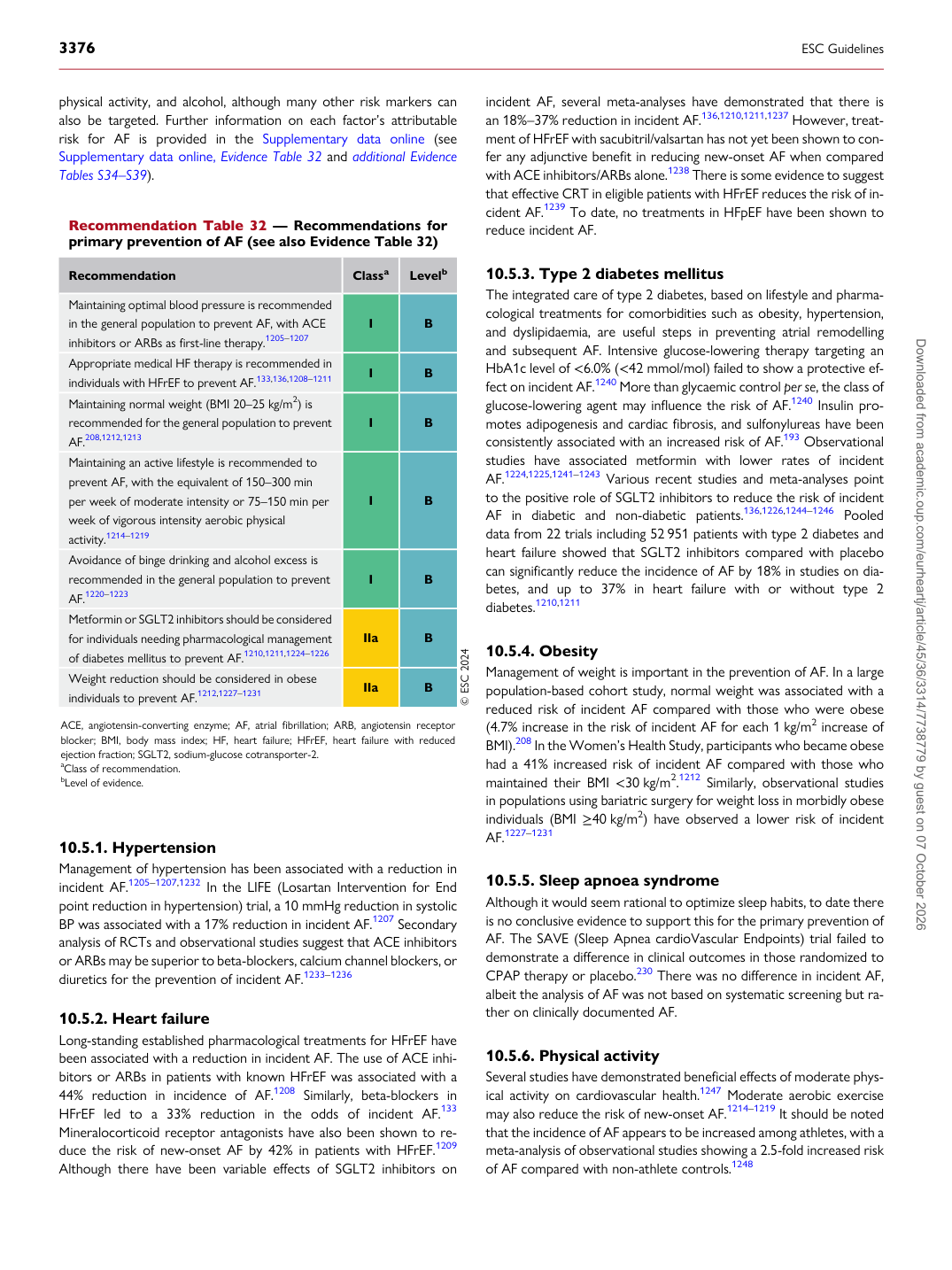
Recommendation Table 32 — Recommendations for primary prevention of AF (see also Evidence Table 32)

Recommendation Classa Levelb

Maintaining optimal blood pressure is recommended in the general population to prevent AF, with ACE inhibitors or ARBs as first-line therapy.1205–1207 I B Appropriate medical HF therapy is recommended in individuals with HFrEF to prevent AF.133,136,1208–1211 I B Maintaining normal weight (BMI 20–25 kg/m2) is recommended for the general population to prevent AF.208,1212,1213 I B Maintaining an active lifestyle is recommended to prevent AF, with the equivalent of 150–300 min per week of moderate intensity or 75–150 min per week of vigorous intensity aerobic physical activity.1214–1219 I B Avoidance of binge drinking and alcohol excess is recommended in the general population to prevent AF.1220–1223 I B Metformin or SGLT2 inhibitors should be considered for individuals needing pharmacological management of diabetes mellitus to prevent AF.1210,1211,1224–1226 IIa B Weight reduction should be considered in obese individuals to prevent AF.1212,1227–1231 IIa B © ESC 2024

ACE, angiotensin-converting enzyme; AF, atrial fibrillation; ARB, angiotensin receptor blocker; BMI, body mass index; HF, heart failure; HFrEF, heart failure with reduced ejection fraction; SGLT2, sodium-glucose cotransporter-2. aClass of recommendation. bLevel of evidence. Downloaded from academic.oup.com/eurheartj/article/45/36/3314/7738779 by guest on 07 October 2026