p.62 抽出テキスト
and Halland, Sweden), 75- and 76-year-olds were randomized to be invited to prolonged screening for AF using single-lead ECGs twice daily for 2 weeks, or to standard of care. After a median of 6.9 years there was a small reduction in the primary combined endpoint of all-cause mortality, stroke, systematic embolism, and severe bleeding in favour of prolonged screening (HR, 0.96; 95% CI, 0.92–1.00; P = .045).6 In the LOOP (Atrial Fibrillation Detected by Continuous ECG Monitoring) trial, individuals at increased risk of stroke were randomized to receive an implantable loop recorder that monitored heart rhythm for an average of 3.3 years, or to a control group receiving standard of care. Although there was a higher detection of AF (31.8%) and subsequent initiation of OAC in the loop recorder group compared with standard of care (12.2%), this was not accompanied by a difference in the primary outcome of stroke or systemic embolism.5 In a meta-analysis of recent RCTs on the outcome of stroke, a small but significant benefit was seen in favour of prolonged screening (RR, 0.91; 95% CI, 0.84–0.99).1136 This was not repeated in a second meta-analysis including older RCTs, where no risk reduction was seen with regard to mortality or stroke.1135 Notably, both these meta-analyses are likely underpowered to assess clinical outcomes.

10.4 Factors associated with incident AF

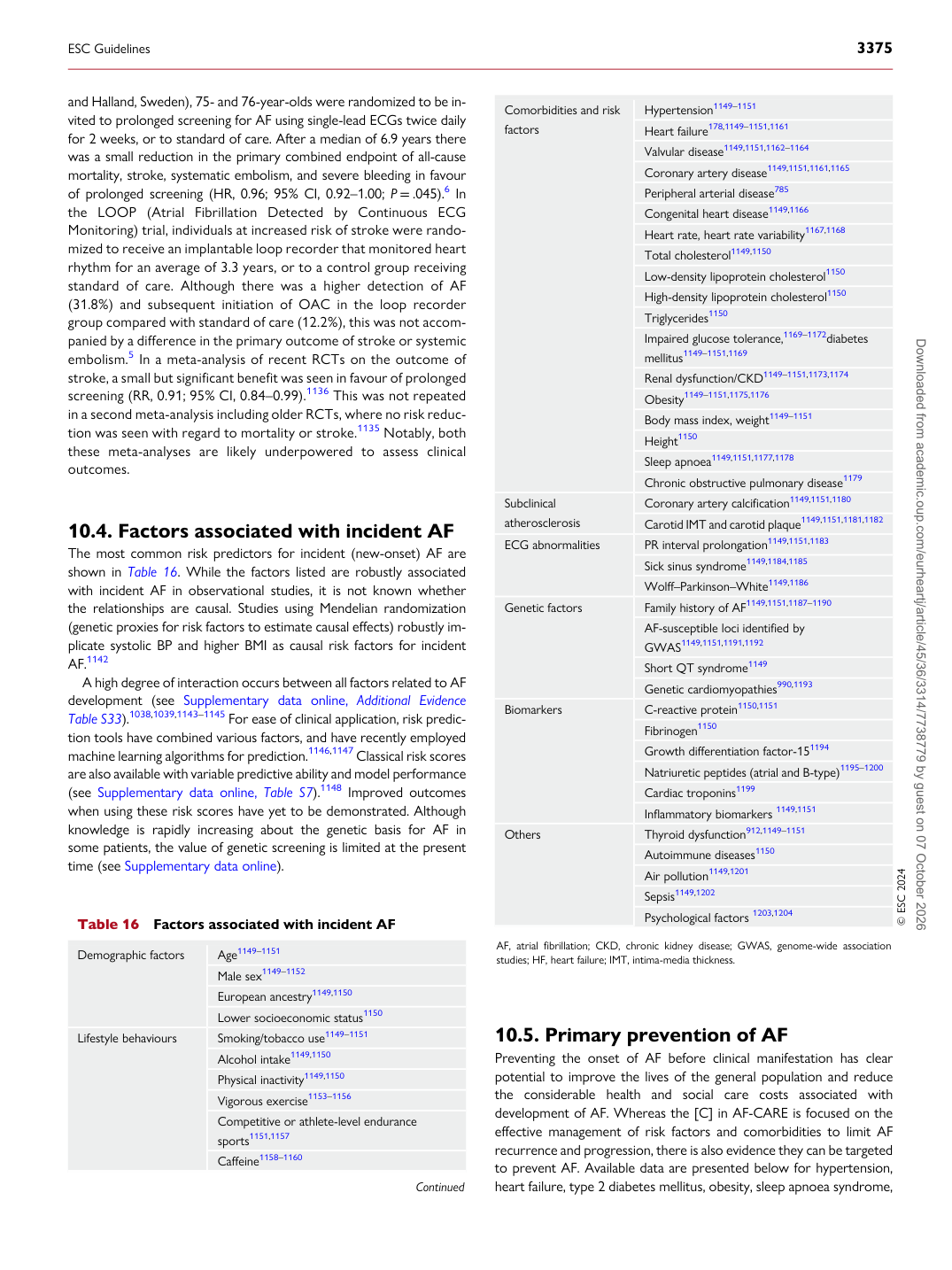
The most common risk predictors for incident (new-onset) AF are shown in Table 16. While the factors listed are robustly associated with incident AF in observational studies, it is not known whether the relationships are causal. Studies using Mendelian randomization (genetic proxies for risk factors to estimate causal effects) robustly implicate systolic BP and higher BMI as causal risk factors for incident AF.1142 A high degree of interaction occurs between all factors related to AF development (see Supplementary data online, Additional Evidence Table S33).1038,1039,1143–1145 For ease of clinical application, risk prediction tools have combined various factors, and have recently employed machine learning algorithms for prediction.1146,1147 Classical risk scores are also available with variable predictive ability and model performance (see Supplementary data online, Table S7).1148 Improved outcomes when using these risk scores have yet to be demonstrated. Although knowledge is rapidly increasing about the genetic basis for AF in some patients, the value of genetic screening is limited at the present time (see Supplementary data online).

10.5 Primary prevention of AF

Preventing the onset of AF before clinical manifestation has clear potential to improve the lives of the general population and reduce the considerable health and social care costs associated with development of AF. Whereas the [C] in AF-CARE is focused on the effective management of risk factors and comorbidities to limit AF recurrence and progression, there is also evidence they can be targeted to prevent AF. Available data are presented below for hypertension, heart failure, type 2 diabetes mellitus, obesity, sleep apnoea syndrome,

Table 16 Factors associated with incident AF Demographic factors Age1149–1151

Male sex1149–1152 European ancestry1149,1150 Lower socioeconomic status1150

Lifestyle behaviours Smoking/tobacco use1149–1151

Alcohol intake1149,1150 Physical inactivity1149,1150 Vigorous exercise1153–1156 Competitive or athlete-level endurance sports1151,1157 Caffeine1158–1160

Continued Comorbidities and risk

factors Hypertension1149–1151

Heart failure178,1149–1151,1161 Valvular disease1149,1151,1162–1164 Coronary artery disease1149,1151,1161,1165 Peripheral arterial disease785 Congenital heart disease1149,1166 Heart rate, heart rate variability1167,1168 Total cholesterol1149,1150 Low-density lipoprotein cholesterol1150 High-density lipoprotein cholesterol1150 Triglycerides1150 Impaired glucose tolerance,1169–1172diabetes mellitus1149–1151,1169 Renal dysfunction/CKD1149–1151,1173,1174 Obesity1149–1151,1175,1176 Body mass index, weight1149–1151 Height1150 Sleep apnoea1149,1151,1177,1178 Chronic obstructive pulmonary disease1179

Subclinical atherosclerosis Coronary artery calcification1149,1151,1180

Carotid IMT and carotid plaque1149,1151,1181,1182

ECG abnormalities PR interval prolongation1149,1151,1183

Sick sinus syndrome1149,1184,1185 Wolff–Parkinson–White1149,1186

Genetic factors Family history of AF1149,1151,1187–1190

AF-susceptible loci identified by GWAS1149,1151,1191,1192 Short QT syndrome1149 Genetic cardiomyopathies990,1193

Biomarkers C-reactive protein1150,1151

Fibrinogen1150 Growth differentiation factor-151194 Natriuretic peptides (atrial and B-type)1195–1200 Cardiac troponins1199 Inflammatory biomarkers 1149,1151

Others Thyroid dysfunction912,1149–1151

Autoimmune diseases1150 Air pollution1149,1201 Sepsis1149,1202 Psychological factors 1203,1204 © ESC 2024

AF, atrial fibrillation; CKD, chronic kidney disease; GWAS, genome-wide association studies; HF, heart failure; IMT, intima-media thickness.

ESC Guidelines                                                                                                                                                                                          3375

Downloaded from academic.oup.com/eurheartj/article/45/36/3314/7738779 by guest on 07 October 2026