p.61 抽出テキスト
10.3.1 Single timepoint screening ‘snapshot’

Several cluster RCTs in primary care settings have explored whether screening performed as a snapshot of the heart rhythm at one timepoint can detect more AF compared with usual care in individuals aged ≥65 years.1138–1140 No increased detection of AF was seen in groups randomized to single timepoint screening.1138–1140 These findings were confirmed in a meta-analysis of RCTs showing that screening as a one-time event did not increase detection of AF compared with usual care.1135 Notably, these studies were performed in healthcare settings where the detection of AF in the population might be high, hence the results might not be generalizable to healthcare settings with a lower spontaneous AF detection. There are no RCTs addressing clinical outcomes in patients with AF detected by single timepoint screening.1123,1135

10.3.2 Prolonged screening

Studies using prolonged screening have shown an increased detection of AF leading to initiation of OAC.1129,1135,1141 Two RCTs have investigated the effect on clinical outcomes in prolonged screening for AF.5,6 In the STROKESTOP trial (Systematic ECG Screening for Atrial Fibrillation Among 75 Year Old Subjects in the Region of Stockholm

Recommendation Table 31 — Recommendations for screening for AF (see also Evidence Table 31)

Recommendations Classa Levelb

Review of an ECG (12-lead, single, or multiple leads) by a physician is recommended to provide a definite diagnosis of AF and commence appropriate management.1091,1121–1123,1125 I B Routine heart rhythm assessment during healthcare contact is recommended in all individuals aged ≥65 years for earlier detection of AF. I C Population-based screening for AF using a prolonged non-invasive ECG-based approach should be considered in individuals aged ≥75 years, or ≥65 years with additional CHA2DS2-VA risk factors to ensure earlier detection of AF.6,1135–1137 IIa B © ESC 2024

AF, atrial fibrillation; CHA2DS2-VA, congestive heart failure, hypertension, age ≥75 years (2 points), diabetes mellitus, prior stroke/transient ischaemic attack/arterial thromboembolism (2 points), vascular disease, age 65–74 years; ECG, electrocardiogram. aClass of recommendation. bLevel of evidence.

Screening approach Population

example Setting for AF detection Type of screening Follow AF-CARE

After thromboembolic

event Patients with embolic stroke of

unknown source

Age ≥65 years, or risk of thromboembolism

Age ≥75 years, or ≥65 years plus

other CHA2DS2-VA

factors Initiated after

index event

At the time of routine healthcare

contact

Structured national

or regional screening programmes

Ad-hoc to catch AF

In patients with

risk factors Patient informed

about implications of AF detection C

Comorbidity and risk factor management

A Avoid stroke and thromboembolism

R Reduce symptoms by rate and rhythm control

E Evaluation and dynamic reassessment

Any rhythm check, confirmed by ECG Routine heart rhythm assessment

(Class I)

Invasive or non-invasive ECG

Prolonged monitoring (Class I)

Population-based

Non-invasive ECG

(Class IIa)

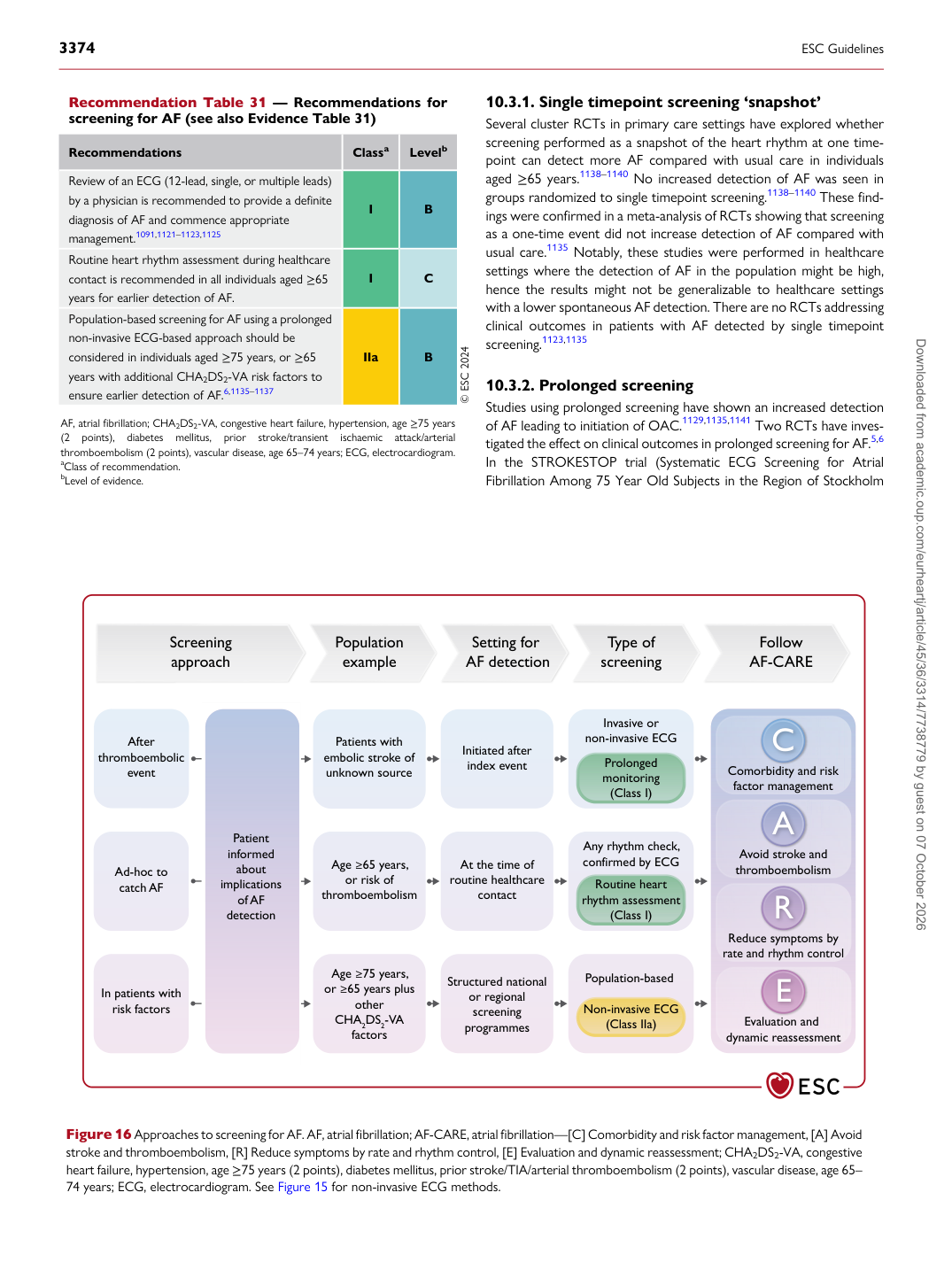
Figure 16 Approaches to screening for AF. AF, atrial fibrillation; AF-CARE, atrial fibrillation—[C] Comorbidity and risk factor management, [A] Avoid stroke and thromboembolism, [R] Reduce symptoms by rate and rhythm control, [E] Evaluation and dynamic reassessment; CHA2DS2-VA, congestive heart failure, hypertension, age ≥75 years (2 points), diabetes mellitus, prior stroke/TIA/arterial thromboembolism (2 points), vascular disease, age 65– 74 years; ECG, electrocardiogram. See Figure 15 for non-invasive ECG methods. Downloaded from academic.oup.com/eurheartj/article/45/36/3314/7738779 by guest on 07 October 2026