p.58 抽出テキスト
pre-excited AF, and atrioventricular node-modulating drugs should be avoided.985,986 Pharmacological cardioversion can be attempted using ibutilide987 or flecainide, while propafenone should be used with caution due to effects on the atrioventricular node.988,989 Amiodarone should be avoided in pre-excited AF due to its delayed action. Further details on inherited cardiomyopathies can be found in the 2023 ESC Guidelines for the management of cardiomyopathies.990

9.12 AF-CARE in cancer

All types of cancer show an increased risk of AF, with prevalence varying from 2% to 28%.991–995 The occurrence of AF may often be related to a pre-existing atrial substrate with vulnerability to AF. AF may be an indicator of an occult cancer, but also can appear in the context of concomitant surgery, chemotherapy, or radiotherapy.916,994,996 Risk of AF is dependent on, among other factors, the cancer type and stage,997 and is greater in older patients with pre-existing cardiovascular disease.991,993,994 Some procedures are associated with higher incidence of AF, including lung surgery (from 6% to 32%) and non-thoracic surgery such as a colectomy (4%–5%).994 Atrial fibrillation in the context of cancer is associated with a twofold higher risk of systemic thromboembolism and stroke, and six-fold increased risk of heart failure.991,994 On the other hand, the coexistence of cancer increases the risk of all-cause mortality and major bleeding in patients with AF.998 Bleeding in those receiving OAC can also unmask the presence of cancer.999 Stroke risk scores may underestimate thromboembolic risk in cancer patients.1000 The association between cancer, AF, and ischaemic stroke also differs between cancer types. In some types of cancer, the risk of bleeding seems to exceed the risk of thromboembolism.998 Risk stratification is therefore complex in this population, and should be performed on an individual basis considering cancer type, stage, prognosis, bleeding risk, and other risk factors. These aspects can change within a short period of time, requiring dynamic assessment and management. As with non-cancer patients, DOACs in those with cancer have similar efficacy and better safety compared with VKAs.1001–1010 Low molecular weight heparin is a short-term anticoagulation option, mostly during some cancer treatments, recent active bleeding, or thrombocytopaenia.1011 Decision-making on AF management, including on rhythm control, is best performed within a cardio-oncology multidisciplinary team.916,1012 Attention is required on interactions with cancer treatments, in particular QT-interval prolongation with AADs.

9.13 AF-CARE in older, multimorbid, or

frail patients Atrial fibrillation increases with age, and older patients more frequently have multimorbidity and frailty which are associated with worse clinical outcomes.1013–1016 Multimorbidity is the coexistence of two or more medically diagnosed diseases in the same individual. Frailty is defined as a person more vulnerable and less able to respond to a stressor or acute event, increasing the risk of adverse outcomes.1016,1017 The prevalence of frailty in AF varies due to different methods of assessment from 4.4% to 75.4%, and AF prevalence in the frail population ranges from 48.2% to 75.4%.1018 Frailty status is a strong independent risk factor for new-onset AF among older adults with hypertension.1019 Atrial fibrillation in frail patients is associated with less use of OAC and lower rates of management with a rhythm control strategy.1015,1018,1020 Oral anticoagulation initiation in older, frail multimorbid AF patients has improved since the introduction of DOACs, but is still lower in AF patients at older age (OR, 0.98 per year; 95% CI, 0.98–0.98), with dementia (OR, 0.57; 95% CI, 0.55–0.58), or frailty (OR, 0.74; 95% CI, 0.72–0.76).1021 The value of observational data which show potential benefit from OAC (in particular, DOACs) is limited due to prescription biases.1022–1027 Frail patients aged ≥75 years with polypharmacy and stable on a VKA may remain on the VKA rather than switching to a DOAC (Section 6.2).309

9.14 AF-CARE in atrial flutter

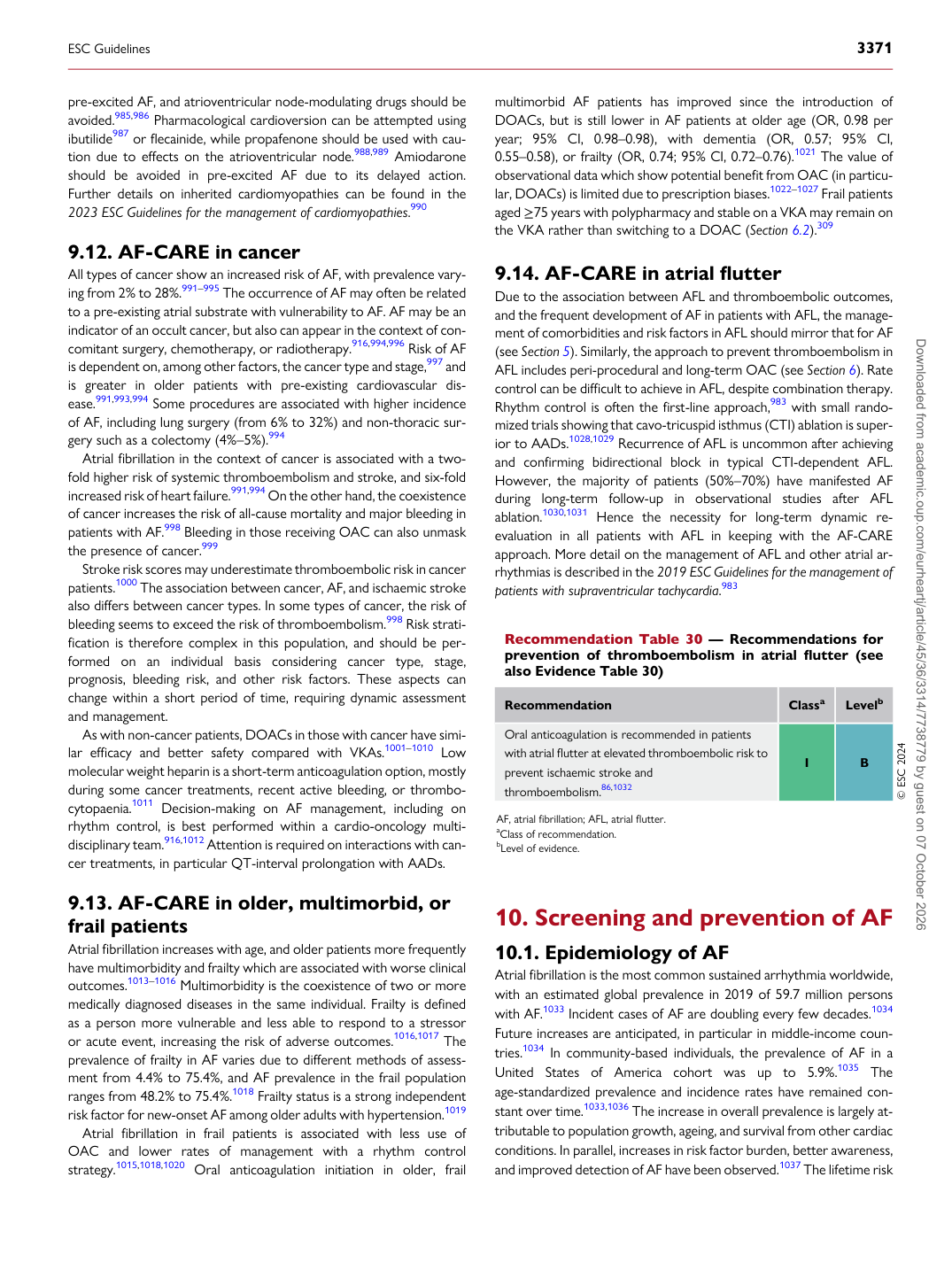
Due to the association between AFL and thromboembolic outcomes, and the frequent development of AF in patients with AFL, the management of comorbidities and risk factors in AFL should mirror that for AF (see Section 5). Similarly, the approach to prevent thromboembolism in AFL includes peri-procedural and long-term OAC (see Section 6). Rate control can be difficult to achieve in AFL, despite combination therapy. Rhythm control is often the first-line approach,983 with small randomized trials showing that cavo-tricuspid isthmus (CTI) ablation is superior to AADs.1028,1029 Recurrence of AFL is uncommon after achieving and confirming bidirectional block in typical CTI-dependent AFL. However, the majority of patients (50%–70%) have manifested AF during long-term follow-up in observational studies after AFL ablation.1030,1031 Hence the necessity for long-term dynamic reevaluation in all patients with AFL in keeping with the AF-CARE approach. More detail on the management of AFL and other atrial arrhythmias is described in the 2019 ESC Guidelines for the management of patients with supraventricular tachycardia.983

10 Screening and prevention of AF

10.1 Epidemiology of AF

Atrial fibrillation is the most common sustained arrhythmia worldwide, with an estimated global prevalence in 2019 of 59.7 million persons with AF.1033 Incident cases of AF are doubling every few decades.1034 Future increases are anticipated, in particular in middle-income countries.1034 In community-based individuals, the prevalence of AF in a United States of America cohort was up to 5.9%.1035 The age-standardized prevalence and incidence rates have remained constant over time.1033,1036 The increase in overall prevalence is largely attributable to population growth, ageing, and survival from other cardiac conditions. In parallel, increases in risk factor burden, better awareness, and improved detection of AF have been observed.1037 The lifetime risk

Recommendation Table 30 — Recommendations for prevention of thromboembolism in atrial flutter (see also Evidence Table 30)

Recommendation Classa Levelb

Oral anticoagulation is recommended in patients with atrial flutter at elevated thromboembolic risk to prevent ischaemic stroke and thromboembolism.86,1032 I B © ESC 2024

AF, atrial fibrillation; AFL, atrial flutter. aClass of recommendation. bLevel of evidence.

ESC Guidelines                                                                                                                                                                                          3371

Downloaded from academic.oup.com/eurheartj/article/45/36/3314/7738779 by guest on 07 October 2026