p.57 抽出テキスト
9.9 AF-CARE in congenital heart disease

Survival of patients with congenital heart disease has increased over time, but robust data on the management of AF are missing and available evidence is derived mainly from observational studies. Oral anticoagulants are recommended for all patients with AF and intracardiac repair, cyanotic congenital heart disease, Fontan palliation, or systemic right ventricle irrespective of the individuals’ thromboembolic risk factors.897 Patients with AF and other congenital heart diseases should follow the general risk stratification for OAC use in AF (i.e. depending on the thromboembolic risk or CHA2DS2-VA score). Direct oral anticoagulants are contraindicated in patients with mechanical heart valves,331 but appear safe in patients with congenital heart disease,898,899 or those with a valvular bioprosthesis.900,901 Rate control drugs such as selective beta-1 receptor blockers, verapamil, diltiazem, and digoxin can be used with caution, with monitoring for bradycardia and hypotension. Rhythm control strategies such as amiodarone may be effective, but warrant monitoring for bradycardia. When cardioversion is planned, both 3 weeks of OAC and TOE should be considered because thrombi are common in patients with congenital heart disease and atrial arrhythmias.902,903 Ablation approaches can be successful in patients with congenital heart disease, but AF recurrence rates may be high (see Supplementary data online, Additional Evidence Table S30). In patients with atrial septal defect, closure may be performed before the fourth decade of life to decrease the risk of AF or AFL.904 Patients with stroke who underwent closure of their PFO may have an increased risk of AF,905 but in patients with PFO and AF, PFO closure is not recommended for stroke prevention. AF surgery or catheter ablation can be considered at the time of closure of the atrial septal defect within a multidisciplinary team.906–908 AF catheter ablation of late atrial arrhythmias is likely to be effective after surgical atrial septal closure.909

9.10 AF-CARE in endocrine disorders

Endocrine dysfunction is closely related to AF, both as the direct action of endocrine hormones and as a consequence of treatments for endocrine disease. Optimal management of endocrine disorders is therefore part of the AF-CARE pathway.910,911 Clinical and subclinical hyperthyroidism, as well as subclinical hypothyroidism, are associated with an increased risk of AF.912,913 Patients presenting with new-onset or recurrent AF should be tested for thyroid-stimulating hormone (TSH) levels. The risk of AF is enhanced in vulnerable patients, including the elderly and those with structural atrial diseases,914,915 as well as cancer patients on immune checkpoint inhibitors.916,917 In hyperthyroidism, and even in the euthyroid range, the risk of AF increases according to the reduction in TSH and elevated levels of thyroxine.918,919 Moreover, the risk of stroke is higher in patients with hyperthyroidism, which can be mitigated by treating the thyroid disorder.920,921 Amiodarone induces thyroid dysfunction in 15%–20% of treated patients, leading to both hypo- and hyperthyroidism,922,923 which warrants referral to an endocrinologist (see Supplementary data online for further details).

Hypercalcaemia may also induce arrhythmias, but the role of primary hyperparathyroidism in incident AF is poorly studied. Surgical parathyroidectomy has been found to reduce both supraventricular and ventricular premature beats.924–926 Primary aldosteronism is related to an increased risk of AF through direct actions and vascular effects,927,928 with a three-fold higher rate of incident AF compared with patients with essential hypertension.929 Increases in genetically predicted plasma cortisol are associated with greater risk of AF, and patients with adrenal incidentalomas with subclinical cortisol secretion have a higher prevalence of AF.930,931 Acromegaly may predispose to an increased substrate for AF, with incident AF rates significantly higher than controls in long-term follow-up, even after adjusting for AF risk factors.932 The association between type 2 diabetes and AF is discussed in Sections 5.3 (AF recurrence) and Section 10.5 (incident AF). In addition to insulin-resistance mechanisms typical of type 2 diabetes, the loss of insulin signalling has recently been associated with electrical changes that can lead to AF. Type 1 diabetes is associated with an increased risk of several cardiovascular diseases including AF.933–937

9.11 AF-CARE in inherited

cardiomyopathies and primary arrhythmia syndromes A higher incidence and prevalence of AF have been described in patients with inherited cardiomyopathies and primary arrhythmia syndromes.271,938–970 AF can be the presenting or only clinically overt feature.969,971–975 AF in these patients is associated with adverse clinical outcomes,947,954,959,963,965,976–978 and has important implications on management (see Supplementary data online, Additional Evidence Table S31). When AF presents at a young age, there should be a careful interrogation about family history and a search for underlying disease.979 Rhythm control approaches may be challenging in patients with inherited cardiomyopathies and primary arrhythmia syndromes. For example, many drugs have a higher risk of adverse events or may be contraindicated (e.g. amiodarone and sotalol in congenital long QT syndrome, and Class IC AADs in Brugada syndrome) (see Supplementary Data online, Table S6). Owing to long-term adverse effects, chronic use of amiodarone is problematic in these typically young individuals. In patients with an implantable cardioverter defibrillator, AF is a common cause of inappropriate shocks.959,966,980,981 Programming a single high-rate ventricular fibrillation zone ≥210–220 b.p.m. with long detection time is safe,950,953,982 and is suggested in patients without documented slow monomorphic ventricular tachycardia. Implantation of an atrial lead may be considered in the case of significant bradycardia with beta-blocker treatment. Patients with Wolff–Parkinson–White syndrome and AF are at risk of fast ventricular rates from rapid conduction of atrial electrical activity to the ventricles via the accessory pathway, potentially leading to ventricular fibrillation and sudden death.983,984 Immediate electrical cardioversion is needed for haemodynamically compromised patients with

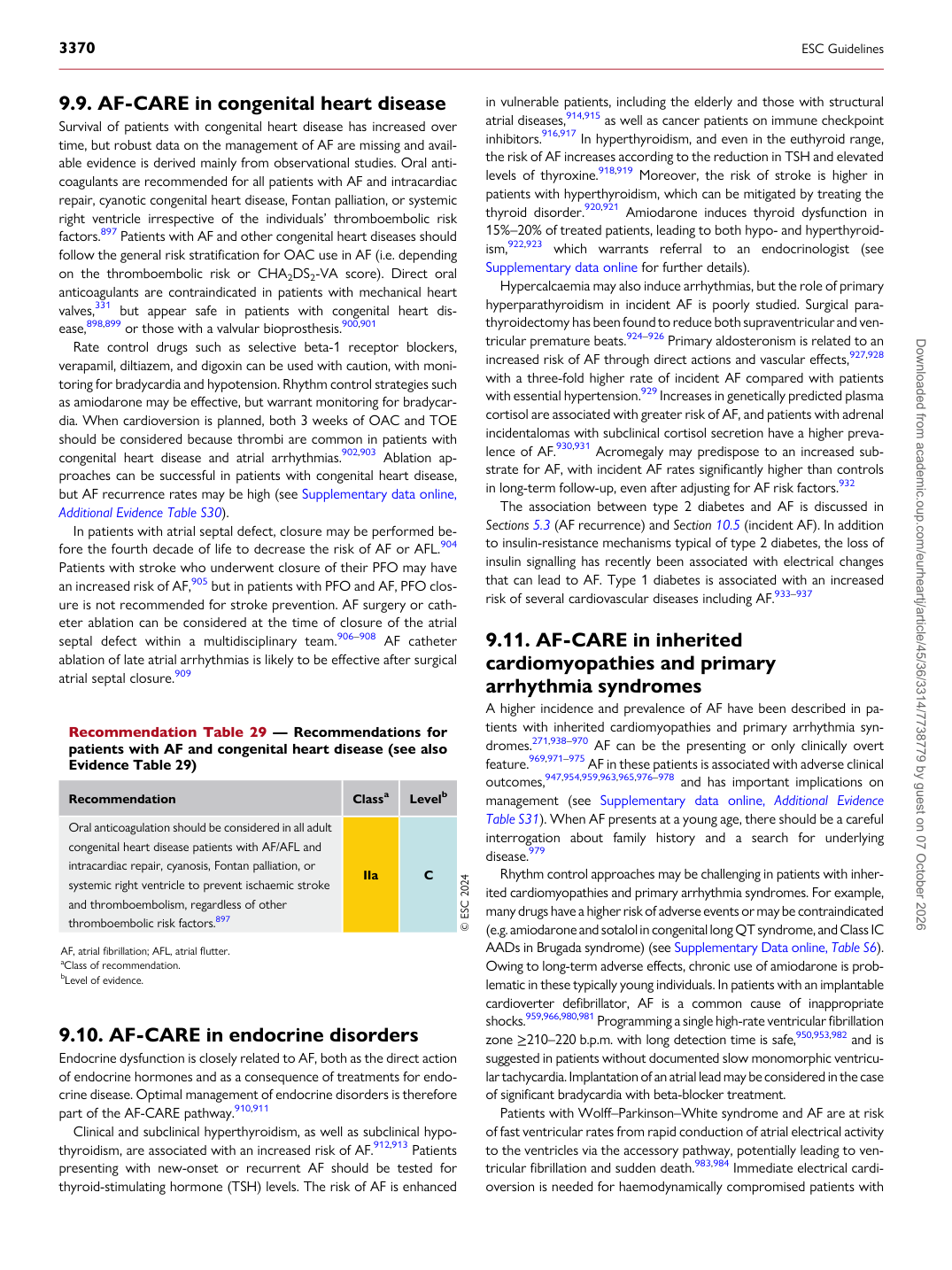
Recommendation Table 29 — Recommendations for patients with AF and congenital heart disease (see also Evidence Table 29)

Recommendation Classa Levelb

Oral anticoagulation should be considered in all adult congenital heart disease patients with AF/AFL and intracardiac repair, cyanosis, Fontan palliation, or systemic right ventricle to prevent ischaemic stroke and thromboembolism, regardless of other thromboembolic risk factors.897 IIa C © ESC 2024

AF, atrial fibrillation; AFL, atrial flutter. aClass of recommendation. bLevel of evidence. Downloaded from academic.oup.com/eurheartj/article/45/36/3314/7738779 by guest on 07 October 2026