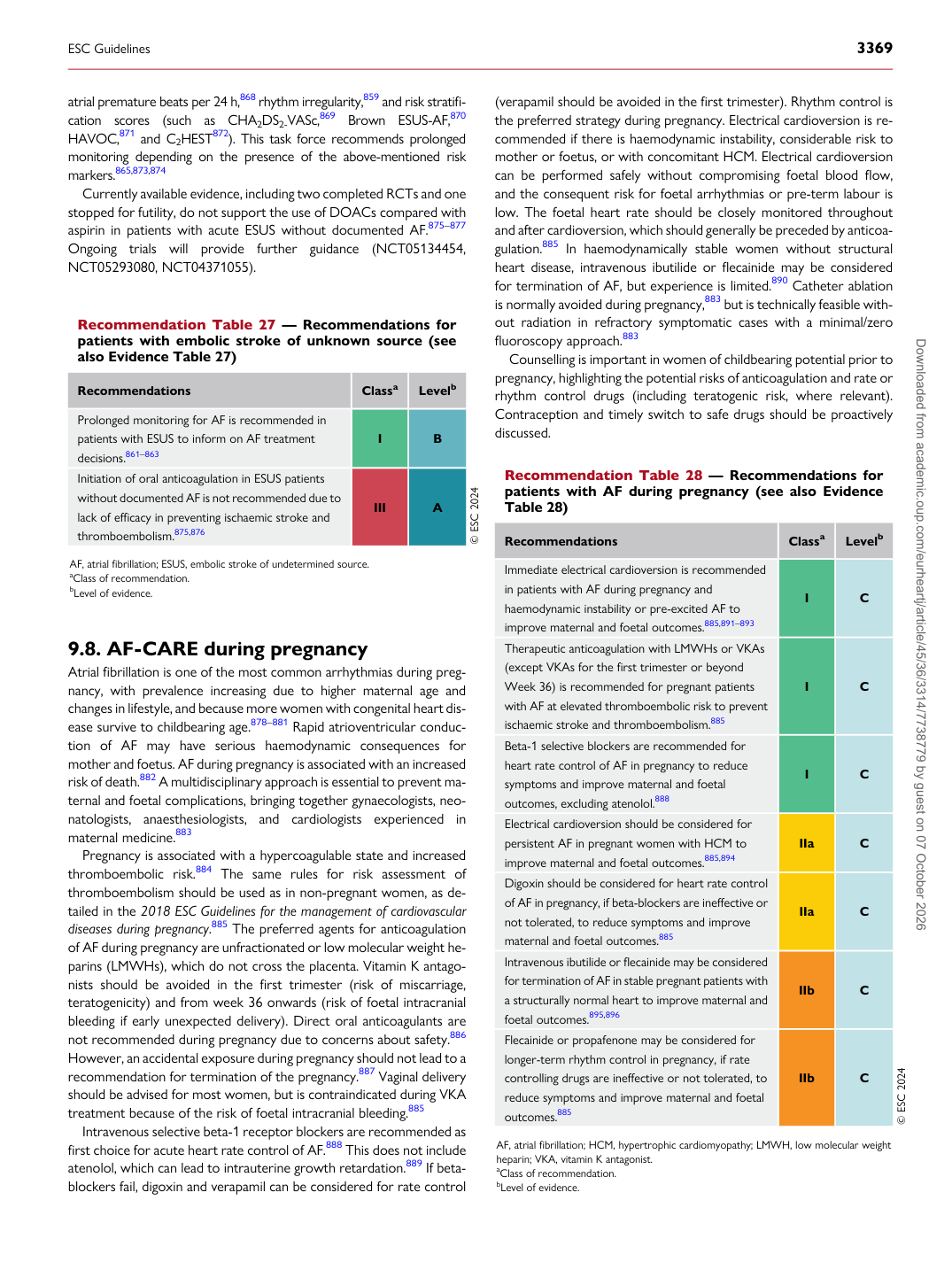
p.56 抽出テキスト
atrial premature beats per 24 h,868 rhythm irregularity,859 and risk stratification scores (such as CHA2DS2-VASc,869 Brown ESUS-AF,870 HAVOC,871 and C2HEST872). This task force recommends prolonged monitoring depending on the presence of the above-mentioned risk markers.865,873,874 Currently available evidence, including two completed RCTs and one stopped for futility, do not support the use of DOACs compared with aspirin in patients with acute ESUS without documented AF.875–877 Ongoing trials will provide further guidance (NCT05134454, NCT05293080, NCT04371055).

9.8 AF-CARE during pregnancy

Atrial fibrillation is one of the most common arrhythmias during pregnancy, with prevalence increasing due to higher maternal age and changes in lifestyle, and because more women with congenital heart disease survive to childbearing age.878–881 Rapid atrioventricular conduction of AF may have serious haemodynamic consequences for mother and foetus. AF during pregnancy is associated with an increased risk of death.882 A multidisciplinary approach is essential to prevent maternal and foetal complications, bringing together gynaecologists, neonatologists, anaesthesiologists, and cardiologists experienced in maternal medicine.883 Pregnancy is associated with a hypercoagulable state and increased thromboembolic risk.884 The same rules for risk assessment of thromboembolism should be used as in non-pregnant women, as detailed in the 2018 ESC Guidelines for the management of cardiovascular diseases during pregnancy.885 The preferred agents for anticoagulation of AF during pregnancy are unfractionated or low molecular weight heparins (LMWHs), which do not cross the placenta. Vitamin K antagonists should be avoided in the first trimester (risk of miscarriage, teratogenicity) and from week 36 onwards (risk of foetal intracranial bleeding if early unexpected delivery). Direct oral anticoagulants are not recommended during pregnancy due to concerns about safety.886 However, an accidental exposure during pregnancy should not lead to a recommendation for termination of the pregnancy.887 Vaginal delivery should be advised for most women, but is contraindicated during VKA treatment because of the risk of foetal intracranial bleeding.885 Intravenous selective beta-1 receptor blockers are recommended as first choice for acute heart rate control of AF.888 This does not include atenolol, which can lead to intrauterine growth retardation.889 If betablockers fail, digoxin and verapamil can be considered for rate control (verapamil should be avoided in the first trimester). Rhythm control is the preferred strategy during pregnancy. Electrical cardioversion is recommended if there is haemodynamic instability, considerable risk to mother or foetus, or with concomitant HCM. Electrical cardioversion can be performed safely without compromising foetal blood flow, and the consequent risk for foetal arrhythmias or pre-term labour is low. The foetal heart rate should be closely monitored throughout and after cardioversion, which should generally be preceded by anticoagulation.885 In haemodynamically stable women without structural heart disease, intravenous ibutilide or flecainide may be considered for termination of AF, but experience is limited.890 Catheter ablation is normally avoided during pregnancy,883 but is technically feasible without radiation in refractory symptomatic cases with a minimal/zero fluoroscopy approach.883

Counselling is important in women of childbearing potential prior to pregnancy, highlighting the potential risks of anticoagulation and rate or rhythm control drugs (including teratogenic risk, where relevant). Contraception and timely switch to safe drugs should be proactively discussed.

Recommendation Table 27 — Recommendations for patients with embolic stroke of unknown source (see also Evidence Table 27)

Recommendations Classa Levelb

Prolonged monitoring for AF is recommended in patients with ESUS to inform on AF treatment decisions.861–863 I B Initiation of oral anticoagulation in ESUS patients without documented AF is not recommended due to lack of efficacy in preventing ischaemic stroke and thromboembolism.875,876 III A © ESC 2024

AF, atrial fibrillation; ESUS, embolic stroke of undetermined source. aClass of recommendation. bLevel of evidence. Recommendation Table 28 — Recommendations for patients with AF during pregnancy (see also Evidence Table 28)

Recommendations Classa Levelb

Immediate electrical cardioversion is recommended in patients with AF during pregnancy and haemodynamic instability or pre-excited AF to improve maternal and foetal outcomes.885,891–893 I C Therapeutic anticoagulation with LMWHs or VKAs (except VKAs for the first trimester or beyond Week 36) is recommended for pregnant patients with AF at elevated thromboembolic risk to prevent ischaemic stroke and thromboembolism.885 I C Beta-1 selective blockers are recommended for heart rate control of AF in pregnancy to reduce symptoms and improve maternal and foetal outcomes, excluding atenolol.888 I C Electrical cardioversion should be considered for persistent AF in pregnant women with HCM to improve maternal and foetal outcomes.885,894 IIa C Digoxin should be considered for heart rate control of AF in pregnancy, if beta-blockers are ineffective or not tolerated, to reduce symptoms and improve maternal and foetal outcomes.885 IIa C Intravenous ibutilide or flecainide may be considered for termination of AF in stable pregnant patients with a structurally normal heart to improve maternal and foetal outcomes.895,896 IIb C Flecainide or propafenone may be considered for longer-term rhythm control in pregnancy, if rate controlling drugs are ineffective or not tolerated, to reduce symptoms and improve maternal and foetal outcomes.885 IIb C © ESC 2024

AF, atrial fibrillation; HCM, hypertrophic cardiomyopathy; LMWH, low molecular weight heparin; VKA, vitamin K antagonist. aClass of recommendation. bLevel of evidence.

ESC Guidelines                                                                                                                                                                                          3369

Downloaded from academic.oup.com/eurheartj/article/45/36/3314/7738779 by guest on 07 October 2026