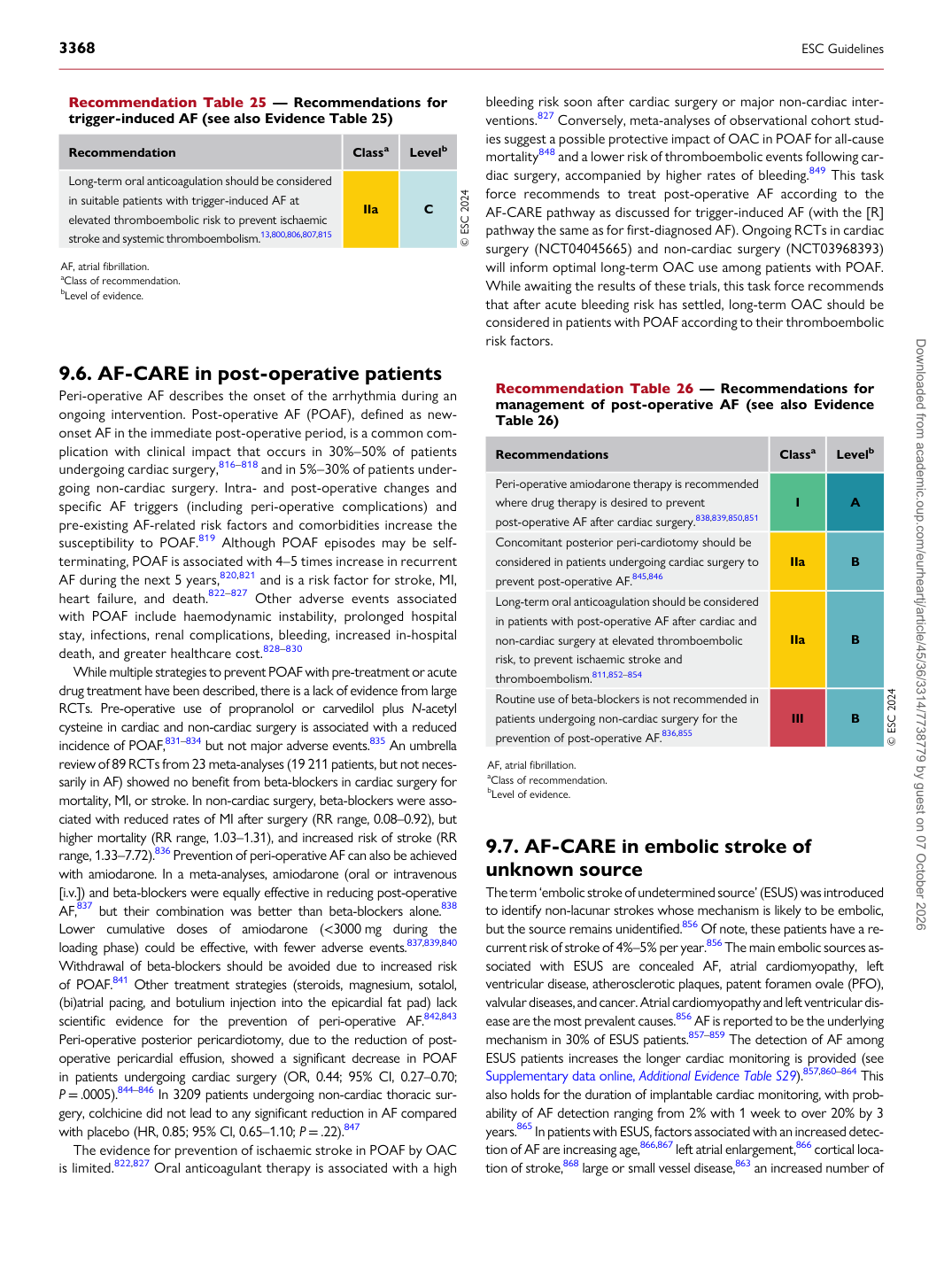
p.55 抽出テキスト
9.6 AF-CARE in post-operative patients

Peri-operative AF describes the onset of the arrhythmia during an ongoing intervention. Post-operative AF (POAF), defined as newonset AF in the immediate post-operative period, is a common complication with clinical impact that occurs in 30%–50% of patients undergoing cardiac surgery,816–818 and in 5%–30% of patients undergoing non-cardiac surgery. Intra- and post-operative changes and specific AF triggers (including peri-operative complications) and pre-existing AF-related risk factors and comorbidities increase the susceptibility to POAF.819 Although POAF episodes may be selfterminating, POAF is associated with 4–5 times increase in recurrent AF during the next 5 years,820,821 and is a risk factor for stroke, MI, heart failure, and death.822–827 Other adverse events associated with POAF include haemodynamic instability, prolonged hospital stay, infections, renal complications, bleeding, increased in-hospital death, and greater healthcare cost.828–830 While multiple strategies to prevent POAF with pre-treatment or acute drug treatment have been described, there is a lack of evidence from large RCTs. Pre-operative use of propranolol or carvedilol plus N-acetyl cysteine in cardiac and non-cardiac surgery is associated with a reduced incidence of POAF,831–834 but not major adverse events.835 An umbrella review of 89 RCTs from 23 meta-analyses (19 211 patients, but not necessarily in AF) showed no benefit from beta-blockers in cardiac surgery for mortality, MI, or stroke. In non-cardiac surgery, beta-blockers were associated with reduced rates of MI after surgery (RR range, 0.08–0.92), but higher mortality (RR range, 1.03–1.31), and increased risk of stroke (RR range, 1.33–7.72).836 Prevention of peri-operative AF can also be achieved with amiodarone. In a meta-analyses, amiodarone (oral or intravenous [i.v.]) and beta-blockers were equally effective in reducing post-operative AF,837 but their combination was better than beta-blockers alone.838 Lower cumulative doses of amiodarone (<3000 mg during the loading phase) could be effective, with fewer adverse events.837,839,840 Withdrawal of beta-blockers should be avoided due to increased risk of POAF.841 Other treatment strategies (steroids, magnesium, sotalol, (bi)atrial pacing, and botulium injection into the epicardial fat pad) lack scientific evidence for the prevention of peri-operative AF.842,843 Peri-operative posterior pericardiotomy, due to the reduction of postoperative pericardial effusion, showed a significant decrease in POAF in patients undergoing cardiac surgery (OR, 0.44; 95% CI, 0.27–0.70; P = .0005).844–846 In 3209 patients undergoing non-cardiac thoracic surgery, colchicine did not lead to any significant reduction in AF compared with placebo (HR, 0.85; 95% CI, 0.65–1.10; P = .22).847 The evidence for prevention of ischaemic stroke in POAF by OAC is limited.822,827 Oral anticoagulant therapy is associated with a high bleeding risk soon after cardiac surgery or major non-cardiac interventions.827 Conversely, meta-analyses of observational cohort studies suggest a possible protective impact of OAC in POAF for all-cause mortality848 and a lower risk of thromboembolic events following cardiac surgery, accompanied by higher rates of bleeding.849 This task force recommends to treat post-operative AF according to the AF-CARE pathway as discussed for trigger-induced AF (with the [R] pathway the same as for first-diagnosed AF). Ongoing RCTs in cardiac surgery (NCT04045665) and non-cardiac surgery (NCT03968393) will inform optimal long-term OAC use among patients with POAF. While awaiting the results of these trials, this task force recommends that after acute bleeding risk has settled, long-term OAC should be considered in patients with POAF according to their thromboembolic risk factors.

9.7 AF-CARE in embolic stroke of

unknown source The term ‘embolic stroke of undetermined source’ (ESUS) was introduced to identify non-lacunar strokes whose mechanism is likely to be embolic, but the source remains unidentified.856 Of note, these patients have a recurrent risk of stroke of 4%–5% per year.856 The main embolic sources associated with ESUS are concealed AF, atrial cardiomyopathy, left ventricular disease, atherosclerotic plaques, patent foramen ovale (PFO), valvular diseases, and cancer. Atrial cardiomyopathy and left ventricular disease are the most prevalent causes.856 AF is reported to be the underlying mechanism in 30% of ESUS patients.857–859 The detection of AF among ESUS patients increases the longer cardiac monitoring is provided (see Supplementary data online, Additional Evidence Table S29).857,860–864 This also holds for the duration of implantable cardiac monitoring, with probability of AF detection ranging from 2% with 1 week to over 20% by 3 years.865 In patients with ESUS, factors associated with an increased detection of AF are increasing age,866,867 left atrial enlargement,866 cortical location of stroke,868 large or small vessel disease,863 an increased number of

Recommendation Table 26 — Recommendations for management of post-operative AF (see also Evidence Table 26)

Recommendations Classa Levelb

Peri-operative amiodarone therapy is recommended where drug therapy is desired to prevent post-operative AF after cardiac surgery.838,839,850,851 I A Concomitant posterior peri-cardiotomy should be considered in patients undergoing cardiac surgery to prevent post-operative AF.845,846 IIa B Long-term oral anticoagulation should be considered in patients with post-operative AF after cardiac and non-cardiac surgery at elevated thromboembolic risk, to prevent ischaemic stroke and thromboembolism.811,852–854 IIa B Routine use of beta-blockers is not recommended in patients undergoing non-cardiac surgery for the prevention of post-operative AF.836,855 III B © ESC 2024

AF, atrial fibrillation. aClass of recommendation. bLevel of evidence.

Recommendation Table 25 — Recommendations for trigger-induced AF (see also Evidence Table 25)

Recommendation Classa Levelb

Long-term oral anticoagulation should be considered in suitable patients with trigger-induced AF at elevated thromboembolic risk to prevent ischaemic stroke and systemic thromboembolism.13,800,806,807,815 IIa C © ESC 2024

AF, atrial fibrillation. aClass of recommendation. bLevel of evidence.

Downloaded from academic.oup.com/eurheartj/article/45/36/3314/7738779 by guest on 07 October 2026