p.54 抽出テキスト
9.4.2 Introduction or re-introduction of

anticoagulation after ischaemic stroke The optimal time for administering OAC in patients with acute cardioembolic stroke and AF remains unclear. Randomized control trials have been unable to provide any evidence to support the administration of anticoagulants or heparin in patients with acute ischaemic stroke within 48 h from stroke onset. This suggests that low-dose aspirin should be administered to all patients during this timeframe.794 Two trials have examined the use of DOAC therapy early after stroke, with no difference in clinical outcomes compared with delayed DOAC prescription. The ELAN (Early versus Late initiation of direct oral Anticoagulants in post-ischaemic stroke patients with atrial fibrillatioN) trial randomized 2013 patients with acute ischaemic stroke and AF to open-label early use of DOACs (<48 h after minor/moderate stroke; day 6–7 after major stroke) vs. later DOAC prescription (day 3–4 after minor stroke; day 6–7 after moderate stroke; day 12–14 after major stroke). There was no significant difference in the composite thromboembolic, bleeding, and vascular death outcome at 30 days (risk difference early vs. late, −1.18%; 95% CI, −2.84 to 0.47).795 The TIMING (Timing of Oral Anticoagulant Therapy in Acute Ischemic Stroke With Atrial Fibrillation) trial, a registry-based, non-inferiority, open-label, blinded endpoint trial randomized 888 patients within 72 h of ischaemic stroke onset to early (≤4 days) or delayed (5–10 days) DOAC initiation. Early DOAC use was non-inferior to the delayed strategy for the composite of thromboembolism, bleeding and all-cause mortality at 90 days (risk difference, −1.79%; 95% CI, −5.31% to 1.74%).796 Two ongoing trials will provide further guidance on the most appropriate timing of DOAC therapy after ischaemic stroke (NCT03759938, NCT03021928).

9.4.3 Introduction or re-introduction of

anticoagulation after haemorrhagic stroke There is insufficient evidence currently to recommend whether OAC should be started or re-started after ICH to protect against the high risk of ischaemic stroke in these patients (see Supplementary data online, Additional Evidence Table S28). Data from two pilot trials are available. The APACHE-AF (Apixaban After Anticoagulation-associated Intracerebral Haemorrhage in Patients With Atrial Fibrillation) trial was a prospective, randomized, open-label trial with masked endpoint assessment; 101 patients who survived 7–90 days after anticoagulationassociated ICH were randomized to apixaban or no OAC. During a median of 1.9 years follow-up (222 person-years), there was no difference in non-fatal stroke or vascular death, with an annual event rate of 12.6% with apixaban and 11.9% with no OAC (adjusted HR, 1.05; 95% CI, 0.48–2.31; P = .90).797 SoSTART (Start or STop Anticoagulants Randomised Trial) was an open-label RCT in 203 patients with AF after symptomatic spontaneous ICH. Starting OAC was not non-inferior to avoiding long-term (≥1 year) OAC, with ICH recurrence in 8/101 (8%) vs. 4/102 (4%) patients (adjusted HR, 2.42; 95% CI, 0.72–8.09). Mortality occurred in 22/101 (22%) patients in the OAC group vs. 11/102 (11%) patients where OAC were avoided.798 Until additional trials report on the clinical challenge of post-ICH anticoagulation (NCT03950076, NCT03996772), an individualized multidisciplinary approach is advised led by an expert neurology team.

9.5 AF-CARE for trigger-induced AF

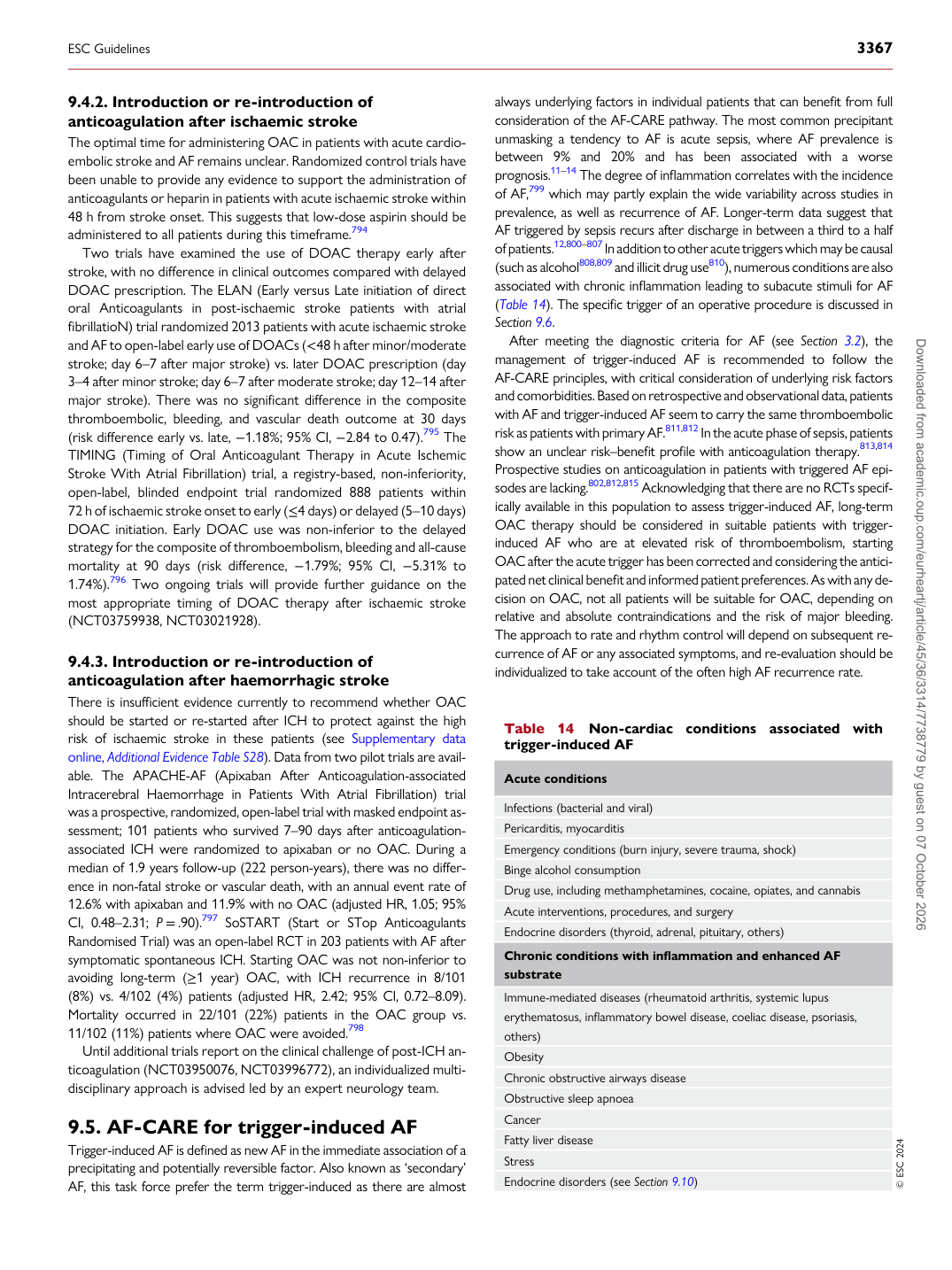
Trigger-induced AF is defined as new AF in the immediate association of a precipitating and potentially reversible factor. Also known as ‘secondary’ AF, this task force prefer the term trigger-induced as there are almost always underlying factors in individual patients that can benefit from full consideration of the AF-CARE pathway. The most common precipitant unmasking a tendency to AF is acute sepsis, where AF prevalence is between 9% and 20% and has been associated with a worse prognosis.11–14 The degree of inflammation correlates with the incidence of AF,799 which may partly explain the wide variability across studies in prevalence, as well as recurrence of AF. Longer-term data suggest that AF triggered by sepsis recurs after discharge in between a third to a half of patients.12,800–807 In addition to other acute triggers which may be causal (such as alcohol808,809 and illicit drug use810), numerous conditions are also associated with chronic inflammation leading to subacute stimuli for AF (Table 14). The specific trigger of an operative procedure is discussed in Section 9.6.

After meeting the diagnostic criteria for AF (see Section 3.2), the management of trigger-induced AF is recommended to follow the AF-CARE principles, with critical consideration of underlying risk factors and comorbidities. Based on retrospective and observational data, patients with AF and trigger-induced AF seem to carry the same thromboembolic risk as patients with primary AF.811,812 In the acute phase of sepsis, patients show an unclear risk–benefit profile with anticoagulation therapy.813,814 Prospective studies on anticoagulation in patients with triggered AF episodes are lacking.802,812,815 Acknowledging that there are no RCTs specifically available in this population to assess trigger-induced AF, long-term OAC therapy should be considered in suitable patients with triggerinduced AF who are at elevated risk of thromboembolism, starting OAC after the acute trigger has been corrected and considering the anticipated net clinical benefit and informed patient preferences. As with any decision on OAC, not all patients will be suitable for OAC, depending on relative and absolute contraindications and the risk of major bleeding. The approach to rate and rhythm control will depend on subsequent recurrence of AF or any associated symptoms, and re-evaluation should be individualized to take account of the often high AF recurrence rate.

Table 14 Non-cardiac conditions associated with trigger-induced AF

Acute conditions

Infections (bacterial and viral) Pericarditis, myocarditis Emergency conditions (burn injury, severe trauma, shock) Binge alcohol consumption Drug use, including methamphetamines, cocaine, opiates, and cannabis Acute interventions, procedures, and surgery Endocrine disorders (thyroid, adrenal, pituitary, others) Chronic conditions with inflammation and enhanced AF substrate Immune-mediated diseases (rheumatoid arthritis, systemic lupus erythematosus, inflammatory bowel disease, coeliac disease, psoriasis, others) Obesity Chronic obstructive airways disease Obstructive sleep apnoea Cancer Fatty liver disease Stress Endocrine disorders (see Section 9.10) © ESC 2024

ESC Guidelines                                                                                                                                                                                          3367

Downloaded from academic.oup.com/eurheartj/article/45/36/3314/7738779 by guest on 07 October 2026