p.53 抽出テキスト
The evidence for ACS treated without revascularization is limited. Six to 12 months of a single antiplatelet agent in addition to a long-term DOAC is usually sufficient and can minimize bleeding risk.760,764,774 Although there are no head-to-head comparisons between aspirin and clopidogrel, studies have typically used clopidogrel. In patients with stable CCS for more than 12 months, sole therapy with a DOAC is sufficient and no additional antiplatelet therapy is required.353 In patients at potential risk of gastrointestinal bleeding, use of proton pump inhibitors is reasonable during combined antithrombotic therapy, although evidence in AF patients is limited.437,777–779 Multimorbid patients with ACS or CCS need careful assessment of ischaemic risk and management of modifiable bleeding risk factors, with a comprehensive work-up to individually adapt antithrombotic therapy.

9.3 AF-CARE in vascular disease

Peripheral arterial disease (PAD) is common in patients with AF, ranging from 6.7% to 14% of patients.783,784 Manifest PAD is associated with incident AF.785 PAD predicts a higher mortality in patients with AF and is an independent predictor of stroke in those not on OAC.783,786 Patients with lower extremity artery disease and AF also have a higher overall mortality and risk of major cardiac events.784,787,788 A public health database of >40 000 patients hospitalized for PAD or critical limb ischaemia showed AF to be an independent predictor for mortality (HR, 1.46; 95% CI, 1.39–1.52) and ischaemic stroke (HR, 1.63; 95% CI, 1.44–1.85) as compared with propensity-matched controls.784 Similarly, in patients undergoing carotid endarterectomy or stenting, the presence of AF is associated with higher mortality (OR, 1.59; 95% CI, 1.11–2.26).789 Anticoagulation alone is usually sufficient in the chronic disease phase, with DOACs being the preferred agents despite one RCT subanalysis showing a higher risk of bleeding as compared with warfarin.790 In the case of recent endovascular revascularization, a period of combination with single antiplatelet therapy should be considered, weighing bleeding and thrombotic risks and keeping the period of combination antithrombotic therapy as brief as possible (ranging between 1 month for peripheral791 and 90 days for neuro-interventional procedures).792

9.4 AF-CARE in acute stroke or

intracranial haemorrhage 9.4.1. Management of acute ischaemic stroke Management of acute stroke in patients with AF is beyond the scope of these guidelines. In AF patients presenting with acute ischaemic stroke while taking OAC, acute therapy depends on the treatment regimen and intensity of OAC. Management should be co-ordinated by a specialist neurologist team according to relevant guidelines.793

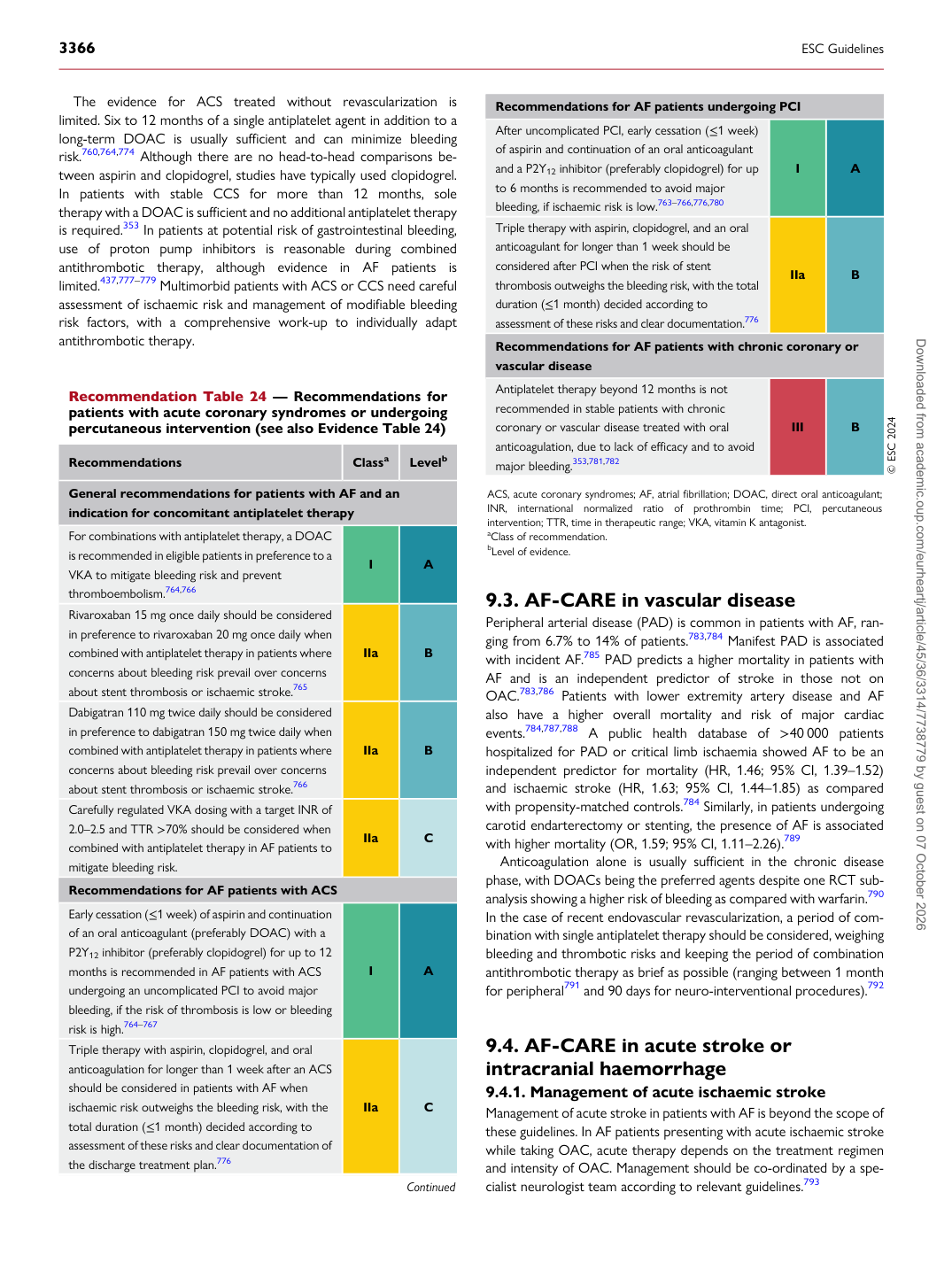
Recommendation Table 24 — Recommendations for patients with acute coronary syndromes or undergoing percutaneous intervention (see also Evidence Table 24)

Recommendations Classa Levelb

General recommendations for patients with AF and an indication for concomitant antiplatelet therapy For combinations with antiplatelet therapy, a DOAC is recommended in eligible patients in preference to a VKA to mitigate bleeding risk and prevent thromboembolism.764,766 I A Rivaroxaban 15 mg once daily should be considered in preference to rivaroxaban 20 mg once daily when combined with antiplatelet therapy in patients where concerns about bleeding risk prevail over concerns about stent thrombosis or ischaemic stroke.765 IIa B Dabigatran 110 mg twice daily should be considered in preference to dabigatran 150 mg twice daily when combined with antiplatelet therapy in patients where concerns about bleeding risk prevail over concerns about stent thrombosis or ischaemic stroke.766 IIa B Carefully regulated VKA dosing with a target INR of 2.0–2.5 and TTR >70% should be considered when combined with antiplatelet therapy in AF patients to mitigate bleeding risk. IIa C Recommendations for AF patients with ACS Early cessation (≤1 week) of aspirin and continuation of an oral anticoagulant (preferably DOAC) with a P2Y12 inhibitor (preferably clopidogrel) for up to 12 months is recommended in AF patients with ACS undergoing an uncomplicated PCI to avoid major bleeding, if the risk of thrombosis is low or bleeding risk is high.764–767 I A Triple therapy with aspirin, clopidogrel, and oral anticoagulation for longer than 1 week after an ACS should be considered in patients with AF when ischaemic risk outweighs the bleeding risk, with the total duration (≤1 month) decided according to assessment of these risks and clear documentation of the discharge treatment plan.776 IIa C

Continued Recommendations for AF patients undergoing PCI

After uncomplicated PCI, early cessation (≤1 week) of aspirin and continuation of an oral anticoagulant and a P2Y12 inhibitor (preferably clopidogrel) for up to 6 months is recommended to avoid major bleeding, if ischaemic risk is low.763–766,776,780 I A Triple therapy with aspirin, clopidogrel, and an oral anticoagulant for longer than 1 week should be considered after PCI when the risk of stent thrombosis outweighs the bleeding risk, with the total duration (≤1 month) decided according to assessment of these risks and clear documentation.776 IIa B Recommendations for AF patients with chronic coronary or vascular disease Antiplatelet therapy beyond 12 months is not recommended in stable patients with chronic coronary or vascular disease treated with oral anticoagulation, due to lack of efficacy and to avoid major bleeding.353,781,782 III B © ESC 2024

ACS, acute coronary syndromes; AF, atrial fibrillation; DOAC, direct oral anticoagulant; INR, international normalized ratio of prothrombin time; PCI, percutaneous intervention; TTR, time in therapeutic range; VKA, vitamin K antagonist. aClass of recommendation. bLevel of evidence. Downloaded from academic.oup.com/eurheartj/article/45/36/3314/7738779 by guest on 07 October 2026