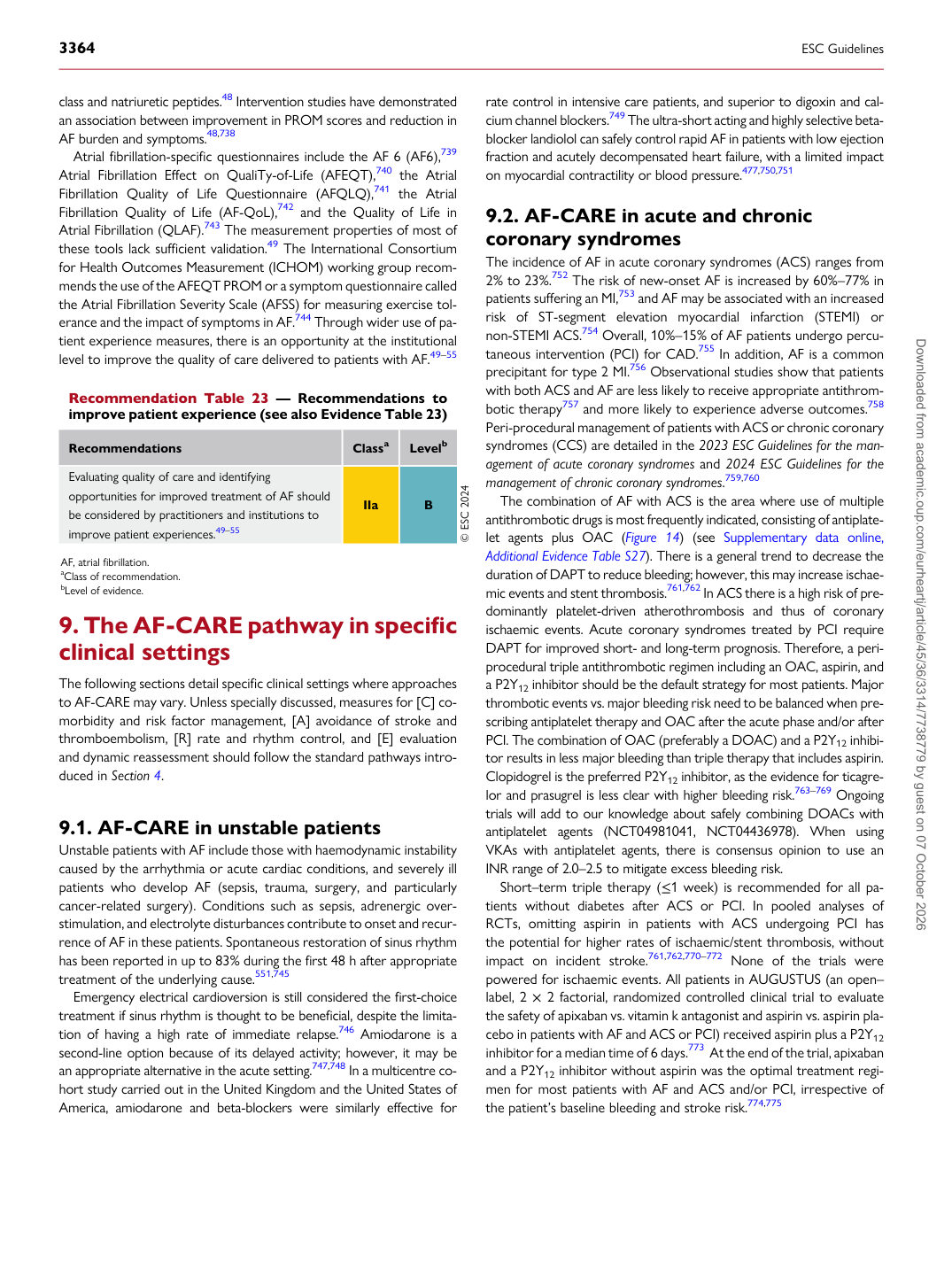
p.51 抽出テキスト
class and natriuretic peptides.48 Intervention studies have demonstrated an association between improvement in PROM scores and reduction in AF burden and symptoms.48,738

Atrial fibrillation-specific questionnaires include the AF 6 (AF6),739 Atrial Fibrillation Effect on QualiTy-of-Life (AFEQT),740 the Atrial Fibrillation Quality of Life Questionnaire (AFQLQ),741 the Atrial Fibrillation Quality of Life (AF-QoL),742 and the Quality of Life in Atrial Fibrillation (QLAF).743 The measurement properties of most of these tools lack sufficient validation.49 The International Consortium for Health Outcomes Measurement (ICHOM) working group recommends the use of the AFEQT PROM or a symptom questionnaire called the Atrial Fibrillation Severity Scale (AFSS) for measuring exercise tolerance and the impact of symptoms in AF.744 Through wider use of patient experience measures, there is an opportunity at the institutional level to improve the quality of care delivered to patients with AF.49–55

9 The AF-CARE pathway in specific

clinical settings

The following sections detail specific clinical settings where approaches to AF-CARE may vary. Unless specially discussed, measures for [C] comorbidity and risk factor management, [A] avoidance of stroke and thromboembolism, [R] rate and rhythm control, and [E] evaluation and dynamic reassessment should follow the standard pathways introduced in Section 4.

9.1 AF-CARE in unstable patients

Unstable patients with AF include those with haemodynamic instability caused by the arrhythmia or acute cardiac conditions, and severely ill patients who develop AF (sepsis, trauma, surgery, and particularly cancer-related surgery). Conditions such as sepsis, adrenergic overstimulation, and electrolyte disturbances contribute to onset and recurrence of AF in these patients. Spontaneous restoration of sinus rhythm has been reported in up to 83% during the first 48 h after appropriate treatment of the underlying cause.551,745 Emergency electrical cardioversion is still considered the first-choice treatment if sinus rhythm is thought to be beneficial, despite the limitation of having a high rate of immediate relapse.746 Amiodarone is a second-line option because of its delayed activity; however, it may be an appropriate alternative in the acute setting.747,748 In a multicentre cohort study carried out in the United Kingdom and the United States of America, amiodarone and beta-blockers were similarly effective for rate control in intensive care patients, and superior to digoxin and calcium channel blockers.749 The ultra-short acting and highly selective betablocker landiolol can safely control rapid AF in patients with low ejection fraction and acutely decompensated heart failure, with a limited impact on myocardial contractility or blood pressure.477,750,751

9.2 AF-CARE in acute and chronic

coronary syndromes The incidence of AF in acute coronary syndromes (ACS) ranges from 2% to 23%.752 The risk of new-onset AF is increased by 60%–77% in patients suffering an MI,753 and AF may be associated with an increased risk of ST-segment elevation myocardial infarction (STEMI) or non-STEMI ACS.754 Overall, 10%–15% of AF patients undergo percutaneous intervention (PCI) for CAD.755 In addition, AF is a common precipitant for type 2 MI.756 Observational studies show that patients with both ACS and AF are less likely to receive appropriate antithrombotic therapy757 and more likely to experience adverse outcomes.758 Peri-procedural management of patients with ACS or chronic coronary syndromes (CCS) are detailed in the 2023 ESC Guidelines for the management of acute coronary syndromes and 2024 ESC Guidelines for the management of chronic coronary syndromes.759,760 The combination of AF with ACS is the area where use of multiple antithrombotic drugs is most frequently indicated, consisting of antiplatelet agents plus OAC (Figure 14) (see Supplementary data online, Additional Evidence Table S27). There is a general trend to decrease the duration of DAPT to reduce bleeding; however, this may increase ischaemic events and stent thrombosis.761,762 In ACS there is a high risk of predominantly platelet-driven atherothrombosis and thus of coronary ischaemic events. Acute coronary syndromes treated by PCI require DAPT for improved short- and long-term prognosis. Therefore, a periprocedural triple antithrombotic regimen including an OAC, aspirin, and a P2Y12 inhibitor should be the default strategy for most patients. Major thrombotic events vs. major bleeding risk need to be balanced when prescribing antiplatelet therapy and OAC after the acute phase and/or after PCI. The combination of OAC (preferably a DOAC) and a P2Y12 inhibitor results in less major bleeding than triple therapy that includes aspirin. Clopidogrel is the preferred P2Y12 inhibitor, as the evidence for ticagrelor and prasugrel is less clear with higher bleeding risk.763–769 Ongoing trials will add to our knowledge about safely combining DOACs with antiplatelet agents (NCT04981041, NCT04436978). When using VKAs with antiplatelet agents, there is consensus opinion to use an INR range of 2.0–2.5 to mitigate excess bleeding risk. Short–term triple therapy (≤1 week) is recommended for all patients without diabetes after ACS or PCI. In pooled analyses of RCTs, omitting aspirin in patients with ACS undergoing PCI has the potential for higher rates of ischaemic/stent thrombosis, without impact on incident stroke.761,762,770–772 None of the trials were powered for ischaemic events. All patients in AUGUSTUS (an open– label, 2 × 2 factorial, randomized controlled clinical trial to evaluate the safety of apixaban vs. vitamin k antagonist and aspirin vs. aspirin placebo in patients with AF and ACS or PCI) received aspirin plus a P2Y12 inhibitor for a median time of 6 days.773  At the end of the trial, apixaban and a P2Y12 inhibitor without aspirin was the optimal treatment regimen for most patients with AF and ACS and/or PCI, irrespective of the patient’s baseline bleeding and stroke risk.774,775

Recommendation Table 23 — Recommendations to improve patient experience (see also Evidence Table 23)

Recommendations Classa Levelb

Evaluating quality of care and identifying opportunities for improved treatment of AF should be considered by practitioners and institutions to improve patient experiences.49–55 IIa B © ESC 2024

AF, atrial fibrillation. aClass of recommendation. bLevel of evidence. Downloaded from academic.oup.com/eurheartj/article/45/36/3314/7738779 by guest on 07 October 2026