p.50 抽出テキスト
8.4 Patient-reported outcome measures

Patients with AF have a lower quality of life compared with the general population.732 Improvement in quality of life and functional status should play a key role in assessing and reassessing treatment decisions (see Supplementary data online, Additional Evidence Table S26).36 Patient-reported outcome measures are valuable to measure quality of life, functional status, symptoms, and treatment burden for patients with AF over time.55,733–735 Patient-reported outcome measures are playing an increasing role in clinical trials to assess the success of treatment; however, they remain under-utilized.736,737 They can be divided into generic or disease-specific tools, with the latter helping to provide insight into AF-related impacts.738 However, multimorbidity can still confound the sensitivity of all PROMs, impacting on association with other established metrics of treatment performance such as mEHRA symptom

AF-CARE

pathway Objective for

imaging

To identify comorbidities which are associated with recurrence and progression of AF

To determine stroke risk, choice of anticoagulant drug and ensure safety for cardioversion

To determine optimal

choice of rate and rhythm control strategy and likely success of ablation

To detect changes in the patient's heart structure and function which would affect their management plan

C Comorbidity and risk factor management

R Reduce symptoms

by rate and rhythm control

Avoid stroke and thromboembolism

A

Evaluation and dynamic reassessment

E Assessment

Left ventricular ejection fraction, wall motion abnormalities, diastolic indices, right ventricular function and left ventricular hypertrophy to determine subtype and aetiology of heart failure

Detection of valvular disease

Detection of pericardial fluid or pericardial disease

Detection of heart failure for CHA2DS2-VA score

Transoesophageal echocardiogram for left atrial appendage assessment to exclude thrombus prior to cardioversion

Detection of moderate-severe mitral stenosis to determine choice of anticoagulation

Reassess known valve disease for increase in severity Reassess left ventricular size and function if there is a change in the patient’s clinical status or symptoms

Left ventricular ejection fraction to determine choice of rate control

Left ventricular size and function to determine choice of rhythm control

Severity of valvular disease to determine choice of rhythm control

Left atrial size and function to determine risk of arrhythmia recurrence following ablation Example of

pathology

Cardiac amyloid

Clot in LAA

Severe LV impairment

Mixed mitral valve disease

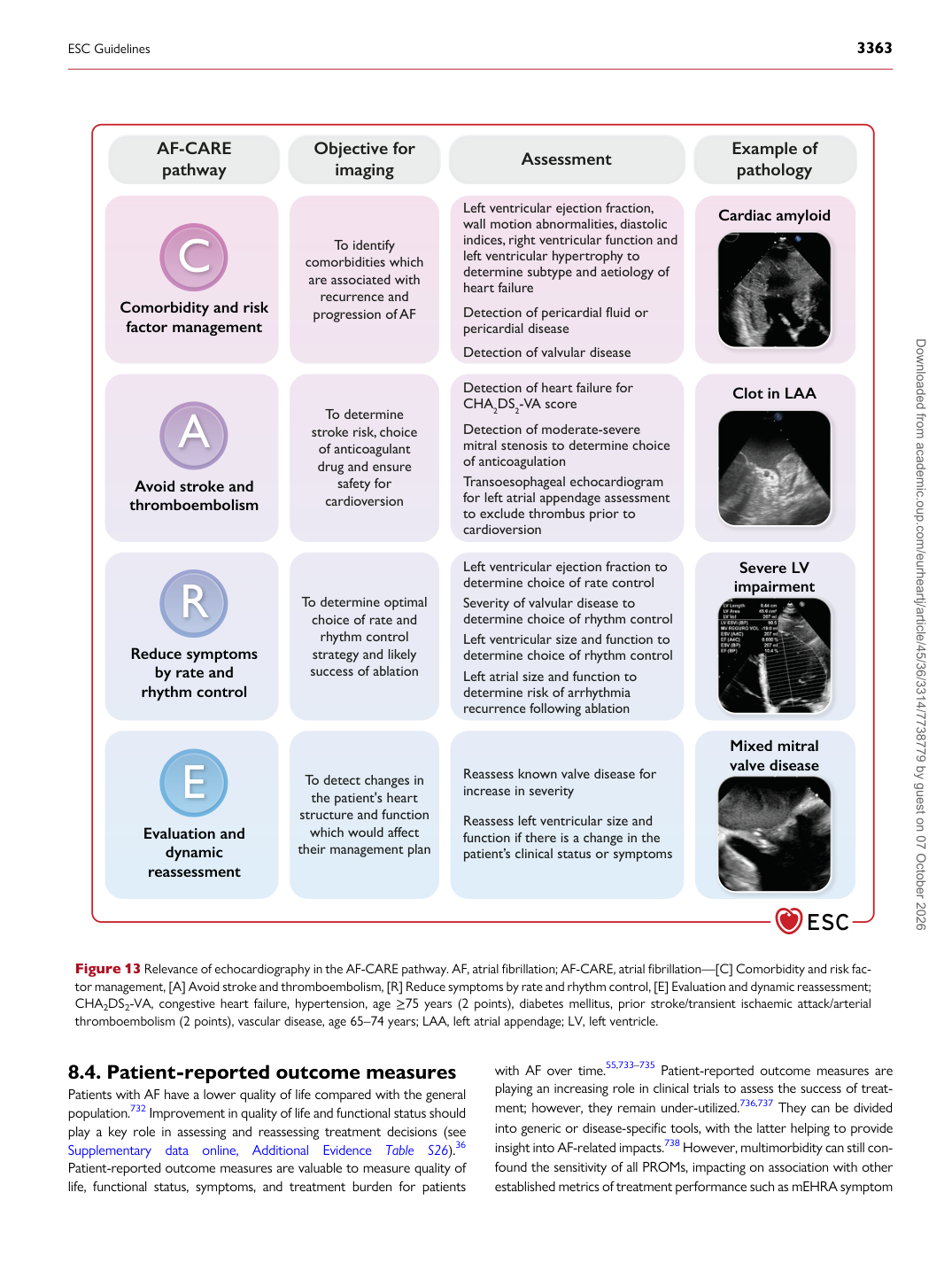
Figure 13 Relevance of echocardiography in the AF-CARE pathway. AF, atrial fibrillation; AF-CARE, atrial fibrillation—[C] Comorbidity and risk factor management, [A] Avoid stroke and thromboembolism, [R] Reduce symptoms by rate and rhythm control, [E] Evaluation and dynamic reassessment; CHA2DS2-VA, congestive heart failure, hypertension, age ≥75 years (2 points), diabetes mellitus, prior stroke/transient ischaemic attack/arterial thromboembolism (2 points), vascular disease, age 65–74 years; LAA, left atrial appendage; LV, left ventricle.

ESC Guidelines                                                                                                                                                                                          3363

Downloaded from academic.oup.com/eurheartj/article/45/36/3314/7738779 by guest on 07 October 2026