p.48 抽出テキスト
7.2.8 AF ablation during cardiac surgery

Atrial fibrillation is a significant risk factor for early mortality, late mortality, and stroke in patients referred for cardiac surgery.675–677 The best validated method of surgical ablation is the Maze procedure, consisting of a pattern of transmural lesions including PVI, with subsequent modifications using bipolar radiofrequency and/or cryothermy ablation with LAA amputation (see Supplementary data online, Additional Evidence Table S25).678–681 Education and training, close co-operation within a multidisciplinary team, and shared decision-making can improve the quality and outcomes of surgical ablation.682 A number of RCTs have shown that surgical AF ablation during cardiac surgery increases freedom from arrhythmia recurrence.683–688 Performing surgical AF ablation, mainly targeting those patients needing mitral valve surgery, is not associated with increased morbidity or mortality.678,683–685 Observational data, including large registries, have supported the potential value of surgical AF ablation,689–700 but further RCTs are needed to evaluate which patients should be selected, and whether this approach contributes to the prevention of stroke, thromboembolism, and death. Data on pacemaker implantation rates after surgical AF ablation are variable and are likely influenced by centre experience and the patients treated (e.g. underlying sinus node disease). In a systematic review of 22 RCTs (1726 patients), permanent pacemaker implantation rates were higher with surgical AF ablation than without concomitant AF surgery (6.0% vs. 4.1%; RR, 1.69; 95% CI, 1.12–2.54).701 Observational registry data from contemporary cohorts (2011– 2020) suggest an overall pacemaker rate post-operatively of 2.1% in patients selected for surgical AF ablation, with no discernible impact of surgical ablation on the need for a pacemaker, but higher rates in those needing multivalve surgery.702 With a safetyfirst approach in mind, imaging is advised during surgical AF ablation to exclude thrombus and help to plan the surgical approach (e.g. with TOE), regardless of effective pre-procedural anticoagulant use. 7.2.9 Atrial tachycardia after pulmonary vein

isolation After any ablation for AF, recurrent arrhythmias may manifest as AF, but also as atrial tachycardia (AT). Although AT may be perceived as a step in the right direction by the treating physician, this view is often not shared by the patient because AT can be equally or more symptomatic than the original AF. Conventionally, an early arrhythmia recurrence post-PVI (whether AT, AF, or flutter) is considered potentially transitory.708 Recent trials using continuous implantable loop recorders for peri-procedural monitoring have provided insight into the incidence and significance of early arrhythmia recurrences, and have confirmed a link between early and later recurrence.709 Discussion of management options for AT post-ablation should ideally involve a multidisciplinary team with experience in interventional management of complex arrhythmias, considering technical challenges, procedural efficacy, and safety, in the context of patient preferences.

8 [E] Evaluation and dynamic reassessment

The development and progression of AF results from continuous interactions between underlying mechanisms (electrical, cellular, neurohormonal, and haemodynamic), coupled with a broad range of clinical factors and associated comorbidities. Each individual factor

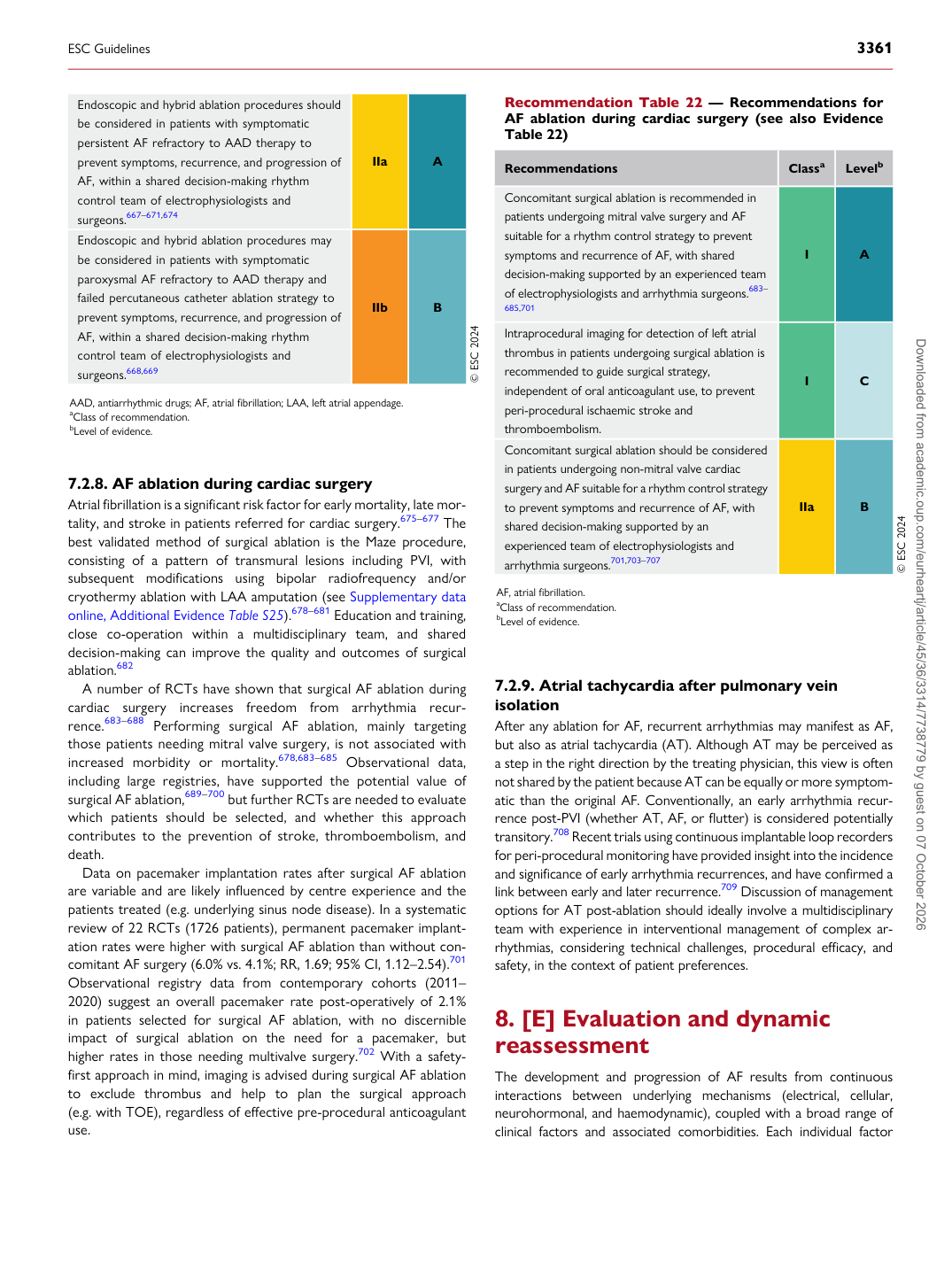
Endoscopic and hybrid ablation procedures should be considered in patients with symptomatic persistent AF refractory to AAD therapy to prevent symptoms, recurrence, and progression of AF, within a shared decision-making rhythm control team of electrophysiologists and surgeons.667–671,674 IIa A Endoscopic and hybrid ablation procedures may be considered in patients with symptomatic paroxysmal AF refractory to AAD therapy and failed percutaneous catheter ablation strategy to prevent symptoms, recurrence, and progression of AF, within a shared decision-making rhythm control team of electrophysiologists and surgeons.668,669 IIb B © ESC 2024

AAD, antiarrhythmic drugs; AF, atrial fibrillation; LAA, left atrial appendage. aClass of recommendation. bLevel of evidence. Recommendation Table 22 — Recommendations for AF ablation during cardiac surgery (see also Evidence Table 22)

Recommendations Classa Levelb

Concomitant surgical ablation is recommended in patients undergoing mitral valve surgery and AF suitable for a rhythm control strategy to prevent symptoms and recurrence of AF, with shared decision-making supported by an experienced team of electrophysiologists and arrhythmia surgeons.683– 685,701 I A

Intraprocedural imaging for detection of left atrial thrombus in patients undergoing surgical ablation is recommended to guide surgical strategy, independent of oral anticoagulant use, to prevent peri-procedural ischaemic stroke and thromboembolism. I C Concomitant surgical ablation should be considered in patients undergoing non-mitral valve cardiac surgery and AF suitable for a rhythm control strategy to prevent symptoms and recurrence of AF, with shared decision-making supported by an experienced team of electrophysiologists and arrhythmia surgeons.701,703–707 IIa B © ESC 2024

AF, atrial fibrillation. aClass of recommendation. bLevel of evidence.

ESC Guidelines                                                                                                                                                                                          3361

Downloaded from academic.oup.com/eurheartj/article/45/36/3314/7738779 by guest on 07 October 2026