p.47 抽出テキスト
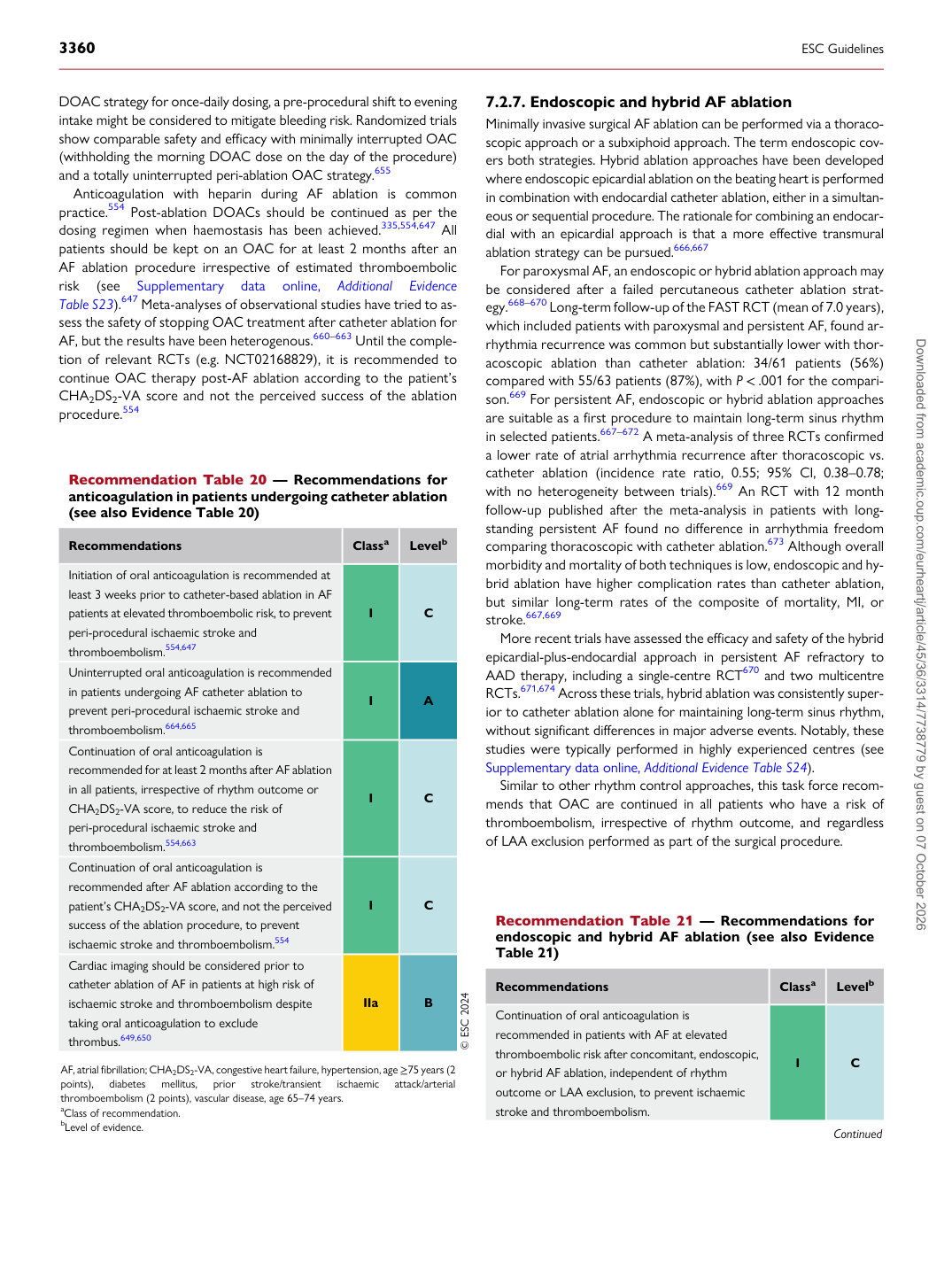
DOAC strategy for once-daily dosing, a pre-procedural shift to evening intake might be considered to mitigate bleeding risk. Randomized trials show comparable safety and efficacy with minimally interrupted OAC (withholding the morning DOAC dose on the day of the procedure) and a totally uninterrupted peri-ablation OAC strategy.655 Anticoagulation with heparin during AF ablation is common practice.554 Post-ablation DOACs should be continued as per the dosing regimen when haemostasis has been achieved.335,554,647 All patients should be kept on an OAC for at least 2 months after an AF ablation procedure irrespective of estimated thromboembolic risk (see Supplementary data online, Additional Evidence Table S23).647 Meta-analyses of observational studies have tried to assess the safety of stopping OAC treatment after catheter ablation for AF, but the results have been heterogenous.660–663 Until the completion of relevant RCTs (e.g. NCT02168829), it is recommended to continue OAC therapy post-AF ablation according to the patient’s CHA2DS2-VA score and not the perceived success of the ablation procedure.554 7.2.7 Endoscopic and hybrid AF ablation

Minimally invasive surgical AF ablation can be performed via a thoracoscopic approach or a subxiphoid approach. The term endoscopic covers both strategies. Hybrid ablation approaches have been developed where endoscopic epicardial ablation on the beating heart is performed in combination with endocardial catheter ablation, either in a simultaneous or sequential procedure. The rationale for combining an endocardial with an epicardial approach is that a more effective transmural ablation strategy can be pursued.666,667 For paroxysmal AF, an endoscopic or hybrid ablation approach may be considered after a failed percutaneous catheter ablation strategy.668–670 Long-term follow-up of the FAST RCT (mean of 7.0 years), which included patients with paroxysmal and persistent AF, found arrhythmia recurrence was common but substantially lower with thoracoscopic ablation than catheter ablation: 34/61 patients (56%) compared with 55/63 patients (87%), with P < .001 for the comparison.669 For persistent AF, endoscopic or hybrid ablation approaches are suitable as a first procedure to maintain long-term sinus rhythm in selected patients.667–672 A meta-analysis of three RCTs confirmed a lower rate of atrial arrhythmia recurrence after thoracoscopic vs. catheter ablation (incidence rate ratio, 0.55; 95% CI, 0.38–0.78; with no heterogeneity between trials).669 An RCT with 12 month follow-up published after the meta-analysis in patients with longstanding persistent AF found no difference in arrhythmia freedom comparing thoracoscopic with catheter ablation.673 Although overall morbidity and mortality of both techniques is low, endoscopic and hybrid ablation have higher complication rates than catheter ablation, but similar long-term rates of the composite of mortality, MI, or stroke.667,669 More recent trials have assessed the efficacy and safety of the hybrid epicardial-plus-endocardial approach in persistent AF refractory to AAD therapy, including a single-centre RCT670 and two multicentre RCTs.671,674 Across these trials, hybrid ablation was consistently superior to catheter ablation alone for maintaining long-term sinus rhythm, without significant differences in major adverse events. Notably, these studies were typically performed in highly experienced centres (see Supplementary data online, Additional Evidence Table S24). Similar to other rhythm control approaches, this task force recommends that OAC are continued in all patients who have a risk of thromboembolism, irrespective of rhythm outcome, and regardless of LAA exclusion performed as part of the surgical procedure.

Recommendation Table 21 — Recommendations for endoscopic and hybrid AF ablation (see also Evidence Table 21)

Recommendations Classa Levelb

Continuation of oral anticoagulation is recommended in patients with AF at elevated thromboembolic risk after concomitant, endoscopic, or hybrid AF ablation, independent of rhythm outcome or LAA exclusion, to prevent ischaemic stroke and thromboembolism. I C

Continued

Recommendation Table 20 — Recommendations for anticoagulation in patients undergoing catheter ablation (see also Evidence Table 20)

Recommendations Classa Levelb

Initiation of oral anticoagulation is recommended at least 3 weeks prior to catheter-based ablation in AF patients at elevated thromboembolic risk, to prevent peri-procedural ischaemic stroke and thromboembolism.554,647 I C Uninterrupted oral anticoagulation is recommended in patients undergoing AF catheter ablation to prevent peri-procedural ischaemic stroke and thromboembolism.664,665 I A Continuation of oral anticoagulation is recommended for at least 2 months after AF ablation in all patients, irrespective of rhythm outcome or CHA2DS2-VA score, to reduce the risk of peri-procedural ischaemic stroke and thromboembolism.554,663 I C Continuation of oral anticoagulation is recommended after AF ablation according to the patient’s CHA2DS2-VA score, and not the perceived success of the ablation procedure, to prevent ischaemic stroke and thromboembolism.554 I C Cardiac imaging should be considered prior to catheter ablation of AF in patients at high risk of ischaemic stroke and thromboembolism despite taking oral anticoagulation to exclude thrombus.649,650 IIa B © ESC 2024

AF, atrial fibrillation; CHA2DS2-VA, congestive heart failure, hypertension, age ≥75 years (2 points), diabetes mellitus, prior stroke/transient ischaemic attack/arterial thromboembolism (2 points), vascular disease, age 65–74 years. aClass of recommendation. bLevel of evidence. Downloaded from academic.oup.com/eurheartj/article/45/36/3314/7738779 by guest on 07 October 2026