p.46 抽出テキスト
characteristics, including but not limited to AF type, left atrial dilatation, and the presence of atrial and/or ventricular fibrosis, could refine patient selection to maximize outcome benefit from AF catheter ablation in patients with HFrEF.604,608,613–617 The prognostic value of catheter ablation in patients with HFpEF is less well established than for HFrEF.617–626 Recent registries and trials report varying rates of peri-procedural serious adverse events associated with catheter ablation (2.9%–7.2%) with a very low 30 day mortality rate (<0.1%). Operator experience and procedural volume at the ablation centre are critical, since they are associated with complication rates and 30 day mortality.627–631 Intermittent rhythm monitoring has typically been used to detect AF relapses following catheter ablation. Recent technology developments such as smartwatch or smartphone photoplethysmography and wearable patches may have an emerging role in post-ablation monitoring.632,633 In addition, implantable loop recorders have been used to quantify AF burden before and after ablation as an additional endpoint beyond binary AF elimination.634 Management of arrhythmia recurrence post-ablation is an informed, shared decision-making process driven by available options for symptom control. In the post-AF ablation context, there is data supporting a role for AAD continuation or reinitiation, even for previously ineffective drugs.635 A short-term AAD treatment (2–3 months) following ablation reduces early recurrences of AF,554,635–639 but does not affect late recurrences636,637,640–642 or 1 year clinical outcomes.642 Repeat PVI should be offered in patients with AF recurrence if symptom improvement was demonstrated after the first ablation, with shared decision-making and clear goals of treatment.643–645

7.2.6 Anticoagulation in patients undergoing

catheter ablation The presence of left atrial thrombus is a contraindication to catheterbased AF ablation due to the risk of thrombus dislodgement leading to ischaemic stroke. Patients planned for catheter ablation of AF with an increased risk of thromboembolism should be on OAC for at least 3 full weeks prior to the procedure.554,647 There is a wide range in practice for visualization of intra-atrial thrombi prior to catheter ablation, including TOE, intracardiac echocardiography, or delayed phase cardiac computed tomography (CT).554,648 The prevalence of left atrial thrombus was 1.3% and 2.7% in two meta-analyses of observational studies in patients planned for catheter ablation of AF on adequate OAC.649,650 The prevalence of left atrial thrombus was higher in patients with elevated stroke risk scores, and in patients with non-paroxysmal compared with paroxysmal AF.650 In addition, several patient subgroups with AF have increased risk of ischaemic stroke and intracardiac thrombus even if treated with adequate anticoagulation, including those with cardiac amyloidosis, rheumatic heart disease, and hypertrophic cardiomyopathy (HCM). Cardiac imaging before catheter ablation should be considered in these high-risk patient groups regardless of preceding effective OAC. Observational studies suggest that patients with a low thromboembolic risk profile may be managed without visualization of the LAA,651–653 but no RCTs have been performed (see Supplementary data online, Additional Evidence Table S21). For patients who have been anticoagulated prior to the ablation procedure it is recommended to avoid interruption of OAC (see Supplementary data online, Additional Evidence Table S22).654–656 Patients with interrupted OAC showed an increase in silent stroke detected by brain magnetic resonance imaging (MRI) as compared with those with uninterrupted OAC.657–659 In a true uninterrupted

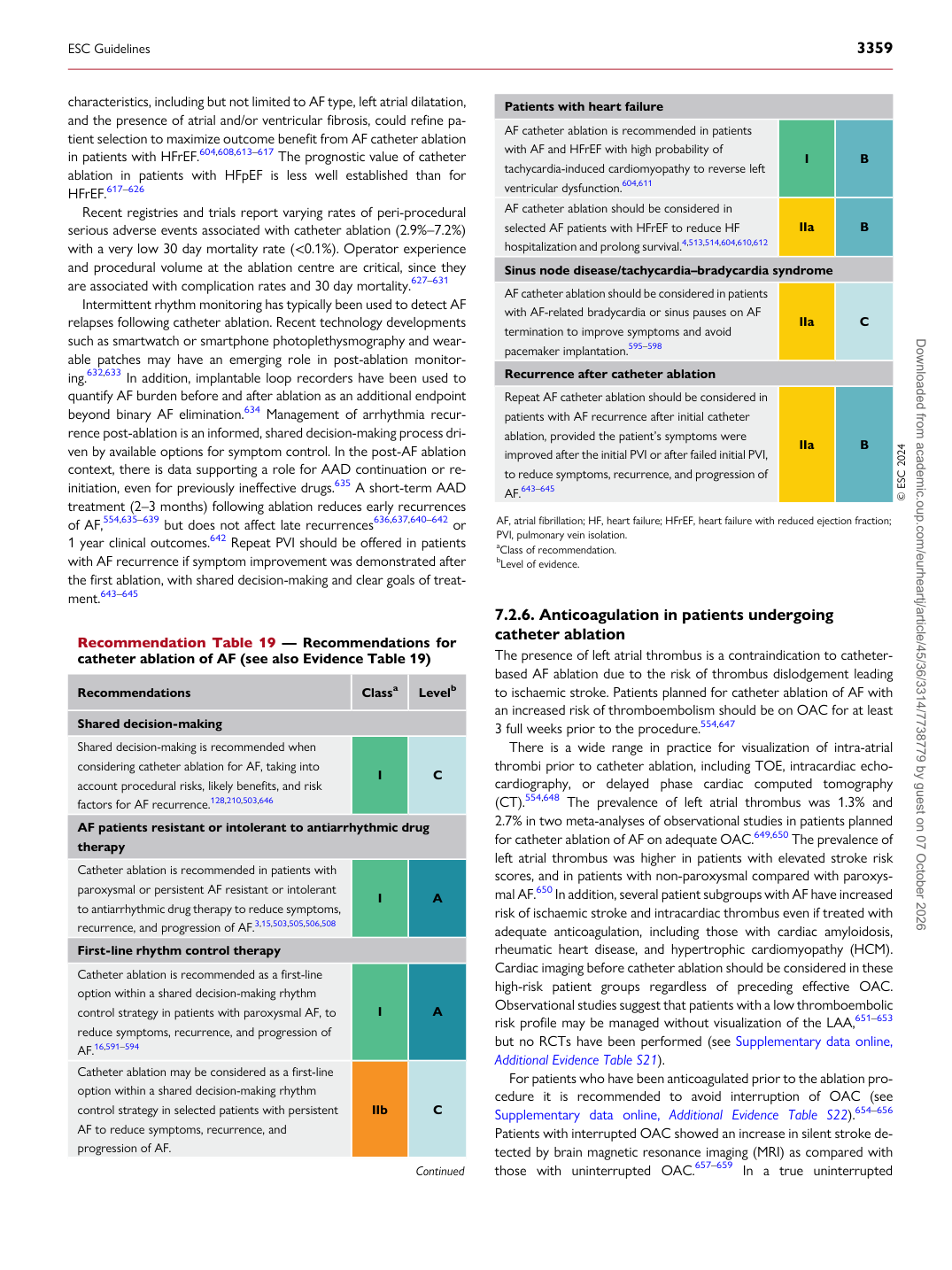
Recommendation Table 19 — Recommendations for catheter ablation of AF (see also Evidence Table 19)

Recommendations Classa Levelb

Shared decision-making Shared decision-making is recommended when considering catheter ablation for AF, taking into account procedural risks, likely benefits, and risk factors for AF recurrence.128,210,503,646 I C AF patients resistant or intolerant to antiarrhythmic drug therapy Catheter ablation is recommended in patients with paroxysmal or persistent AF resistant or intolerant to antiarrhythmic drug therapy to reduce symptoms, recurrence, and progression of AF.3,15,503,505,506,508 I A First-line rhythm control therapy Catheter ablation is recommended as a first-line option within a shared decision-making rhythm control strategy in patients with paroxysmal AF, to reduce symptoms, recurrence, and progression of AF.16,591–594 I A Catheter ablation may be considered as a first-line option within a shared decision-making rhythm control strategy in selected patients with persistent AF to reduce symptoms, recurrence, and progression of AF. IIb C

Continued Patients with heart failure

AF catheter ablation is recommended in patients with AF and HFrEF with high probability of tachycardia-induced cardiomyopathy to reverse left ventricular dysfunction.604,611 I B AF catheter ablation should be considered in selected AF patients with HFrEF to reduce HF hospitalization and prolong survival.4,513,514,604,610,612 IIa B Sinus node disease/tachycardia–bradycardia syndrome AF catheter ablation should be considered in patients with AF-related bradycardia or sinus pauses on AF termination to improve symptoms and avoid pacemaker implantation.595–598 IIa C Recurrence after catheter ablation Repeat AF catheter ablation should be considered in patients with AF recurrence after initial catheter ablation, provided the patient’s symptoms were improved after the initial PVI or after failed initial PVI, to reduce symptoms, recurrence, and progression of AF.643–645 IIa B © ESC 2024

AF, atrial fibrillation; HF, heart failure; HFrEF, heart failure with reduced ejection fraction; PVI, pulmonary vein isolation. aClass of recommendation. bLevel of evidence.

ESC Guidelines                                                                                                                                                                                          3359

Downloaded from academic.oup.com/eurheartj/article/45/36/3314/7738779 by guest on 07 October 2026