p.45 抽出テキスト
rhythm.39,128 The RACE 3 trial, including patients with early persistent AF and mild-to-moderate heart failure (predominantly HFpEF and HFmrEF), showed that targeted therapy of underlying conditions improved sinus rhythm maintenance at 1 year (75% vs. 63% as compared with standard care).39 The selection of an AAD for long-term rhythm control requires careful evaluation that takes into account AF type, patient parameters, and safety profile.445 It also includes shared decision-making, balancing the benefit/risk ratio of AADs in comparison with other strategies. Notably, recent evidence has shown that careful institution of AADs can be performed safely.17 The long-term effectiveness of AADs is limited. In a meta-analysis of 59 RCTs, AADs reduced AF recurrences by 20%–50% compared with no treatment, placebo, or drugs for rate control.576,577 When one AAD fails to reduce AF recurrences, a clinically acceptable response may be achieved with another drug, particularly if from a different class.578 Combinations of AADs are not recommended. The data available suggest that AADs do not produce an appreciable effect on mortality or other cardiovascular complications with the exception of increased mortality signals for sotalol574,579,580 and amiodarone.581 In contrast, use of AADs within a rhythm control strategy can be associated with reduction of morbidity and mortality in selected patients.582 All AADs may produce serious cardiac (proarrhythmia, negative inotropism, hypotension) and extracardiac adverse effects (organ toxicity, predominantly amiodarone). Drug safety, rather than efficacy, should determine the choice of drug. The risk of proarrhythmia increases in patients with structural heart disease. Suggested doses for long-term oral AAD are presented in Table 13.577,583,584 7.2.5 Catheter ablation

Catheter ablation prevents AF recurrences, reduces AF burden, and improves quality of life in symptomatic paroxysmal or persistent AF where the patient is intolerant or does not respond to AAD.503–509 Multiple RCTs have provided evidence in favour of catheter ablation as a first-line approach for rhythm control in patients with paroxysmal AF, with a similar risk of adverse events as compared with initial AAD treatment (see Supplementary data online, Additional Evidence Table S20).15,16,591–594 In contrast, it is not clear whether first-line ablation is superior to drug therapy in persistent AF. Catheter ablation may also have a role in patients with symptoms due to prolonged pauses upon AF termination, where non-randomized data have shown improved symptoms, and avoidance of pacemaker implantation.595–598 Pulmonary vein isolation (PVI) remains the cornerstone of AF catheter ablation,503,508,593,599 but the optimal ablation strategy has not been clarified in the non-paroxysmal AF population.600 New technologies are emerging, such as pulsed field ablation, in which high-amplitude electrical pulses are used to ablate the myocardium by electroporation with high tissue specificity. In a single-blind RCT of 607 patients, pulsed field ablation was non-inferior for efficacy and safety endpoints compared with conventional radiofrequency or cryoballoon ablation.601 Regarding timing of ablation, a small RCT found that delaying catheter ablation in patients with paroxysmal or persistent AF by 12 months (while on optimized medical therapy) did not impact on arrhythmiafree survival compared with ablation within 1 month.602 As with any type of rhythm control, many patients in clinical practice will not be suitable for catheter ablation due to factors that reduce the likelihood of a positive response, such as left atrial dilatation. Definitive evidence that supports the prognostic benefit of catheter ablation is needed before this invasive treatment can be considered for truly asymptomatic patients. As previously noted, the CABANA trial did not confirm a benefit of catheter ablation compared with medical therapy, although high crossover rates and low event rates may have diluted the treatment effect.3 Therefore, only highly selected asymptomatic patients could be candidates for catheter ablation, and only after detailed discussion of associated risks and potential benefit of delaying AF progression.4,603 Randomized trials have shown that AF catheter ablation in patients with HFrEF significantly reduces arrhythmia recurrence and increases ejection fraction, with improvement in clinical outcomes and mortality also observed in selected patients.4,513,514,604–612 Several

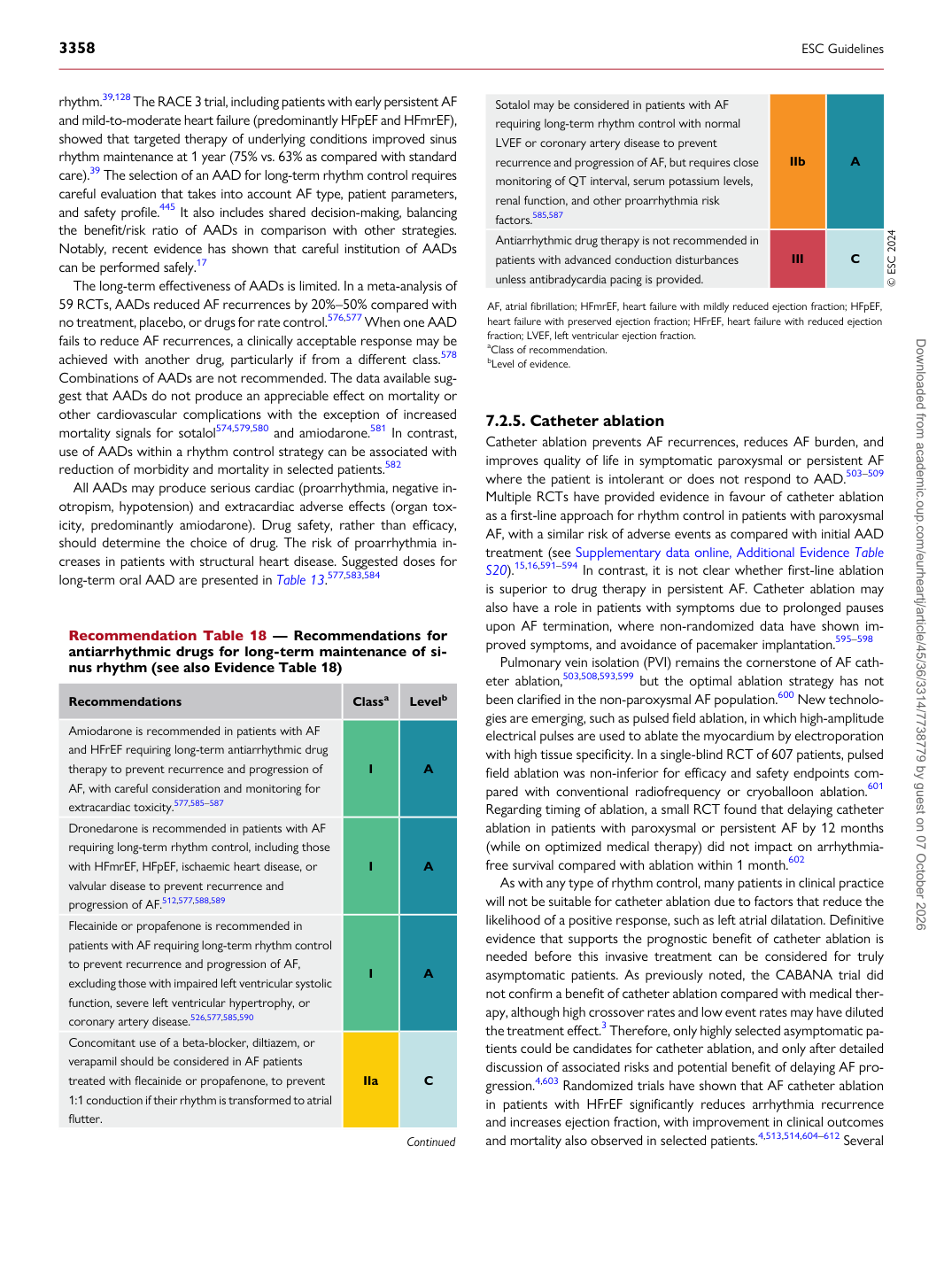
Recommendation Table 18 — Recommendations for antiarrhythmic drugs for long-term maintenance of sinus rhythm (see also Evidence Table 18)

Recommendations Classa Levelb

Amiodarone is recommended in patients with AF and HFrEF requiring long-term antiarrhythmic drug therapy to prevent recurrence and progression of AF, with careful consideration and monitoring for extracardiac toxicity.577,585–587 I A Dronedarone is recommended in patients with AF requiring long-term rhythm control, including those with HFmrEF, HFpEF, ischaemic heart disease, or valvular disease to prevent recurrence and progression of AF.512,577,588,589 I A Flecainide or propafenone is recommended in patients with AF requiring long-term rhythm control to prevent recurrence and progression of AF, excluding those with impaired left ventricular systolic function, severe left ventricular hypertrophy, or coronary artery disease.526,577,585,590 I A Concomitant use of a beta-blocker, diltiazem, or verapamil should be considered in AF patients treated with flecainide or propafenone, to prevent 1:1 conduction if their rhythm is transformed to atrial flutter. IIa C

Continued Sotalol may be considered in patients with AF

requiring long-term rhythm control with normal LVEF or coronary artery disease to prevent recurrence and progression of AF, but requires close monitoring of QT interval, serum potassium levels, renal function, and other proarrhythmia risk factors.585,587 IIb A Antiarrhythmic drug therapy is not recommended in patients with advanced conduction disturbances unless antibradycardia pacing is provided. III C © ESC 2024

AF, atrial fibrillation; HFmrEF, heart failure with mildly reduced ejection fraction; HFpEF, heart failure with preserved ejection fraction; HFrEF, heart failure with reduced ejection fraction; LVEF, left ventricular ejection fraction. aClass of recommendation. bLevel of evidence. Downloaded from academic.oup.com/eurheartj/article/45/36/3314/7738779 by guest on 07 October 2026