p.43 抽出テキスト
7.2.2 Electrical cardioversion

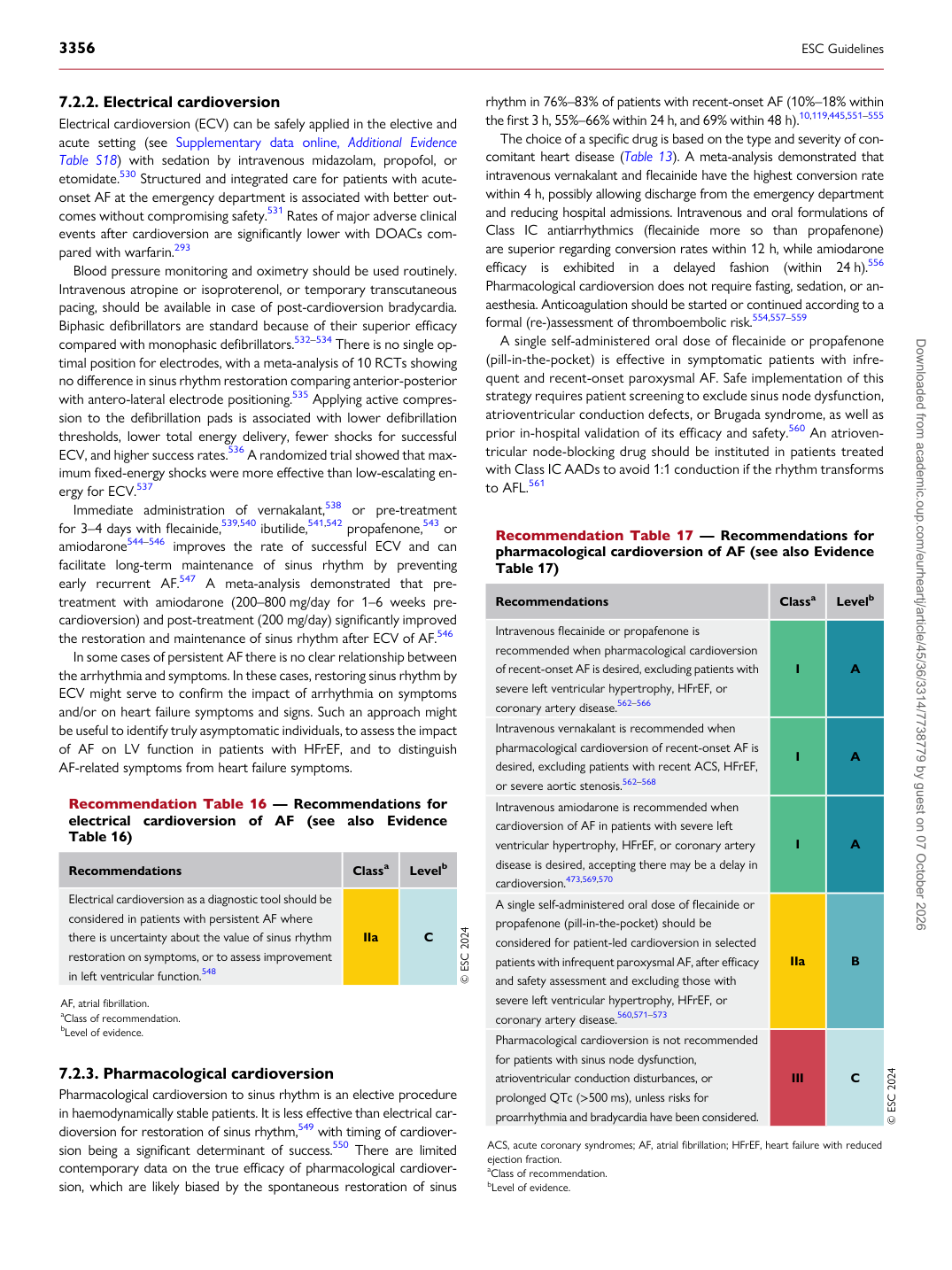
Electrical cardioversion (ECV) can be safely applied in the elective and acute setting (see Supplementary data online, Additional Evidence Table S18) with sedation by intravenous midazolam, propofol, or etomidate.530 Structured and integrated care for patients with acuteonset AF at the emergency department is associated with better outcomes without compromising safety.531 Rates of major adverse clinical events after cardioversion are significantly lower with DOACs compared with warfarin.293 Blood pressure monitoring and oximetry should be used routinely. Intravenous atropine or isoproterenol, or temporary transcutaneous pacing, should be available in case of post-cardioversion bradycardia. Biphasic defibrillators are standard because of their superior efficacy compared with monophasic defibrillators.532–534 There is no single optimal position for electrodes, with a meta-analysis of 10 RCTs showing no difference in sinus rhythm restoration comparing anterior-posterior with antero-lateral electrode positioning.535 Applying active compression to the defibrillation pads is associated with lower defibrillation thresholds, lower total energy delivery, fewer shocks for successful ECV, and higher success rates.536 A randomized trial showed that maximum fixed-energy shocks were more effective than low-escalating energy for ECV.537 Immediate administration of vernakalant,538 or pre-treatment for 3–4 days with flecainide,539,540 ibutilide,541,542 propafenone,543 or amiodarone544–546 improves the rate of successful ECV and can facilitate long-term maintenance of sinus rhythm by preventing early recurrent AF.547 A meta-analysis demonstrated that pretreatment with amiodarone (200–800 mg/day for 1–6 weeks precardioversion) and post-treatment (200 mg/day) significantly improved the restoration and maintenance of sinus rhythm after ECV of AF.546 In some cases of persistent AF there is no clear relationship between the arrhythmia and symptoms. In these cases, restoring sinus rhythm by ECV might serve to confirm the impact of arrhythmia on symptoms and/or on heart failure symptoms and signs. Such an approach might be useful to identify truly asymptomatic individuals, to assess the impact of AF on LV function in patients with HFrEF, and to distinguish AF-related symptoms from heart failure symptoms.

7.2.3 Pharmacological cardioversion

Pharmacological cardioversion to sinus rhythm is an elective procedure in haemodynamically stable patients. It is less effective than electrical cardioversion for restoration of sinus rhythm,549 with timing of cardioversion being a significant determinant of success.550 There are limited contemporary data on the true efficacy of pharmacological cardioversion, which are likely biased by the spontaneous restoration of sinus rhythm in 76%–83% of patients with recent-onset AF (10%–18% within the first 3 h, 55%–66% within 24 h, and 69% within 48 h).10,119,445,551–555

The choice of a specific drug is based on the type and severity of concomitant heart disease (Table 13). A meta-analysis demonstrated that intravenous vernakalant and flecainide have the highest conversion rate within 4 h, possibly allowing discharge from the emergency department and reducing hospital admissions. Intravenous and oral formulations of Class IC antiarrhythmics (flecainide more so than propafenone) are superior regarding conversion rates within 12 h, while amiodarone efficacy is exhibited in a delayed fashion (within 24 h).556 Pharmacological cardioversion does not require fasting, sedation, or anaesthesia. Anticoagulation should be started or continued according to a formal (re-)assessment of thromboembolic risk.554,557–559 A single self-administered oral dose of flecainide or propafenone (pill-in-the-pocket) is effective in symptomatic patients with infrequent and recent-onset paroxysmal AF. Safe implementation of this strategy requires patient screening to exclude sinus node dysfunction, atrioventricular conduction defects, or Brugada syndrome, as well as prior in-hospital validation of its efficacy and safety.560 An atrioventricular node-blocking drug should be instituted in patients treated with Class IC AADs to avoid 1:1 conduction if the rhythm transforms to AFL.561

Recommendation Table 17 — Recommendations for pharmacological cardioversion of AF (see also Evidence Table 17)

Recommendations Classa Levelb

Intravenous flecainide or propafenone is recommended when pharmacological cardioversion of recent-onset AF is desired, excluding patients with severe left ventricular hypertrophy, HFrEF, or coronary artery disease.562–566 I A Intravenous vernakalant is recommended when pharmacological cardioversion of recent-onset AF is desired, excluding patients with recent ACS, HFrEF, or severe aortic stenosis.562–568 I A Intravenous amiodarone is recommended when cardioversion of AF in patients with severe left ventricular hypertrophy, HFrEF, or coronary artery disease is desired, accepting there may be a delay in cardioversion.473,569,570 I A A single self-administered oral dose of flecainide or propafenone (pill-in-the-pocket) should be considered for patient-led cardioversion in selected patients with infrequent paroxysmal AF, after efficacy and safety assessment and excluding those with severe left ventricular hypertrophy, HFrEF, or coronary artery disease.560,571–573 IIa B Pharmacological cardioversion is not recommended for patients with sinus node dysfunction, atrioventricular conduction disturbances, or prolonged QTc (>500 ms), unless risks for proarrhythmia and bradycardia have been considered. III C © ESC 2024

ACS, acute coronary syndromes; AF, atrial fibrillation; HFrEF, heart failure with reduced ejection fraction. aClass of recommendation. bLevel of evidence.

Recommendation Table 16 — Recommendations for electrical cardioversion of AF (see also Evidence Table 16)

Recommendations Classa Levelb

Electrical cardioversion as a diagnostic tool should be considered in patients with persistent AF where there is uncertainty about the value of sinus rhythm restoration on symptoms, or to assess improvement in left ventricular function.548 IIa C © ESC 2024

AF, atrial fibrillation. aClass of recommendation. bLevel of evidence. Downloaded from academic.oup.com/eurheartj/article/45/36/3314/7738779 by guest on 07 October 2026