p.42 抽出テキスト
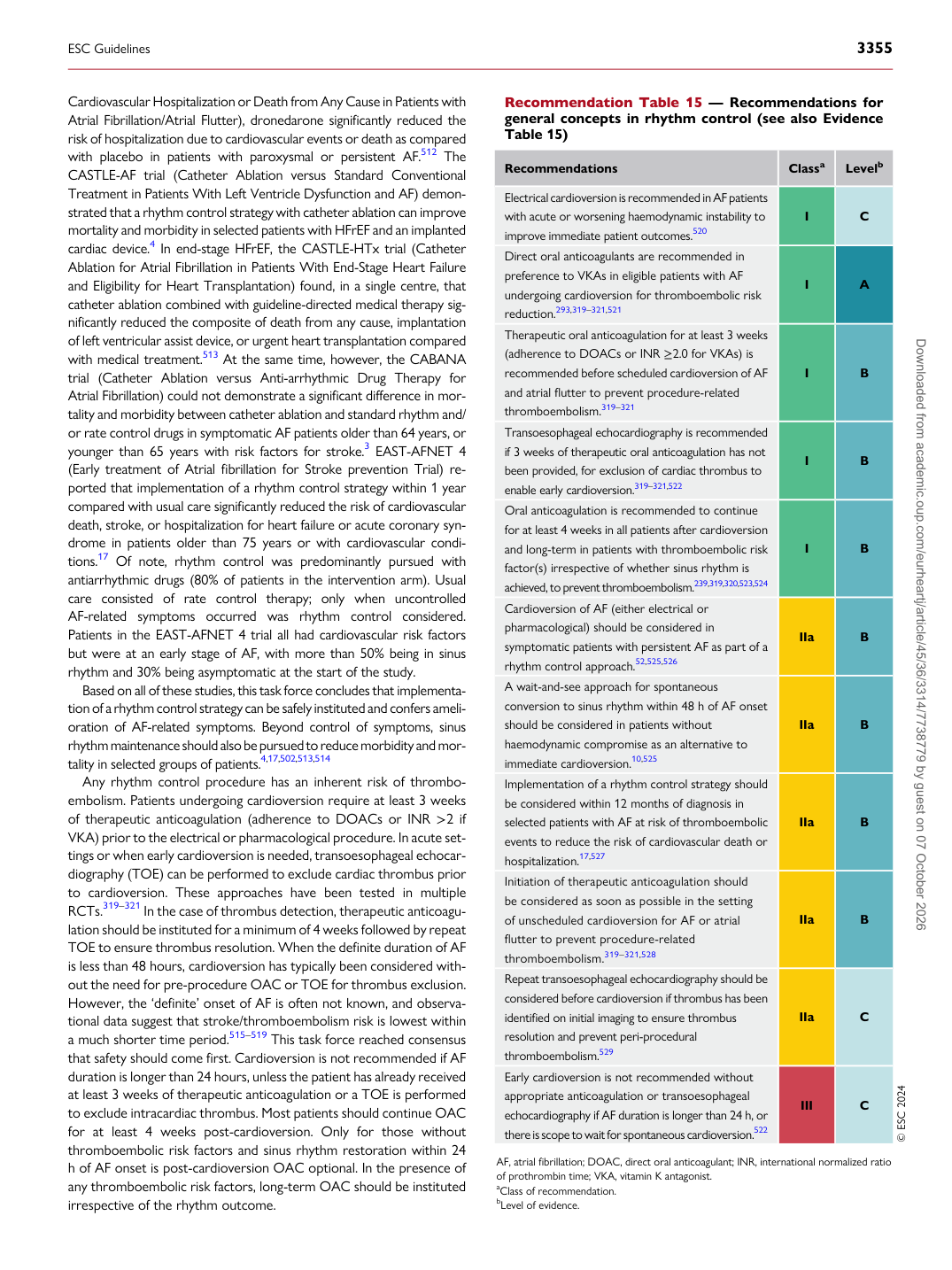
Cardiovascular Hospitalization or Death from Any Cause in Patients with Atrial Fibrillation/Atrial Flutter), dronedarone significantly reduced the risk of hospitalization due to cardiovascular events or death as compared with placebo in patients with paroxysmal or persistent AF.512 The CASTLE-AF trial (Catheter Ablation versus Standard Conventional Treatment in Patients With Left Ventricle Dysfunction and AF) demonstrated that a rhythm control strategy with catheter ablation can improve mortality and morbidity in selected patients with HFrEF and an implanted cardiac device.4 In end-stage HFrEF, the CASTLE-HTx trial (Catheter Ablation for Atrial Fibrillation in Patients With End-Stage Heart Failure and Eligibility for Heart Transplantation) found, in a single centre, that catheter ablation combined with guideline-directed medical therapy significantly reduced the composite of death from any cause, implantation of left ventricular assist device, or urgent heart transplantation compared with medical treatment.513 At the same time, however, the CABANA trial (Catheter Ablation versus Anti-arrhythmic Drug Therapy for Atrial Fibrillation) could not demonstrate a significant difference in mortality and morbidity between catheter ablation and standard rhythm and/ or rate control drugs in symptomatic AF patients older than 64 years, or younger than 65 years with risk factors for stroke.3 EAST-AFNET 4 (Early treatment of Atrial fibrillation for Stroke prevention Trial) reported that implementation of a rhythm control strategy within 1 year compared with usual care significantly reduced the risk of cardiovascular death, stroke, or hospitalization for heart failure or acute coronary syndrome in patients older than 75 years or with cardiovascular conditions.17 Of note, rhythm control was predominantly pursued with antiarrhythmic drugs (80% of patients in the intervention arm). Usual care consisted of rate control therapy; only when uncontrolled AF-related symptoms occurred was rhythm control considered. Patients in the EAST-AFNET 4 trial all had cardiovascular risk factors but were at an early stage of AF, with more than 50% being in sinus rhythm and 30% being asymptomatic at the start of the study. Based on all of these studies, this task force concludes that implementation of a rhythm control strategy can be safely instituted and confers amelioration of AF-related symptoms. Beyond control of symptoms, sinus rhythm maintenance should also be pursued to reduce morbidity and mortality in selected groups of patients.4,17,502,513,514 Any rhythm control procedure has an inherent risk of thromboembolism. Patients undergoing cardioversion require at least 3 weeks of therapeutic anticoagulation (adherence to DOACs or INR >2 if VKA) prior to the electrical or pharmacological procedure. In acute settings or when early cardioversion is needed, transoesophageal echocardiography (TOE) can be performed to exclude cardiac thrombus prior to cardioversion. These approaches have been tested in multiple RCTs.319–321 In the case of thrombus detection, therapeutic anticoagulation should be instituted for a minimum of 4 weeks followed by repeat TOE to ensure thrombus resolution. When the definite duration of AF is less than 48 hours, cardioversion has typically been considered without the need for pre-procedure OAC or TOE for thrombus exclusion. However, the ‘definite’ onset of AF is often not known, and observational data suggest that stroke/thromboembolism risk is lowest within a much shorter time period.515–519 This task force reached consensus that safety should come first. Cardioversion is not recommended if AF duration is longer than 24 hours, unless the patient has already received at least 3 weeks of therapeutic anticoagulation or a TOE is performed to exclude intracardiac thrombus. Most patients should continue OAC for at least 4 weeks post-cardioversion. Only for those without thromboembolic risk factors and sinus rhythm restoration within 24 h of AF onset is post-cardioversion OAC optional. In the presence of any thromboembolic risk factors, long-term OAC should be instituted irrespective of the rhythm outcome. Recommendation Table 15 — Recommendations for general concepts in rhythm control (see also Evidence Table 15)

Recommendations Classa Levelb

Electrical cardioversion is recommended in AF patients with acute or worsening haemodynamic instability to improve immediate patient outcomes.520 I C Direct oral anticoagulants are recommended in preference to VKAs in eligible patients with AF undergoing cardioversion for thromboembolic risk reduction.293,319–321,521 I A Therapeutic oral anticoagulation for at least 3 weeks (adherence to DOACs or INR ≥2.0 for VKAs) is recommended before scheduled cardioversion of AF and atrial flutter to prevent procedure-related thromboembolism.319–321 I B Transoesophageal echocardiography is recommended if 3 weeks of therapeutic oral anticoagulation has not been provided, for exclusion of cardiac thrombus to enable early cardioversion.319–321,522 I B Oral anticoagulation is recommended to continue for at least 4 weeks in all patients after cardioversion and long-term in patients with thromboembolic risk factor(s) irrespective of whether sinus rhythm is achieved, to prevent thromboembolism.239,319,320,523,524 I B Cardioversion of AF (either electrical or pharmacological) should be considered in symptomatic patients with persistent AF as part of a rhythm control approach.52,525,526 IIa B A wait-and-see approach for spontaneous conversion to sinus rhythm within 48 h of AF onset should be considered in patients without haemodynamic compromise as an alternative to immediate cardioversion.10,525 IIa B Implementation of a rhythm control strategy should be considered within 12 months of diagnosis in selected patients with AF at risk of thromboembolic events to reduce the risk of cardiovascular death or hospitalization.17,527 IIa B Initiation of therapeutic anticoagulation should be considered as soon as possible in the setting of unscheduled cardioversion for AF or atrial flutter to prevent procedure-related thromboembolism.319–321,528 IIa B Repeat transoesophageal echocardiography should be considered before cardioversion if thrombus has been identified on initial imaging to ensure thrombus resolution and prevent peri-procedural thromboembolism.529 IIa C Early cardioversion is not recommended without appropriate anticoagulation or transoesophageal echocardiography if AF duration is longer than 24 h, or there is scope to wait for spontaneous cardioversion.522 III C © ESC 2024

AF, atrial fibrillation; DOAC, direct oral anticoagulant; INR, international normalized ratio of prothrombin time; VKA, vitamin K antagonist. aClass of recommendation. bLevel of evidence.

ESC Guidelines                                                                                                                                                                                          3355

Downloaded from academic.oup.com/eurheartj/article/45/36/3314/7738779 by guest on 07 October 2026