p.39 抽出テキスト
7.1.1 Indications and target heart rate

The optimal heart rate target in AF patients depends on the setting, symptom burden, presence of heart failure, and whether rate control is combined with a rhythm control strategy. In the RACE II (Rate Control Efficacy in Permanent Atrial Fibrillation) RCT of patients with permanent AF, lenient rate control (target heart rate <110  [beats per minute] b.p.m.) was non-inferior to a strict approach (<80 b.p.m. at rest; <110 b.p.m. during exercise; Holter for safety) for a composite of clinical events, NYHA class, or hospitalization.186,459 Similar results were found in a post-hoc combined analysis from the AFFIRM (Atrial Fibrillation Follow-up Investigation of Rhythm Management) and the RACE (Rate Control versus Electrical cardioversion) studies.474 Therefore, lenient rate control is an acceptable initial approach, unless there are ongoing symptoms or suspicion of tachycardia-induced cardiomyopathy, where stricter targets may be indicated.

7.1.2 Heart rate control in the acute setting

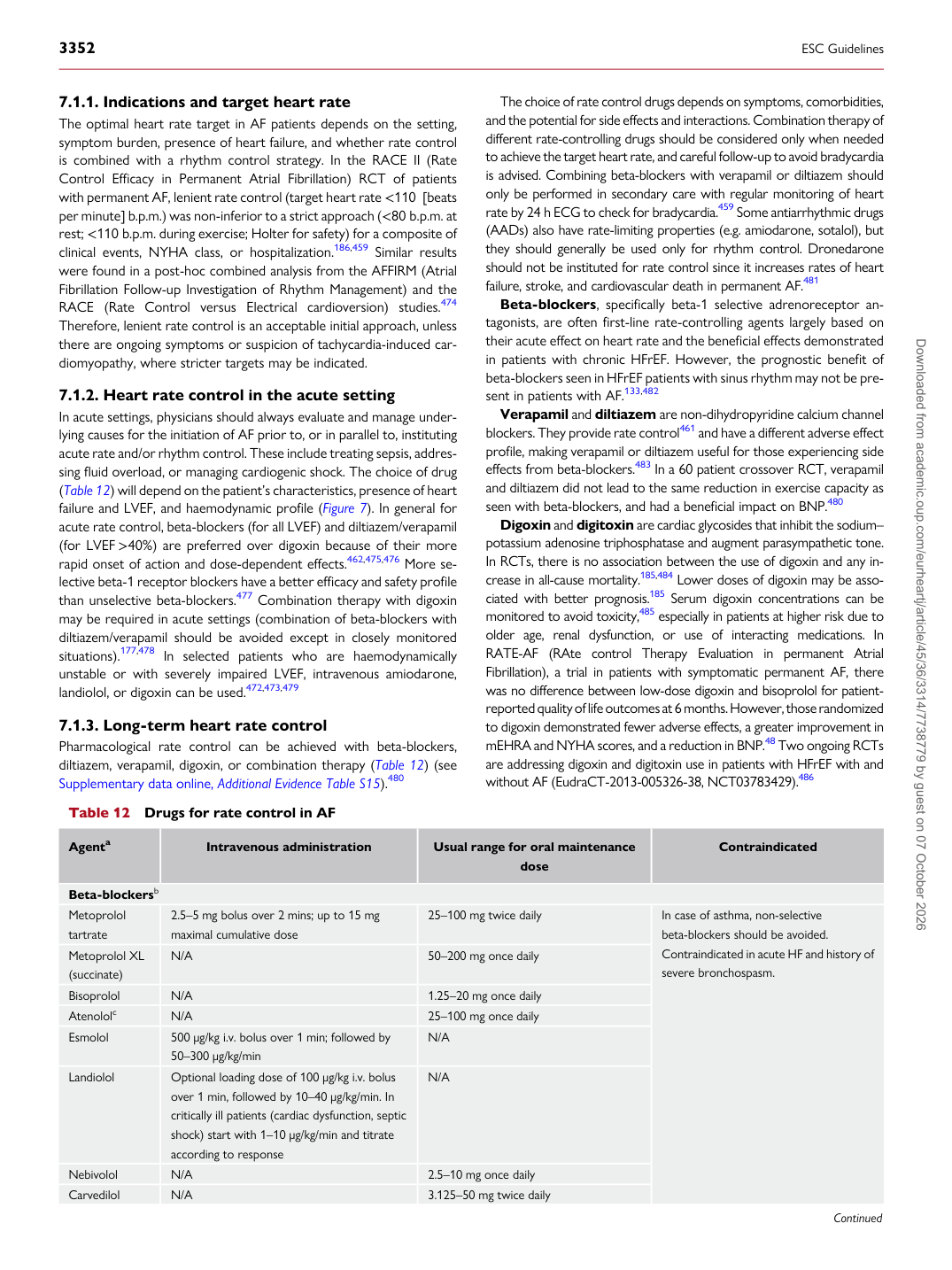
In acute settings, physicians should always evaluate and manage underlying causes for the initiation of AF prior to, or in parallel to, instituting acute rate and/or rhythm control. These include treating sepsis, addressing fluid overload, or managing cardiogenic shock. The choice of drug (Table 12) will depend on the patient’s characteristics, presence of heart failure and LVEF, and haemodynamic profile (Figure 7). In general for acute rate control, beta-blockers (for all LVEF) and diltiazem/verapamil (for LVEF >40%) are preferred over digoxin because of their more rapid onset of action and dose-dependent effects.462,475,476 More selective beta-1 receptor blockers have a better efficacy and safety profile than unselective beta-blockers.477 Combination therapy with digoxin may be required in acute settings (combination of beta-blockers with diltiazem/verapamil should be avoided except in closely monitored situations).177,478 In selected patients who are haemodynamically unstable or with severely impaired LVEF, intravenous amiodarone, landiolol, or digoxin can be used.472,473,479

7.1.3 Long-term heart rate control

Pharmacological rate control can be achieved with beta-blockers, diltiazem, verapamil, digoxin, or combination therapy (Table 12) (see Supplementary data online, Additional Evidence Table S15).480 The choice of rate control drugs depends on symptoms, comorbidities, and the potential for side effects and interactions. Combination therapy of different rate-controlling drugs should be considered only when needed to achieve the target heart rate, and careful follow-up to avoid bradycardia is advised. Combining beta-blockers with verapamil or diltiazem should only be performed in secondary care with regular monitoring of heart rate by 24 h ECG to check for bradycardia.459 Some antiarrhythmic drugs (AADs) also have rate-limiting properties (e.g. amiodarone, sotalol), but they should generally be used only for rhythm control. Dronedarone should not be instituted for rate control since it increases rates of heart failure, stroke, and cardiovascular death in permanent AF.481

Beta-blockers, specifically beta-1 selective adrenoreceptor antagonists, are often first-line rate-controlling agents largely based on their acute effect on heart rate and the beneficial effects demonstrated in patients with chronic HFrEF. However, the prognostic benefit of beta-blockers seen in HFrEF patients with sinus rhythm may not be present in patients with AF.133,482 Verapamil and diltiazem are non-dihydropyridine calcium channel blockers. They provide rate control461 and have a different adverse effect profile, making verapamil or diltiazem useful for those experiencing side effects from beta-blockers.483 In a 60 patient crossover RCT, verapamil and diltiazem did not lead to the same reduction in exercise capacity as seen with beta-blockers, and had a beneficial impact on BNP.480 Digoxin and digitoxin are cardiac glycosides that inhibit the sodium– potassium adenosine triphosphatase and augment parasympathetic tone. In RCTs, there is no association between the use of digoxin and any increase in all-cause mortality.185,484 Lower doses of digoxin may be associated with better prognosis.185 Serum digoxin concentrations can be monitored to avoid toxicity,485 especially in patients at higher risk due to older age, renal dysfunction, or use of interacting medications. In RATE-AF (RAte control Therapy Evaluation in permanent Atrial Fibrillation), a trial in patients with symptomatic permanent AF, there was no difference between low-dose digoxin and bisoprolol for patientreported quality of life outcomes at 6 months. However, those randomized to digoxin demonstrated fewer adverse effects, a greater improvement in mEHRA and NYHA scores, and a reduction in BNP.48 Two ongoing RCTs are addressing digoxin and digitoxin use in patients with HFrEF with and without AF (EudraCT-2013-005326-38, NCT03783429).486

Table 12 Drugs for rate control in AF

Agenta Intravenous administration Usual range for oral maintenance

dose Contraindicated

Beta-blockersb Metoprolol tartrate 2.5–5 mg bolus over 2 mins; up to 15 mg

maximal cumulative dose 25–100 mg twice daily In case of asthma, non-selective

beta-blockers should be avoided.

Contraindicated in acute HF and history of severe bronchospasm. Metoprolol XL (succinate) N/A 50–200 mg once daily Bisoprolol N/A 1.25–20 mg once daily Atenololc N/A 25–100 mg once daily Esmolol 500 μg/kg i.v. bolus over 1 min; followed by

50–300 μg/kg/min N/A

Landiolol Optional loading dose of 100 μg/kg i.v. bolus

over 1 min, followed by 10–40 μg/kg/min. In critically ill patients (cardiac dysfunction, septic shock) start with 1–10 μg/kg/min and titrate according to response N/A

Nebivolol N/A 2.5–10 mg once daily Carvedilol N/A 3.125–50 mg twice daily

Downloaded from academic.oup.com/eurheartj/article/45/36/3314/7738779 by guest on 07 October 2026