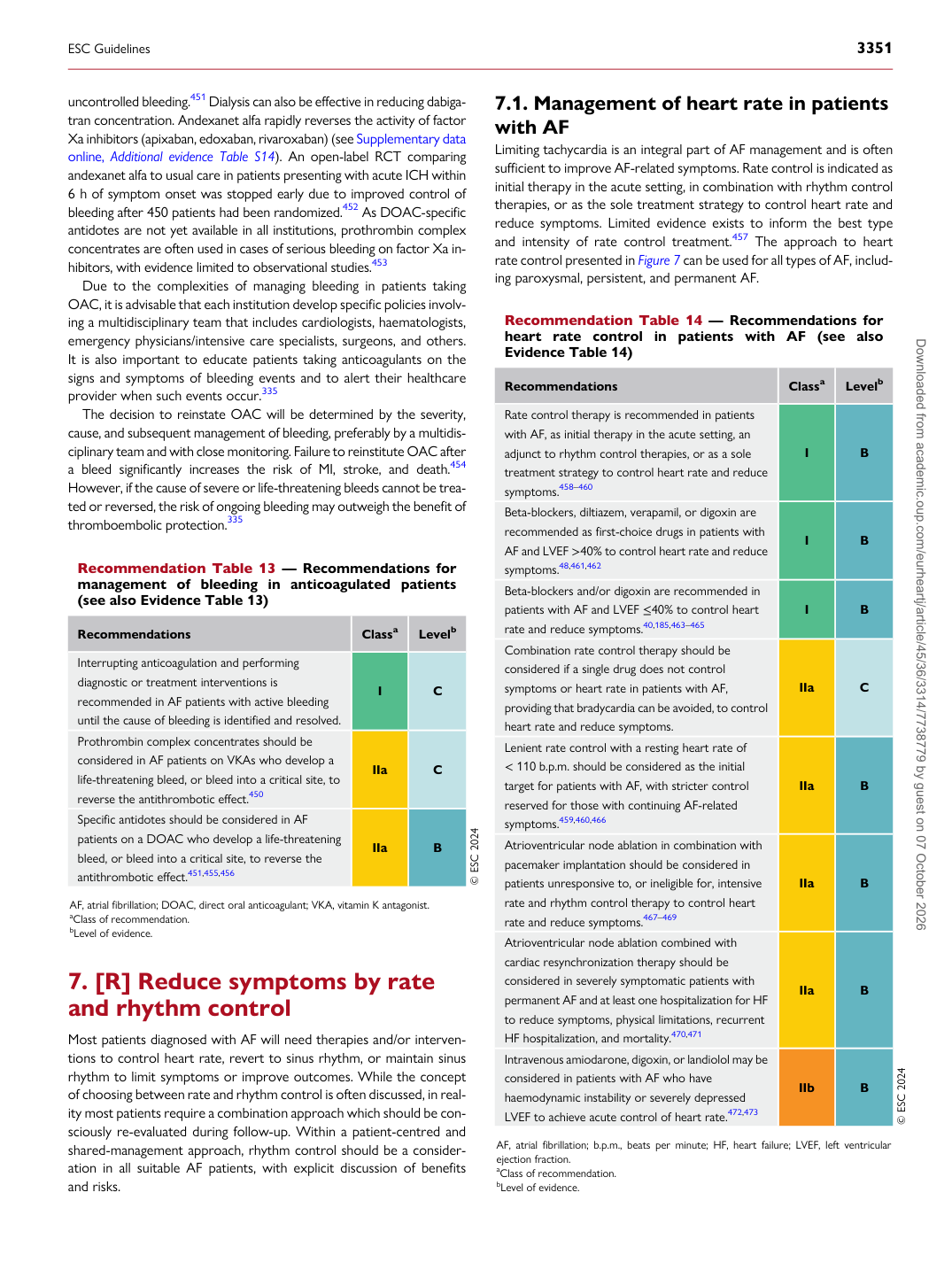
p.38 抽出テキスト
uncontrolled bleeding.451 Dialysis can also be effective in reducing dabigatran concentration. Andexanet alfa rapidly reverses the activity of factor Xa inhibitors (apixaban, edoxaban, rivaroxaban) (see Supplementary data online, Additional evidence Table S14). An open-label RCT comparing andexanet alfa to usual care in patients presenting with acute ICH within 6 h of symptom onset was stopped early due to improved control of bleeding after 450 patients had been randomized.452 As DOAC-specific antidotes are not yet available in all institutions, prothrombin complex concentrates are often used in cases of serious bleeding on factor Xa inhibitors, with evidence limited to observational studies.453 Due to the complexities of managing bleeding in patients taking OAC, it is advisable that each institution develop specific policies involving a multidisciplinary team that includes cardiologists, haematologists, emergency physicians/intensive care specialists, surgeons, and others. It is also important to educate patients taking anticoagulants on the signs and symptoms of bleeding events and to alert their healthcare provider when such events occur.335 The decision to reinstate OAC will be determined by the severity, cause, and subsequent management of bleeding, preferably by a multidisciplinary team and with close monitoring. Failure to reinstitute OAC after a bleed significantly increases the risk of MI, stroke, and death.454 However, if the cause of severe or life-threatening bleeds cannot be treated or reversed, the risk of ongoing bleeding may outweigh the benefit of thromboembolic protection.335

7 [R] Reduce symptoms by rate and rhythm control

Most patients diagnosed with AF will need therapies and/or interventions to control heart rate, revert to sinus rhythm, or maintain sinus rhythm to limit symptoms or improve outcomes. While the concept of choosing between rate and rhythm control is often discussed, in reality most patients require a combination approach which should be consciously re-evaluated during follow-up. Within a patient-centred and shared-management approach, rhythm control should be a consideration in all suitable AF patients, with explicit discussion of benefits and risks. 7.1 Management of heart rate in patients

with AF Limiting tachycardia is an integral part of AF management and is often sufficient to improve AF-related symptoms. Rate control is indicated as initial therapy in the acute setting, in combination with rhythm control therapies, or as the sole treatment strategy to control heart rate and reduce symptoms. Limited evidence exists to inform the best type and intensity of rate control treatment.457 The approach to heart rate control presented in Figure 7 can be used for all types of AF, including paroxysmal, persistent, and permanent AF.

Recommendation Table 14 — Recommendations for heart rate control in patients with AF (see also Evidence Table 14)

Recommendations Classa Levelb

Rate control therapy is recommended in patients with AF, as initial therapy in the acute setting, an adjunct to rhythm control therapies, or as a sole treatment strategy to control heart rate and reduce symptoms.458–460 I B Beta-blockers, diltiazem, verapamil, or digoxin are recommended as first-choice drugs in patients with AF and LVEF >40% to control heart rate and reduce symptoms.48,461,462 I B Beta-blockers and/or digoxin are recommended in patients with AF and LVEF ≤40% to control heart rate and reduce symptoms.40,185,463–465 I B Combination rate control therapy should be considered if a single drug does not control symptoms or heart rate in patients with AF, providing that bradycardia can be avoided, to control heart rate and reduce symptoms. IIa C Lenient rate control with a resting heart rate of < 110 b.p.m. should be considered as the initial target for patients with AF, with stricter control reserved for those with continuing AF-related symptoms.459,460,466 IIa B Atrioventricular node ablation in combination with pacemaker implantation should be considered in patients unresponsive to, or ineligible for, intensive rate and rhythm control therapy to control heart rate and reduce symptoms.467–469 IIa B Atrioventricular node ablation combined with cardiac resynchronization therapy should be considered in severely symptomatic patients with permanent AF and at least one hospitalization for HF to reduce symptoms, physical limitations, recurrent HF hospitalization, and mortality.470,471 IIa B Intravenous amiodarone, digoxin, or landiolol may be considered in patients with AF who have haemodynamic instability or severely depressed LVEF to achieve acute control of heart rate.472,473 IIb B © ESC 2024

AF, atrial fibrillation; b.p.m., beats per minute; HF, heart failure; LVEF, left ventricular ejection fraction. aClass of recommendation. bLevel of evidence.

Recommendation Table 13 — Recommendations for management of bleeding in anticoagulated patients (see also Evidence Table 13)

Recommendations Classa Levelb

Interrupting anticoagulation and performing diagnostic or treatment interventions is recommended in AF patients with active bleeding until the cause of bleeding is identified and resolved. I C Prothrombin complex concentrates should be considered in AF patients on VKAs who develop a life-threatening bleed, or bleed into a critical site, to reverse the antithrombotic effect.450 IIa C Specific antidotes should be considered in AF patients on a DOAC who develop a life-threatening bleed, or bleed into a critical site, to reverse the antithrombotic effect.451,455,456 IIa B © ESC 2024

AF, atrial fibrillation; DOAC, direct oral anticoagulant; VKA, vitamin K antagonist. aClass of recommendation. bLevel of evidence.

ESC Guidelines                                                                                                                                                                                          3351

Downloaded from academic.oup.com/eurheartj/article/45/36/3314/7738779 by guest on 07 October 2026