p.35 抽出テキスト
6.7 Bleeding risk

6.7.1. Assessment of bleeding risk When initiating antithrombotic therapy, modifiable bleeding risk factors should be managed to improve safety (Figure 10).414–418 This includes strict control of hypertension, advice to reduce excess alcohol intake, avoidance of unnecessary antiplatelet or anti-inflammatory agents, and attention to OAC therapy (adherence, control of TTR if on VKAs, and review of interacting medications). Clinicians should consider the balance between stroke and bleeding risk—as factors for both are dynamic and overlapping, they should be re-assessed at each review depending on the individual patient.419–421 Bleeding risk factors are rarely a reason to withdraw or withhold OAC in eligible patients, as the risk of stroke without anticoagulation often outweighs the risk of major bleeding.422,423 Patients with non-modifiable risk factors should be reviewed more often, and where appropriate, a multidisciplinary team approach should be instituted to guide management. Several bleeding risk scores have been developed to account for a wide range of clinical factors (see Supplementary data online, Table S5 and Additional Evidence Tables S12 and S13).424 Systematic reviews and validation studies in external cohorts have shown contrasting results and only modest predictive ability.244,425–434 This task force does not recommend a specific bleeding risk score given the uncertainty in accuracy and potential adverse implications of not providing appropriate OAC to those at thromboembolic risk. There are very few absolute contraindications to OAC (especially DOAC therapy). Whereas primary intracranial tumours435 or an intracerebral bleed related to cerebral amyloid angiopathy436 are examples where OAC should be avoided, many other contraindications are relative or temporary. For example, a DOAC can often be safely initiated or reinitiated after acute bleeding has stopped, as long as the source has been fully investigated and managed. Co-prescription of proton pump inhibitors is common in clinical practice for patients receiving OAC that are at high risk of gastrointestinal bleeding. However, the evidence base is limited and not specifically in patients with AF. Whereas observational studies have shown potential benefit from proton pump inhibitors,437 a large RCT in patients receiving low-dose anticoagulation and/or aspirin for stable cardiovascular disease found that pantoprazole had no significant impact on upper gastrointestinal bleeding events compared with placebo (HR, 0.88; 95% CI, 0.67–1.15).438 Hence, the use of gastric protection should be individualized for each patient according to the totality of their perceived bleeding risk.

6.7.2 Management of bleeding on anticoagulant

therapy General management of bleeding in patients receiving OAC is outlined in Figure 11. Cause-specific management is beyond the scope of these guidelines, and will depend on the individual circumstances of the patient and the healthcare environment.447 Assessment of patients with active bleeding should include confirmation of the bleeding site, bleeding severity, type/dose/timepoint of last anticoagulant intake, concomitant use of other antithrombotic agents, and other factors influencing bleeding risk (renal function, platelet count, and medications such as non-steroidal anti-inflammatories). INR testing and information on recent results are invaluable for patients taking VKAs. Specific coagulation tests for DOACs include diluted thrombin time, ecarin clotting time, ecarin chromogenic assay for dabigatran, and chromogenic anti-factor Xa assay for rivaroxaban, apixaban, and edoxaban.447–449 Diagnostic and treatment interventions to identify and manage the cause of bleeding (e.g. gastroscopy) should be performed promptly. In cases of minor bleeding, temporary withdrawal of OAC while the cause is managed is usually sufficient, noting that the reduction in anticoagulant effect is dependent on the INR level for VKAs or the half-life of the particular DOAC. For major bleeding events in patients taking VKAs, administration of fresh frozen plasma restores coagulation more rapidly than vitamin K, but prothrombin complex concentrates achieve even faster blood coagulation with fewer complications, and so are preferrable to achieve haemostasis.450 In DOAC-treated patients where the last DOAC dose was taken within 2–4 h, charcoal administration and/or gastric lavage may reduce further exposure. If the patient is taking dabigatran, idarucizumab can fully reverse its anticoagulant effect and help to achieve haemostasis within 2–4 h in

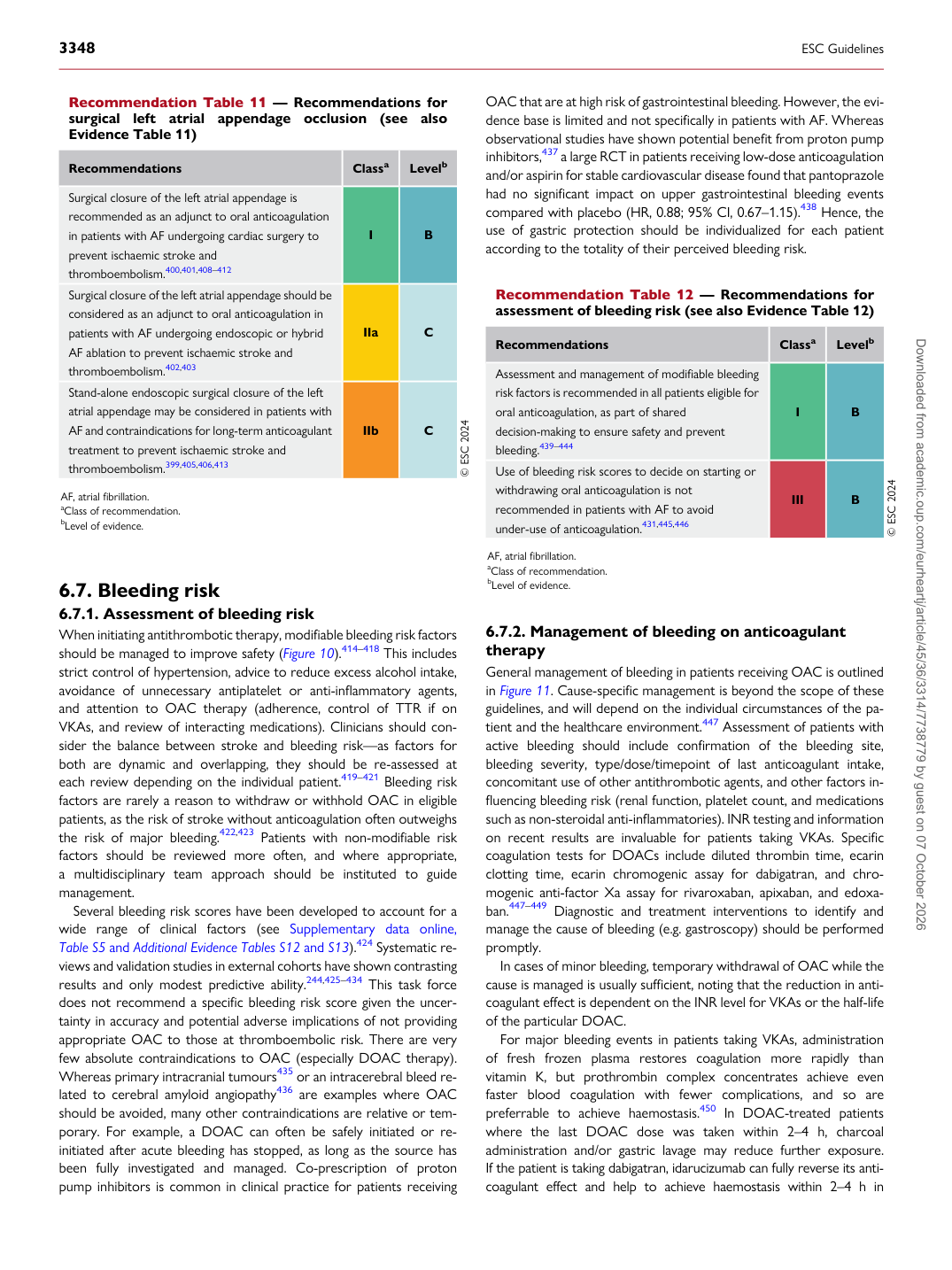
Recommendation Table 12 — Recommendations for assessment of bleeding risk (see also Evidence Table 12)

Recommendations Classa Levelb

Assessment and management of modifiable bleeding risk factors is recommended in all patients eligible for oral anticoagulation, as part of shared decision-making to ensure safety and prevent bleeding.439–444 I B Use of bleeding risk scores to decide on starting or withdrawing oral anticoagulation is not recommended in patients with AF to avoid under-use of anticoagulation.431,445,446 III B © ESC 2024

AF, atrial fibrillation. aClass of recommendation. bLevel of evidence.

Recommendation Table 11 — Recommendations for surgical left atrial appendage occlusion (see also Evidence Table 11)

Recommendations Classa Levelb

Surgical closure of the left atrial appendage is recommended as an adjunct to oral anticoagulation in patients with AF undergoing cardiac surgery to prevent ischaemic stroke and thromboembolism.400,401,408–412 I B Surgical closure of the left atrial appendage should be considered as an adjunct to oral anticoagulation in patients with AF undergoing endoscopic or hybrid AF ablation to prevent ischaemic stroke and thromboembolism.402,403 IIa C Stand-alone endoscopic surgical closure of the left atrial appendage may be considered in patients with AF and contraindications for long-term anticoagulant treatment to prevent ischaemic stroke and thromboembolism.399,405,406,413 IIb C © ESC 2024

AF, atrial fibrillation. aClass of recommendation. bLevel of evidence. Downloaded from academic.oup.com/eurheartj/article/45/36/3314/7738779 by guest on 07 October 2026