p.34 抽出テキスト
Watchman device. The 5-year pooled outcomes demonstrated a similar rate of the composite endpoint (cardiovascular or unexplained death, systemic embolism, and stroke) between the LAAO and warfarin arms. Those randomized to LAAO had significantly lower rates of haemorrhagic stroke and all-cause death, but also a 71% nonsignificant increase in ischaemic stroke and systemic embolism.364 With DOACs demonstrating similar rates of major bleeding to aspirin,242 warfarin in the control arms in these trials is no longer standard of care and hence the place of LAAO in current practice is unclear. The Amulet occluder is an alternative LAAO device which was non-inferior in an RCT to the Watchman device for safety events (procedure-related complications, death, or major bleeding) and thromboembolism.365 In the PRAGUE-17 trial, 402 AF patients were randomized to DOAC or LAAO (Watchman or Amulet), with noninferiority reported for a broad composite primary endpoint of stroke, TIA, systemic embolism, cardiovascular death, major or non-major clinically relevant bleeding, and procedure/device-related complications.366,367 Larger trials368,369 are expected to provide more comprehensive data that can add to the current evidence base (see Supplementary data online, Additional Evidence Table S10). Pending further RCTs (see Supplementary data online, Table S4), patients with a contraindication to all of the OAC options (the four DOACs and VKAs) have the most appropriate rationale for LAAO implantation, despite the paradox that the need for post-procedure antithrombotic treatment exposes the patient to a bleeding risk that may be equivalent to that of DOACs. Regulatory approvals based on RCT protocols suggest the need for 45 days of VKA plus aspirin after implantation, followed by 6 months of DAPT in patients with no major peri-device leaks, and then ongoing aspirin (see Supplementary data online, Figure S2).370–372 However, real-world practice is markedly different and also varied. Direct oral anticoagulant administration at full or reduced dose has been proposed as a treatment alternative to warfarin.373 Observational studies have also supported the use of antiplatelet therapy without associated increases in device-related thrombosis or stroke.374–376 In a propensity-matched comparison of patients receiving limited early OAC vs. antiplatelet treatment post-Watchman implantation, thromboembolic event rates and bleeding complications were similar.377 While waiting for solid RCT data (NCT03445949, NCT03568890),378 pertinent decisions on antithrombotic treatment are usually made on an individualized basis.379–381 Prevention of recurrent stroke, in addition to OAC, is another potential indication for LAAO. Only limited data are so far available from registries,382 with ongoing trials expected to provide more insight (NCT03642509, NCT05963698). Left atrial appendage occlusion device implantation is associated with procedural risk including stroke, major bleeding, devicerelated thrombus, pericardial effusion, vascular complications, and death.362,383–385 Voluntary registries enrolling patients considered ineligible for OAC have reported low peri-procedural risk,372,376,386,387 although national registries report in-hospital major adverse event rates of 9.5% in centres performing 5–15 LAAO cases per year, and 5.6% performing 32–211 cases per year (P < .001).388 Registries with new-generation devices report a lower complication rate compared with RCT data.389,390 Devicerelated thrombi occur with an incidence of 1.7%–7.2% and are associated with a higher risk of ischaemic stroke.386,391–397 Their detection can be documented as late as 1 year post-implantation in one-fifth of patients, thus mandating a late ‘rule-out’ imaging approach.391 Likewise, follow-up screening for peri-device leaks is relevant, as small leaks (0–5 mm) are present in ∼25% and have been associated with higher thromboembolic and bleeding events during 1 year follow-up in a large observational registry of one particular device.398

6.6 Surgical left atrial appendage occlusion

Surgical occlusion or exclusion of the left atrial appendage (LAA) can contribute to stroke prevention in patients with AF undergoing cardiac surgery.399,400 The Left Atrial Appendage Occlusion Study (LAAOS III) randomized 4811 patients with AF to undergo or not undergo LAAO at the time of cardiac surgery for another indication. During a mean of 3.8 years follow-up, ischaemic stroke or systemic embolism occurred in 114 patients (4.8%) in the occlusion group and 168 (7.0%) in the control arm (HR, 0.67; 95% CI, 0.53–0.85; P = .001).401 The LAAOS III trial did not compare appendage occlusion with anticoagulation (77% of participants continued to receive OAC), and therefore, surgical LAA closure should be considered as an adjunct therapy to prevent thromboembolism in addition to anticoagulation in patients with AF. There are no RCT data showing a beneficial effect on ischaemic stroke or systemic embolism in patients with AF undergoing LAAO during endoscopic or hybrid AF ablation. A meta-analysis of RCT and observational data showed no differences in stroke prevention or allcause mortality when comparing LAA clipping during thoracoscopic AF ablation with percutaneous LAAO and catheter ablation.402 While the percutaneous LAAO/catheter ablation group showed a higher acute success rate, it was also associated with a higher risk of haemorrhage during the peri-operative period. In an observational study evaluating 222 AF patients undergoing LAA closure using a clipping device as a part of endoscopic or hybrid AF ablation, complete closure was achieved in 95% of patients.403 There were no intra-operative complications, and freedom from a combined endpoint of ischaemic stroke, haemorrhagic stroke, or TIA was 99.1% over 369 patient-years of follow-up. Trials evaluating the beneficial effect of surgical LAA closure in patients undergoing cardiac surgery but without a known history of AF are ongoing (NCT03724318, NCT02701062).404 There is a potential advantage for stand-alone epicardial over percutaneous LAA closure in patients with a contraindication for OAC, as there is no need for post-procedure anticoagulation after epicardial closure. Observational data show that stand-alone LAA closure using an epicardial clip is feasible and safe.405 A multidisciplinary team approach can facilitate the choice between epicardial or percutaneous LAA closure in such patients.406 The majority of safety data and experience in epicardial LAA closure originate from a single clipping device (AtriClip)403,407,408 (see Supplementary data online, Additional Evidence Table S11).

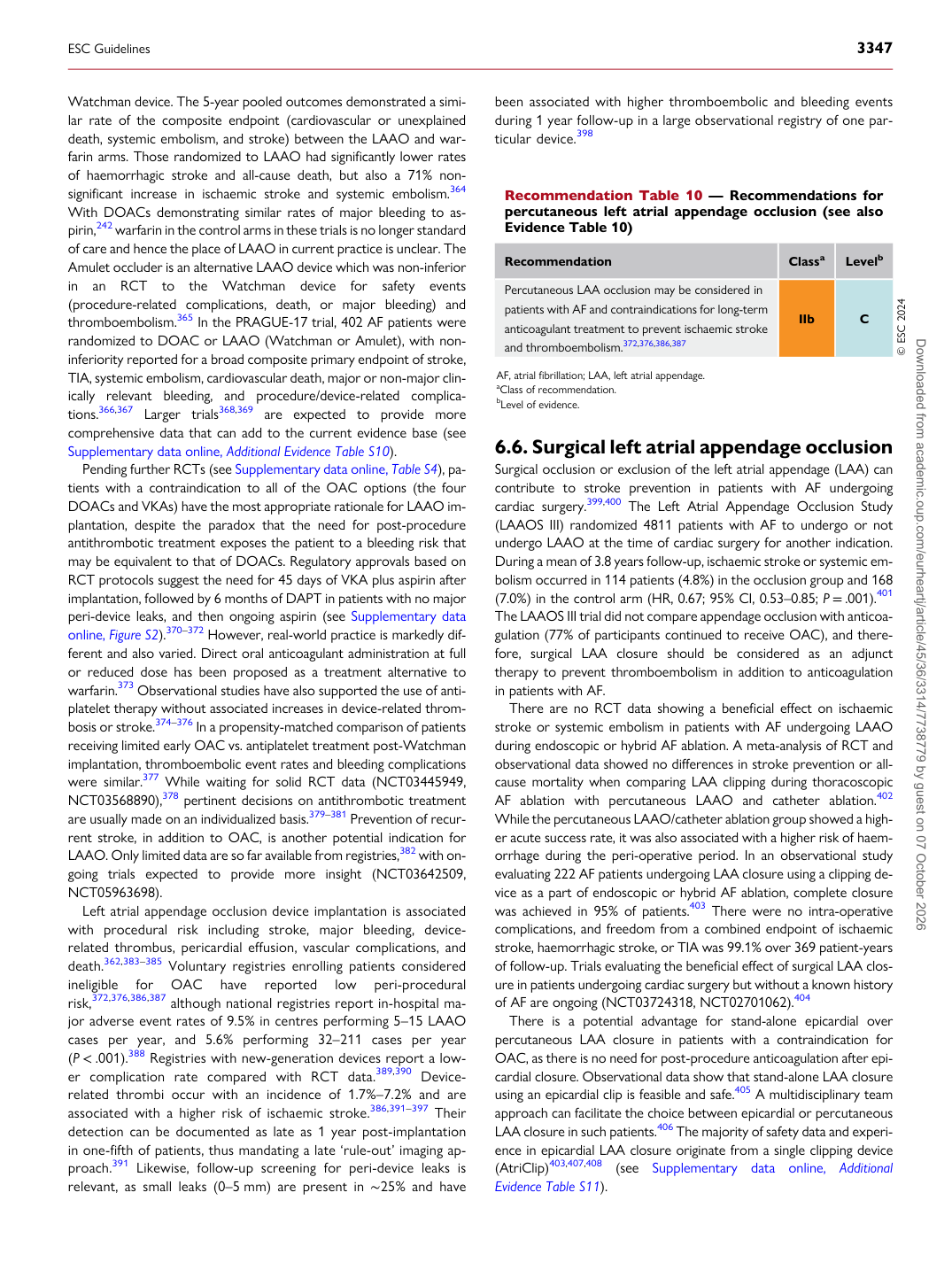
Recommendation Table 10 — Recommendations for percutaneous left atrial appendage occlusion (see also Evidence Table 10)

Recommendation Classa Levelb

Percutaneous LAA occlusion may be considered in patients with AF and contraindications for long-term anticoagulant treatment to prevent ischaemic stroke and thromboembolism.372,376,386,387 IIb C © ESC 2024

AF, atrial fibrillation; LAA, left atrial appendage. aClass of recommendation. bLevel of evidence.

ESC Guidelines                                                                                                                                                                                          3347

Downloaded from academic.oup.com/eurheartj/article/45/36/3314/7738779 by guest on 07 October 2026