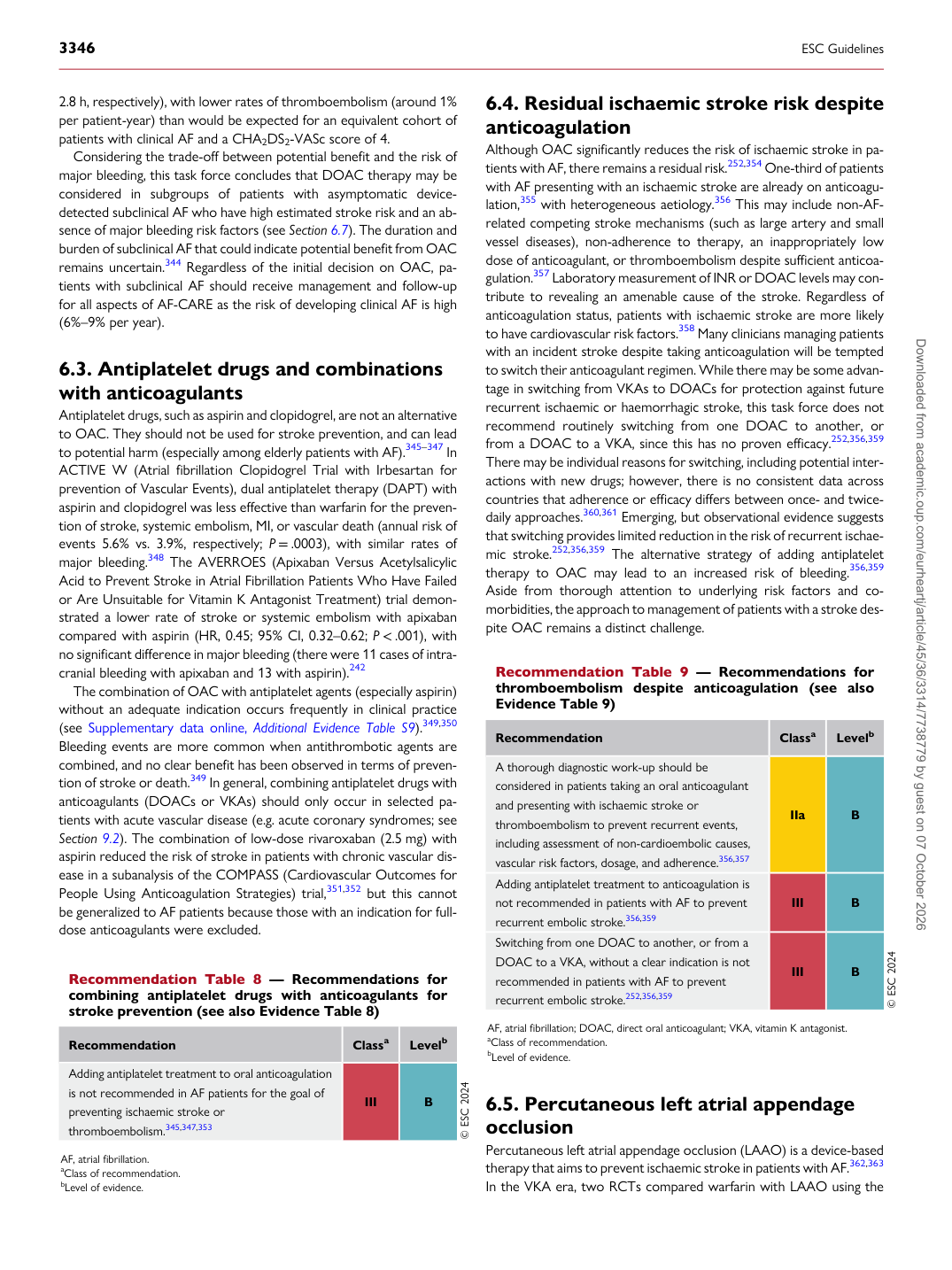
p.33 抽出テキスト
2.8 h, respectively), with lower rates of thromboembolism (around 1% per patient-year) than would be expected for an equivalent cohort of patients with clinical AF and a CHA2DS2-VASc score of 4. Considering the trade-off between potential benefit and the risk of major bleeding, this task force concludes that DOAC therapy may be considered in subgroups of patients with asymptomatic devicedetected subclinical AF who have high estimated stroke risk and an absence of major bleeding risk factors (see Section 6.7). The duration and burden of subclinical AF that could indicate potential benefit from OAC remains uncertain.344 Regardless of the initial decision on OAC, patients with subclinical AF should receive management and follow-up for all aspects of AF-CARE as the risk of developing clinical AF is high (6%–9% per year).

6.3 Antiplatelet drugs and combinations

with anticoagulants Antiplatelet drugs, such as aspirin and clopidogrel, are not an alternative to OAC. They should not be used for stroke prevention, and can lead to potential harm (especially among elderly patients with AF).345–347 In ACTIVE W (Atrial fibrillation Clopidogrel Trial with Irbesartan for prevention of Vascular Events), dual antiplatelet therapy (DAPT) with aspirin and clopidogrel was less effective than warfarin for the prevention of stroke, systemic embolism, MI, or vascular death (annual risk of events 5.6% vs. 3.9%, respectively; P = .0003), with similar rates of major bleeding.348 The AVERROES (Apixaban Versus Acetylsalicylic Acid to Prevent Stroke in Atrial Fibrillation Patients Who Have Failed or Are Unsuitable for Vitamin K Antagonist Treatment) trial demonstrated a lower rate of stroke or systemic embolism with apixaban compared with aspirin (HR, 0.45; 95% CI, 0.32–0.62; P < .001), with no significant difference in major bleeding (there were 11 cases of intracranial bleeding with apixaban and 13 with aspirin).242 The combination of OAC with antiplatelet agents (especially aspirin) without an adequate indication occurs frequently in clinical practice (see Supplementary data online, Additional Evidence Table S9).349,350 Bleeding events are more common when antithrombotic agents are combined, and no clear benefit has been observed in terms of prevention of stroke or death.349 In general, combining antiplatelet drugs with anticoagulants (DOACs or VKAs) should only occur in selected patients with acute vascular disease (e.g. acute coronary syndromes; see Section 9.2). The combination of low-dose rivaroxaban (2.5 mg) with aspirin reduced the risk of stroke in patients with chronic vascular disease in a subanalysis of the COMPASS (Cardiovascular Outcomes for People Using Anticoagulation Strategies) trial,351,352 but this cannot be generalized to AF patients because those with an indication for fulldose anticoagulants were excluded. 6.4 Residual ischaemic stroke risk despite

anticoagulation Although OAC significantly reduces the risk of ischaemic stroke in patients with AF, there remains a residual risk.252,354 One-third of patients with AF presenting with an ischaemic stroke are already on anticoagulation,355 with heterogeneous aetiology.356 This may include non-AFrelated competing stroke mechanisms (such as large artery and small vessel diseases), non-adherence to therapy, an inappropriately low dose of anticoagulant, or thromboembolism despite sufficient anticoagulation.357 Laboratory measurement of INR or DOAC levels may contribute to revealing an amenable cause of the stroke. Regardless of anticoagulation status, patients with ischaemic stroke are more likely to have cardiovascular risk factors.358 Many clinicians managing patients with an incident stroke despite taking anticoagulation will be tempted to switch their anticoagulant regimen. While there may be some advantage in switching from VKAs to DOACs for protection against future recurrent ischaemic or haemorrhagic stroke, this task force does not recommend routinely switching from one DOAC to another, or from a DOAC to a VKA, since this has no proven efficacy.252,356,359 There may be individual reasons for switching, including potential interactions with new drugs; however, there is no consistent data across countries that adherence or efficacy differs between once- and twicedaily approaches.360,361 Emerging, but observational evidence suggests that switching provides limited reduction in the risk of recurrent ischaemic stroke.252,356,359 The alternative strategy of adding antiplatelet therapy to OAC may lead to an increased risk of bleeding.356,359 Aside from thorough attention to underlying risk factors and comorbidities, the approach to management of patients with a stroke despite OAC remains a distinct challenge.

6.5 Percutaneous left atrial appendage

occlusion Percutaneous left atrial appendage occlusion (LAAO) is a device-based therapy that aims to prevent ischaemic stroke in patients with AF.362,363 In the VKA era, two RCTs compared warfarin with LAAO using the

Recommendation Table 9 — Recommendations for thromboembolism despite anticoagulation (see also Evidence Table 9)

Recommendation Classa Levelb

A thorough diagnostic work-up should be considered in patients taking an oral anticoagulant and presenting with ischaemic stroke or thromboembolism to prevent recurrent events, including assessment of non-cardioembolic causes, vascular risk factors, dosage, and adherence.356,357 IIa B Adding antiplatelet treatment to anticoagulation is not recommended in patients with AF to prevent recurrent embolic stroke.356,359 III B Switching from one DOAC to another, or from a DOAC to a VKA, without a clear indication is not recommended in patients with AF to prevent recurrent embolic stroke.252,356,359 III B © ESC 2024

AF, atrial fibrillation; DOAC, direct oral anticoagulant; VKA, vitamin K antagonist. aClass of recommendation. bLevel of evidence.

Recommendation Table 8 — Recommendations for combining antiplatelet drugs with anticoagulants for stroke prevention (see also Evidence Table 8)

Recommendation Classa Levelb

Adding antiplatelet treatment to oral anticoagulation is not recommended in AF patients for the goal of preventing ischaemic stroke or thromboembolism.345,347,353 III B © ESC 2024

AF, atrial fibrillation. aClass of recommendation. bLevel of evidence. Downloaded from academic.oup.com/eurheartj/article/45/36/3314/7738779 by guest on 07 October 2026