p.31 抽出テキスト
6.2.1 Direct oral anticoagulants

The DOACs (apixaban, dabigatran, edoxaban, and rivaroxaban) have all demonstrated at least non-inferior efficacy compared with warfarin for the prevention of thromboembolism, but with the added benefit of a 50% reduction in intracranial haemorrhage (ICH).25–28 Meta-analyses of individual data from 71 683 RCT patients showed that standard, full-dose DOAC treatment compared with warfarin reduces the risk of stroke or systemic embolism (HR, 0.81; 95% CI, 0.73–0.91), all-cause mortality (HR, 0.90; 95% CI, 0.85–0.95), and intracranial bleeding (HR, 0.48; 95% CI, 0.39–0.59), with no significant difference in other major bleeding (HR, 0.86; 95% CI, 0.73–1.00) and little or no between-trial heterogeneity.292 Post-marketing observational data on the effectiveness and safety of dabigatran,313,314 rivaroxaban,315,316 apixaban,317 and edoxaban318 vs. warfarin show general consistency with the respective phase 3 RCTs. For patients undergoing cardioversion, three underpowered trials showed non-significantly lower rates of cardiovascular events with DOACs compared with warfarin.319–321 In meta-analysis of these 5203 patients predominantly undergoing electrical cardioversion, the composite of stroke, systemic embolism, myocardial infarction (MI), and cardiovascular death was significantly lower at 0.42% in patients randomized to a DOAC vs. 0.98% in those allocated VKA (risk ratio, 0.42; 95% CI, 0.21–0.86; P = .017), with no heterogeneity between trials and no significant difference in major bleeding.293

Specific patient subgroups show consistent benefit with DOACs vs. VKAs. For heart failure, major thromboembolic events were lower in DOAC-treated patients vs. warfarin in subgroup analysis of landmark RCTs,322 confirmed in large-scale real-world data.323 In a retrospective cohort of patients aged over 80 years, DOAC use was associated with a lower risk of ischaemic stroke, dementia, mortality, and major bleeding than warfarin,324 but this may be confounded by prescription bias. Direct oral anticoagulants retain their efficacy and safety over VKAs in patients with mild-to-moderate CKD (creatinine clearance [CrCl] >30 mL/min),325 although specific dosing adjustments apply.25–28,326 In Europe, reduced doses of rivaroxaban, apixaban, and edoxaban are approved in patients with severe CKD (CrCl 15–29 mL/ min), although limited numbers of patients were included in the major RCTs against VKA.327 Dabigatran is more dependent on renal elimination and so is contraindicated with an estimated glomerular filtration rate <30 mL/min/1.73 m2. Small trials have been performed in patients on haemodialysis, with two finding no difference between apixaban 2.5 mg twice daily and VKA for efficacy or safety outcomes,328,329 and one trial showing that rivaroxaban 10 mg led to significantly lower rates of cardiovascular events and major bleeding compared with VKA.330 Careful institution and regular follow-up are advised when instituting anticoagulants in any patient with impaired renal function (See Supplementary data online, Additional Evidence Table 8).326 Direct oral anticoagulants as a class should be avoided in specific patient groups, such as those with mechanical heart valves or moderate-to-severe mitral stenosis. In patients with mechanical heart valves, an excess of thromboembolic and major bleeding events among patients on dabigatran therapy vs. VKA was observed, with an RCT terminated prematurely.331 A trial of apixaban vs. VKA after implantation of a mechanical aortic valve was also stopped due to excess thromboembolic events in the apixaban group.332 The restriction on DOAC use does not apply to bioprosthetic heart valves (including mitral) or after transcatheter aortic valve implantation, where DOACs can be used and trial data show non-inferiority for clinical events compared with VKAs.304,333,334 With regards to mitral stenosis, the DOAC vs. VKA trials excluded patients with moderate-to-severe disease. In 4531 randomized patients with rheumatic heart disease and AF, VKAs led to a lower rate of composite cardiovascular events and death than rivaroxaban, without a higher rate of bleeding.294 Eighty-two per cent of the patients included had a mitral valve area ≤2 cm, supporting the restriction of DOAC use in patients with moderate-to-severe mitral stenosis. Note that patients with other types of valve disease (mitral regurgitation and others) should preferentially be prescribed a DOAC, and the term ‘valvular’ AF is obsolete and should be avoided. Inappropriate dose reductions for DOACs are frequent in clinical practice,311 but need to be avoided as they increase the risk of stroke without decreasing bleeding risk.310 Hence, DOAC therapy should be instituted according to the standard full dose as tested in phase 3 RCTs and approved by regulators (Table 11). The prescribed dosage should consider the individual patient’s profile.335 Drug interactions need to be considered in all patients taking or planned for DOACs (see Figure 9 for common drug interactions).336 There is insufficient evidence currently to advise on routine laboratory testing for DOAC levels. However, in certain situations, measurement of DOAC levels (where available) may be helpful, such as severe bleeding, the need for urgent surgery, or thromboembolic events despite apparent DOAC compliance.337,338 Patients should always be involved in decision-making on anticoagulation,339 leading to better alignment with personal preferences that can help to increase understanding and adherence.

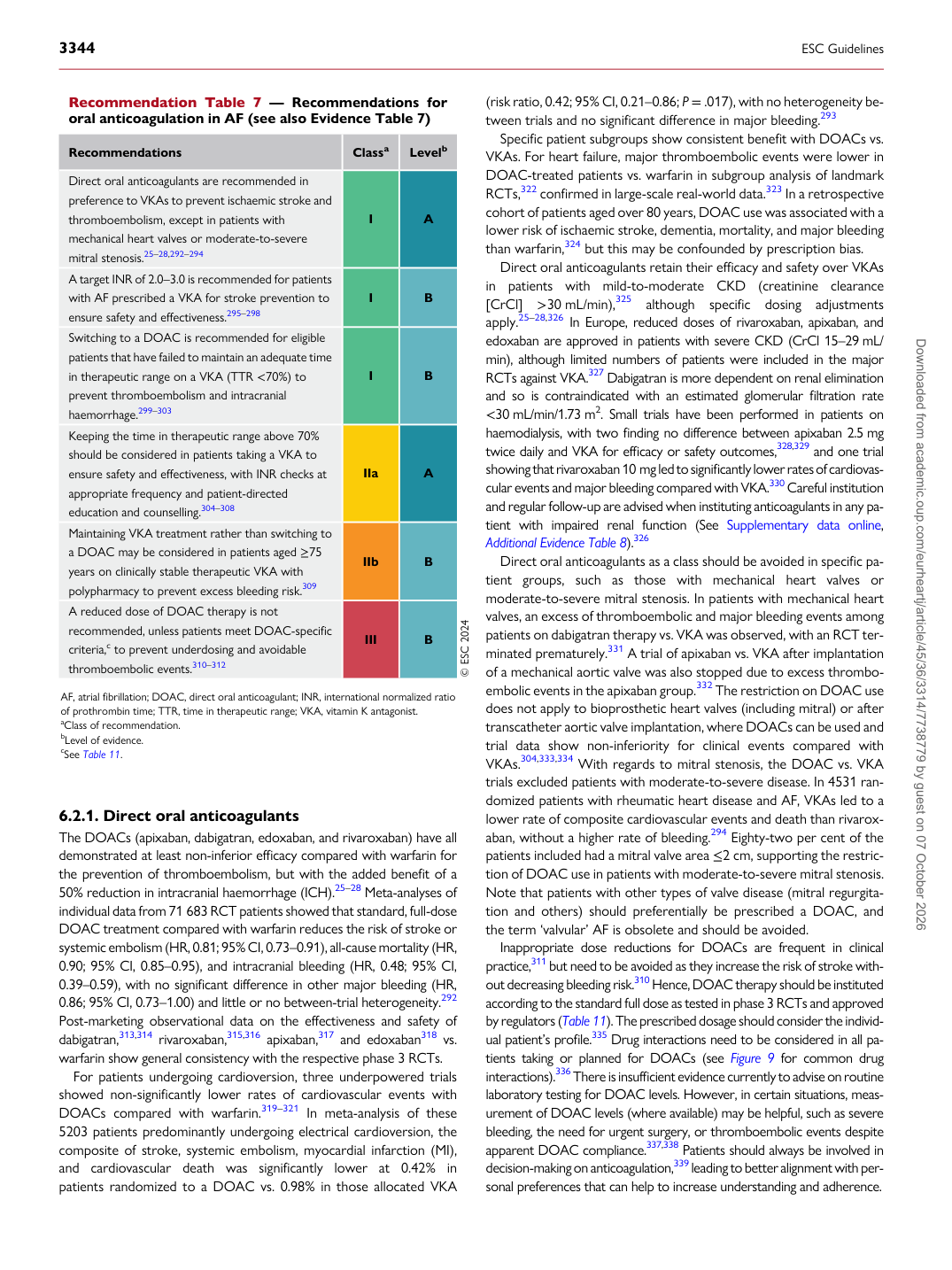
Recommendation Table 7 — Recommendations for oral anticoagulation in AF (see also Evidence Table 7)

Recommendations Classa Levelb

Direct oral anticoagulants are recommended in preference to VKAs to prevent ischaemic stroke and thromboembolism, except in patients with mechanical heart valves or moderate-to-severe mitral stenosis.25–28,292–294 I A A target INR of 2.0–3.0 is recommended for patients with AF prescribed a VKA for stroke prevention to ensure safety and effectiveness.295–298 I B Switching to a DOAC is recommended for eligible patients that have failed to maintain an adequate time in therapeutic range on a VKA (TTR <70%) to prevent thromboembolism and intracranial haemorrhage.299–303 I B Keeping the time in therapeutic range above 70% should be considered in patients taking a VKA to ensure safety and effectiveness, with INR checks at appropriate frequency and patient-directed education and counselling.304–308 IIa A Maintaining VKA treatment rather than switching to a DOAC may be considered in patients aged ≥75 years on clinically stable therapeutic VKA with polypharmacy to prevent excess bleeding risk.309 IIb B A reduced dose of DOAC therapy is not recommended, unless patients meet DOAC-specific criteria,c to prevent underdosing and avoidable thromboembolic events.310–312 III B © ESC 2024

AF, atrial fibrillation; DOAC, direct oral anticoagulant; INR, international normalized ratio of prothrombin time; TTR, time in therapeutic range; VKA, vitamin K antagonist. aClass of recommendation. bLevel of evidence. cSee Table 11. Downloaded from academic.oup.com/eurheartj/article/45/36/3314/7738779 by guest on 07 October 2026