p.29 抽出テキスト
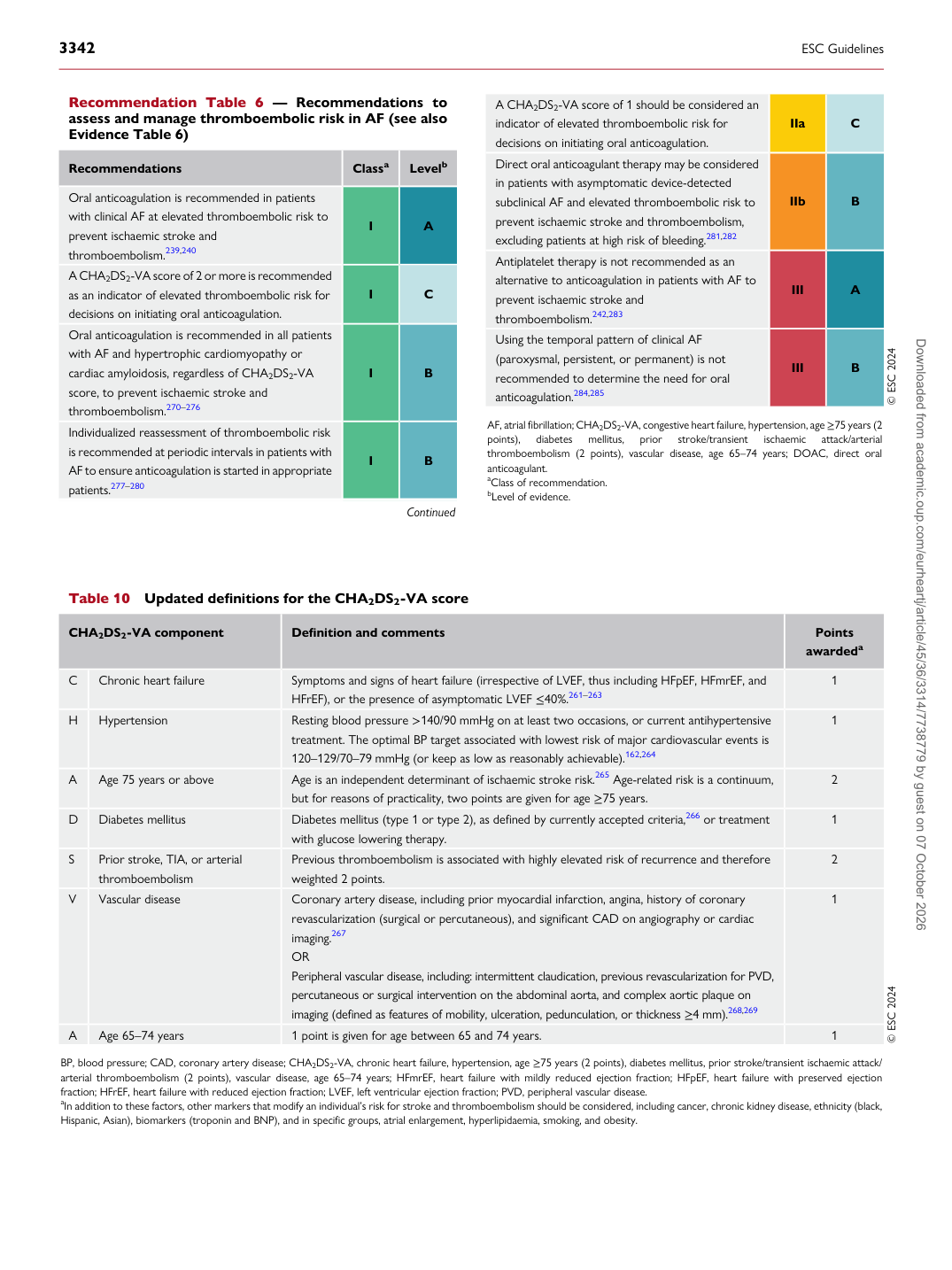
Recommendation Table 6 — Recommendations to assess and manage thromboembolic risk in AF (see also Evidence Table 6)

Recommendations Classa Levelb

Oral anticoagulation is recommended in patients with clinical AF at elevated thromboembolic risk to prevent ischaemic stroke and thromboembolism.239,240 I A A CHA2DS2-VA score of 2 or more is recommended as an indicator of elevated thromboembolic risk for decisions on initiating oral anticoagulation. I C Oral anticoagulation is recommended in all patients with AF and hypertrophic cardiomyopathy or cardiac amyloidosis, regardless of CHA2DS2-VA score, to prevent ischaemic stroke and thromboembolism.270–276 I B Individualized reassessment of thromboembolic risk is recommended at periodic intervals in patients with AF to ensure anticoagulation is started in appropriate patients.277–280 I B

Continued A CHA2DS2-VA score of 1 should be considered an

indicator of elevated thromboembolic risk for decisions on initiating oral anticoagulation. IIa C Direct oral anticoagulant therapy may be considered in patients with asymptomatic device-detected subclinical AF and elevated thromboembolic risk to prevent ischaemic stroke and thromboembolism, excluding patients at high risk of bleeding.281,282 IIb B Antiplatelet therapy is not recommended as an alternative to anticoagulation in patients with AF to prevent ischaemic stroke and thromboembolism.242,283 III A Using the temporal pattern of clinical AF (paroxysmal, persistent, or permanent) is not recommended to determine the need for oral anticoagulation.284,285 III B © ESC 2024

AF, atrial fibrillation; CHA2DS2-VA, congestive heart failure, hypertension, age ≥75 years (2 points), diabetes mellitus, prior stroke/transient ischaemic attack/arterial thromboembolism (2 points), vascular disease, age 65–74 years; DOAC, direct oral anticoagulant. aClass of recommendation. bLevel of evidence.

Table 10 Updated definitions for the CHA2DS2-VA score

CHA2DS2-VA component Definition and comments Points

awardeda

C Chronic heart failure Symptoms and signs of heart failure (irrespective of LVEF, thus including HFpEF, HFmrEF, and HFrEF), or the presence of asymptomatic LVEF ≤40%.261–263 1 H Hypertension Resting blood pressure >140/90 mmHg on at least two occasions, or current antihypertensive treatment. The optimal BP target associated with lowest risk of major cardiovascular events is

120–129/70–79 mmHg (or keep as low as reasonably achievable).162,264 1

A Age 75 years or above Age is an independent determinant of ischaemic stroke risk.265 Age-related risk is a continuum,

but for reasons of practicality, two points are given for age ≥75 years. 2

D Diabetes mellitus Diabetes mellitus (type 1 or type 2), as defined by currently accepted criteria,266 or treatment

with glucose lowering therapy.

1 S Prior stroke, TIA, or arterial

thromboembolism Previous thromboembolism is associated with highly elevated risk of recurrence and therefore

weighted 2 points. 2

V Vascular disease Coronary artery disease, including prior myocardial infarction, angina, history of coronary

revascularization (surgical or percutaneous), and significant CAD on angiography or cardiac imaging.267 OR Peripheral vascular disease, including: intermittent claudication, previous revascularization for PVD, percutaneous or surgical intervention on the abdominal aorta, and complex aortic plaque on imaging (defined as features of mobility, ulceration, pedunculation, or thickness ≥4 mm).268,269 1

A Age 65–74 years 1 point is given for age between 65 and 74 years. 1 © ESC 2024

BP, blood pressure; CAD, coronary artery disease; CHA2DS2-VA, chronic heart failure, hypertension, age ≥75 years (2 points), diabetes mellitus, prior stroke/transient ischaemic attack/ arterial thromboembolism (2 points), vascular disease, age 65–74 years; HFmrEF, heart failure with mildly reduced ejection fraction; HFpEF, heart failure with preserved ejection fraction; HFrEF, heart failure with reduced ejection fraction; LVEF, left ventricular ejection fraction; PVD, peripheral vascular disease. aIn addition to these factors, other markers that modify an individual’s risk for stroke and thromboembolism should be considered, including cancer, chronic kidney disease, ethnicity (black, Hispanic, Asian), biomarkers (troponin and BNP), and in specific groups, atrial enlargement, hyperlipidaemia, smoking, and obesity. Downloaded from academic.oup.com/eurheartj/article/45/36/3314/7738779 by guest on 07 October 2026