p.26 抽出テキスト
5.1 Hypertension

Hypertension in patients with AF is associated with an increased risk of stroke, heart failure, major bleeding, and cardiovascular mortality.158–161 The target for treated systolic blood pressure (BP) in most adults is 120–129 mmHg. Where BP-lowering treatment is poorly tolerated, clinically significant frailty exists or the patient’s age is 85 years or older, a more lenient target of <140 mmHg is acceptable or ‘as low as reasonably achievable’. On-treatment diastolic BP should ideally be 70–79 mmHg.162 In an individual participant data meta-analysis of 22 randomized trials reporting baseline AF, a 5 mmHg reduction in systolic BP reduced the risk of major cardiovascular events by 9% (HR, 0.91; 95% CI, 0.83–1.00), with identical effect in patients with AF or sinus rhythm.129 In individuals with AF, hypertension often coexists with other modifiable and non-modifiable risk factors that all contribute to recurrence of AF, readmission to hospital, and ongoing symptoms after rhythm control.163–171 Optimal control of blood pressure should be considered an essential component of treating AF and undertaken within a strategy of comprehensive risk factor management.126–128 Although the majority of research has focused on clinical outcomes, limited comparative data on hypertension medication suggests that use of angiotensin-converting enzyme (ACE) inhibitors or angiotensin receptor blockers (ARB) may be superior for prevention of recurrent AF.172–175

5.2 Heart failure

Heart failure is a key determinant of prognosis in patients with AF, as well as an important factor associated with recurrence and progression of AF.176,177 During 30 years of follow-up in the Framingham cohort, 57% of those with new heart failure had concomitant AF, and 37% of those with new AF had heart failure.178 Numerous cardiovascular and non-cardiovascular conditions impact the development of both AF and heart failure, leading to the common pathway of atrial cardiomyopathy.18 In patients with acute heart failure attending the emergency department, AF is one of the most prevalent triggering factors of the episode.179 The development of heart failure in patients with AF is associated with a two-fold increase in stroke and thromboembolism,180 even after anticoagulation,181 and 25% higher all-cause mortality.178 Prognosis may be affected by left ventricular ejection fraction (LVEF), with the rate of death highest with the combination of AF and heart failure with reduced ejection fraction (HFrEF) (LVEF ≤ 40%), as compared with AF and HFpEF (LVEF ≥ 50%). However, rates of stroke and incident heart failure hospitalization are similar regardless of LVEF.182 Due to how common concomitant AF and heart failure are in clinical practice, strategies to improve outcomes in these patients are detailed within each component of the AF-CARE pathway. However, it is also critical that heart failure itself is managed appropriately in patients with AF to prevent avoidable adverse events. Optimization of heart failure management should follow current ESC Guidelines: 2023 Focused Update183 of the 2021 ESC Guidelines for the diagnosis and treatment of acute and chronic heart failure.137 Achieving euvolaemia with diuretics is an important first step that not only manages the heart failure component, but can also facilitate better control of heart rate in AF. For HFrEF, it should be highlighted that many older guideline-recommended therapies lack specific evidence for benefit in patients with coexisting AF. No trial data are available in this context for ACE inhibitors, there are conflicting data on ARBs,132,184 and an individual patient-level analysis of RCTs found no

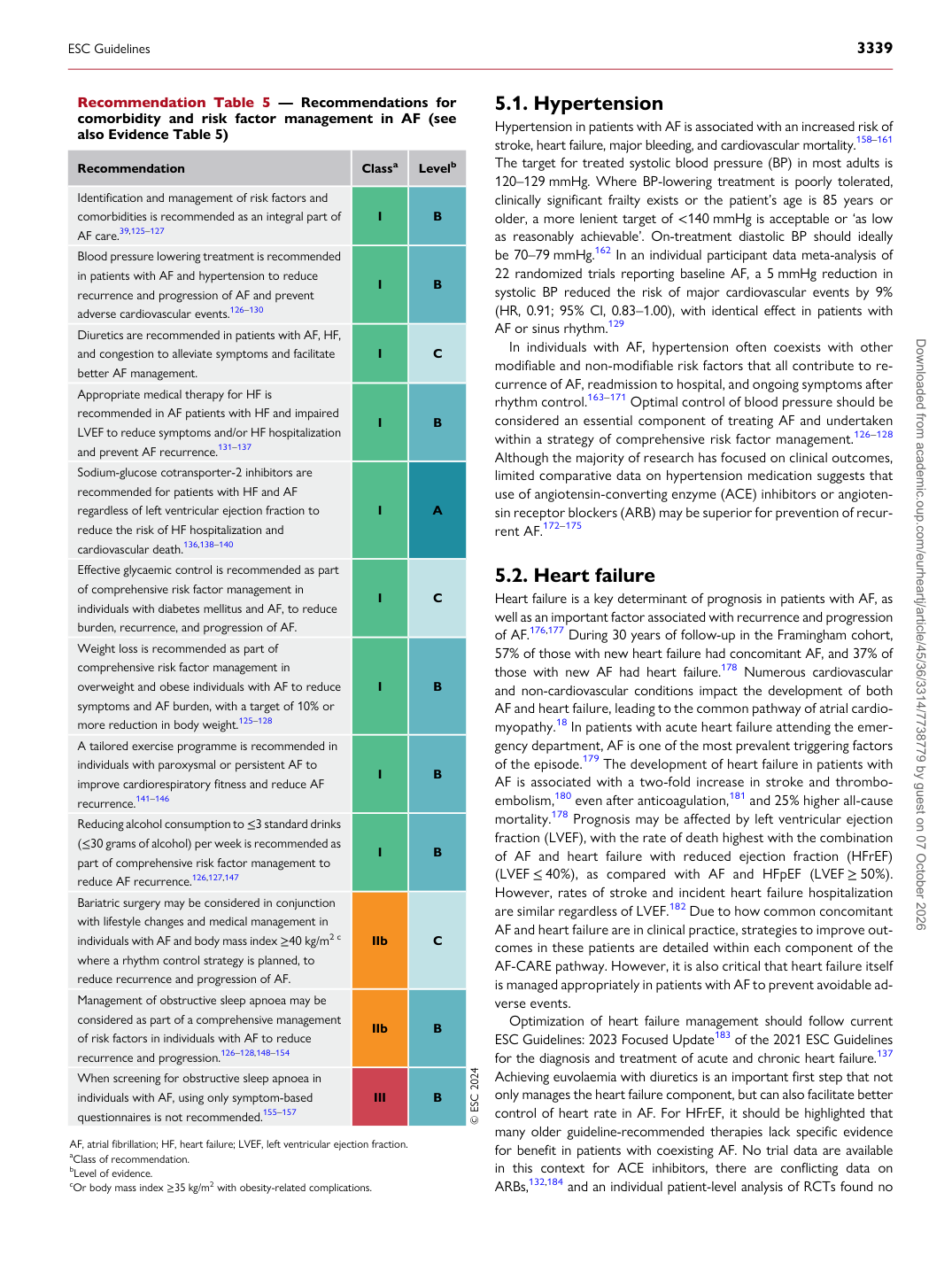
Recommendation Table 5 — Recommendations for comorbidity and risk factor management in AF (see also Evidence Table 5)

Recommendation Classa Levelb

Identification and management of risk factors and comorbidities is recommended as an integral part of AF care.39,125–127 I B Blood pressure lowering treatment is recommended in patients with AF and hypertension to reduce recurrence and progression of AF and prevent adverse cardiovascular events.126–130 I B Diuretics are recommended in patients with AF, HF, and congestion to alleviate symptoms and facilitate better AF management. I C Appropriate medical therapy for HF is recommended in AF patients with HF and impaired LVEF to reduce symptoms and/or HF hospitalization and prevent AF recurrence.131–137 I B Sodium-glucose cotransporter-2 inhibitors are recommended for patients with HF and AF regardless of left ventricular ejection fraction to reduce the risk of HF hospitalization and cardiovascular death.136,138–140 I A Effective glycaemic control is recommended as part of comprehensive risk factor management in individuals with diabetes mellitus and AF, to reduce burden, recurrence, and progression of AF. I C Weight loss is recommended as part of comprehensive risk factor management in overweight and obese individuals with AF to reduce symptoms and AF burden, with a target of 10% or more reduction in body weight.125–128 I B A tailored exercise programme is recommended in individuals with paroxysmal or persistent AF to improve cardiorespiratory fitness and reduce AF recurrence.141–146 I B Reducing alcohol consumption to ≤3 standard drinks (≤30 grams of alcohol) per week is recommended as part of comprehensive risk factor management to reduce AF recurrence.126,127,147 I B Bariatric surgery may be considered in conjunction with lifestyle changes and medical management in individuals with AF and body mass index ≥40 kg/m2 c where a rhythm control strategy is planned, to reduce recurrence and progression of AF. IIb C Management of obstructive sleep apnoea may be considered as part of a comprehensive management of risk factors in individuals with AF to reduce recurrence and progression.126–128,148–154 IIb B When screening for obstructive sleep apnoea in individuals with AF, using only symptom-based questionnaires is not recommended.155–157 III B © ESC 2024

AF, atrial fibrillation; HF, heart failure; LVEF, left ventricular ejection fraction. aClass of recommendation. bLevel of evidence. cOr body mass index ≥35 kg/m2 with obesity-related complications.

ESC Guidelines                                                                                                                                                                                          3339

Downloaded from academic.oup.com/eurheartj/article/45/36/3314/7738779 by guest on 07 October 2026