p.22 抽出テキスト
Rate control target = resting heart rate <110 b.p.m. (lenient control),

with stricter control with continuing symptoms

(Class IIa)

Beta-blocker

or digoxin (Class I) Patient with paroxysmal AF

LVEF ≤40%

Beta-blocker, digoxin, diltiazem or verapamil

(Class I) Combination rate control therapy

(Class IIa)

Combination rate control therapy

(Class IIa)

Amiodarone

(Class I) Dronedarone, flecainide

or propafenone

(Class I)

Catheter ablation

(Class I) Amiodarone or

dronedarone

(Class I)

Sotalol (Class IIb)

HFrEF (LVEF ≤40%) Stable HFmrEF (LVEF 41–49%), coronary heart disease,

valvular heart disease Absence or minimal heart

disease

Sotalol (Class IIb)

Recurrence of AF symptoms

Antiarrhythmic drug therapy Y N

Shared decision-making on rhythm control

(Class I)

If failed antiarrhythmic

drug therapy If failed catheter

ablation

Re-do catheter ablation

(Class IIa) Surgical/hybrid ablation

(Class IIb) Antiarrhythmic drug

therapy (see above)

Catheter ablationa

(Class I)

Shared decision-making

(Class I)

Follow AF-CARE for [C] comorbidity and risk factor management & [A] avoid stroke and thromboembolism

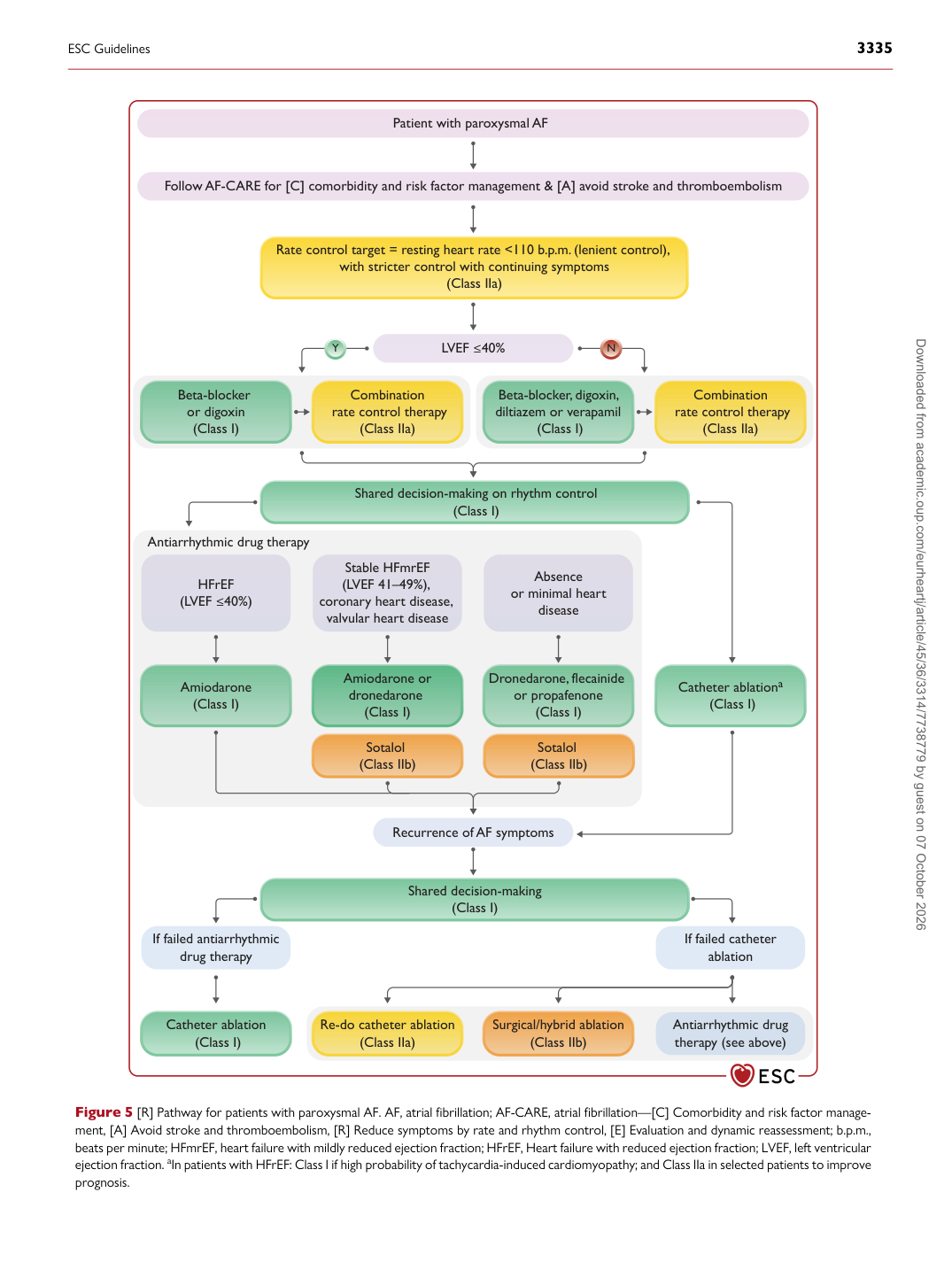
Figure 5 [R] Pathway for patients with paroxysmal AF. AF, atrial fibrillation; AF-CARE, atrial fibrillation—[C] Comorbidity and risk factor management, [A] Avoid stroke and thromboembolism, [R] Reduce symptoms by rate and rhythm control, [E] Evaluation and dynamic reassessment; b.p.m., beats per minute; HFmrEF, heart failure with mildly reduced ejection fraction; HFrEF, Heart failure with reduced ejection fraction; LVEF, left ventricular ejection fraction. aIn patients with HFrEF: Class I if high probability of tachycardia-induced cardiomyopathy; and Class IIa in selected patients to improve prognosis.

ESC Guidelines                                                                                                                                                                                          3335

Downloaded from academic.oup.com/eurheartj/article/45/36/3314/7738779 by guest on 07 October 2026