p.20 抽出テキスト
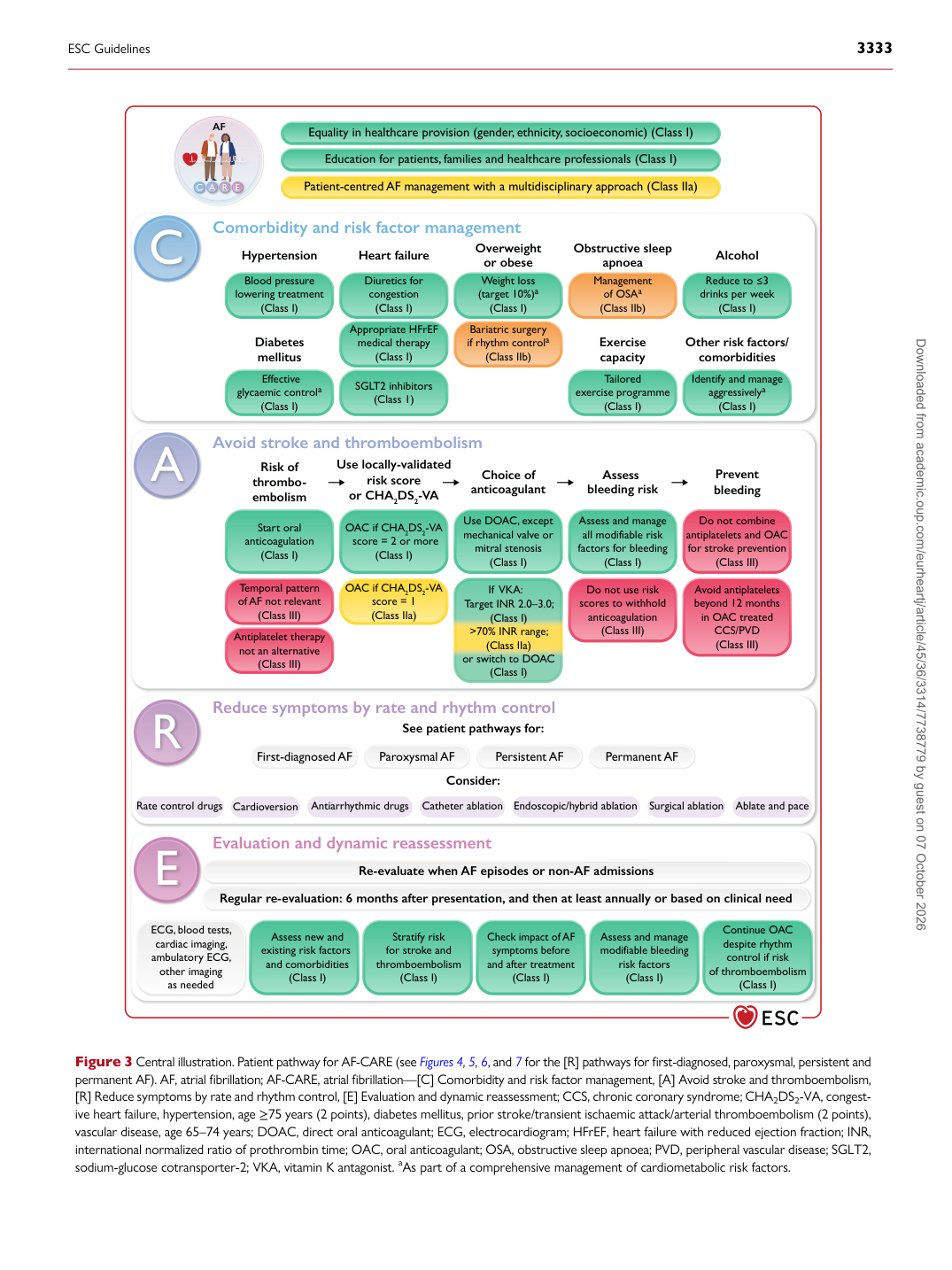
C Comorbidity and risk factor management Hypertension Diabetes mellitus Blood pressure lowering treatment (Class I) Patient-centred AF management with a multidisciplinary approach (Class IIa) Education for patients, families and healthcare professionals (Class I) Equality in healthcare provision (gender, ethnicity, socioeconomic) (Class I) Heart failure Diuretics for congestion (Class I) Overweight or obese Weight loss (target 10%)a (Class I) Obstructive sleep apnoea Management of OSAa (Class IIb) Appropriate HFrEF medical therapy (Class I) Bariatric surgery if rhythm controla (Class IIb) SGLT2 inhibitors (Class 1) Alcohol Reduce to 3 drinks per week (Class I) Effective glycaemic controla (Class I) Exercise capacity Tailored exercise programme (Class I) Other risk factors/ comorbidities Identify and manage aggressivelya (Class I) A Avoid stroke and thromboembolism Risk of thromboembolism Start oral anticoagulation (Class I) Use locally-validated risk score or CHA2DS2-VA OAC if CHA2DS2-VA score = 2 or more (Class I) Choice of anticoagulant Assess bleeding risk OAC if CHA2DS2-VA score = 1 (Class IIa) Use DOAC, except mechanical valve or mitral stenosis (Class I) Target INR 2.0–3.0; (Class I) >70% INR range; (Class IIa) or switch to DOAC (Class I) Assess and manage all modifiable risk factors for bleeding (Class I) Do not use risk scores to withhold anticoagulation (Class III) Do not combine antiplatelets and OAC for stroke prevention (Class III) Avoid antiplatelets beyond 12 months in OAC treated CCS/PVD (Class III) Temporal pattern of AF not relevant (Class III) Antiplatelet therapy not an alternative (Class III) Prevent bleeding R Reduce symptoms by rate and rhythm control E Evaluation and dynamic reassessment See patient pathways for: First-diagnosed AF Paroxysmal AF Persistent AF Permanent AF Consider: AF C A R E If VKA: Rate control drugs Ablate and pace Cardioversion Catheter ablation Endoscopic/hybrid ablation Surgical ablation Antiarrhythmic drugs Re-evaluate when AF episodes or non-AF admissions ECG, blood tests, cardiac imaging, ambulatory ECG, other imaging as needed Assess new and existing risk factors and comorbidities (Class I) Stratify risk for stroke and thromboembolism (Class I) Check impact of AF symptoms before and after treatment (Class I) Assess and manage modifiable bleeding risk factors (Class I) Continue OAC despite rhythm control if risk of thromboembolism (Class I) Regular re-evaluation: 6 months after presentation, and then at least annually or based on clinical need Figure 3 Central illustration. Patient pathway for AF-CARE (see Figures 4, 5, 6, and 7 for the [R] pathways for first-diagnosed, paroxysmal, persistent and permanent AF). AF, atrial fibrillation; AF-CARE, atrial fibrillation—[C] Comorbidity and risk factor management, [A] Avoid stroke and thromboembolism, [R] Reduce symptoms by rate and rhythm control, [E] Evaluation and dynamic reassessment; CCS, chronic coronary syndrome; CHA2DS2-VA, congestive heart failure, hypertension, age ≥75 years (2 points), diabetes mellitus, prior stroke/transient ischaemic attack/arterial thromboembolism (2 points), vascular disease, age 65–74 years; DOAC, direct oral anticoagulant; ECG, electrocardiogram; HFrEF, heart failure with reduced ejection fraction; INR, international normalized ratio of prothrombin time; OAC, oral anticoagulant; OSA, obstructive sleep apnoea; PVD, peripheral vascular disease; SGLT2, sodium-glucose cotransporter-2; VKA, vitamin K antagonist. aAs part of a comprehensive management of cardiometabolic risk factors. ESC Guidelines 3333 Downloaded from academic.oup.com/eurheartj/article/45/36/3314/7738779 by guest on 07 October 2026