p.19 抽出テキスト
4.1.3 Education of healthcare professionals

Gaps in knowledge and skills across all domains of AF care are consistently described among cardiologists, neurologists, internal medicine specialists, emergency physicians, general practitioners, nurses, and allied health practitioners.96–98 Healthcare professionals involved in multidisciplinary AF management should have a knowledge of all available options for diagnosis and treatment.99–101 In the STEEER-AF trial,99 real-world adherence to clinical practice guidelines for AF across six ESC countries was poor. These findings highlight the critical need for appropriate training and education of healthcare professionals.102 Specifically targeted education for healthcare professionals can increase knowledge and lead to more appropriate use of OAC for prevention of thromboembolism.103 However, educational interventions for healthcare providers are often not enough to sustainably impact behaviour.104 Other tools may be needed, such as active feedback,103 clinical decision support tools,105 expert consultation,106 or e-Health learning.107

4.1.4 Inclusive management of AF

Evidence is growing on differences in AF incidence, prevalence, risk factors, comorbidities, and outcomes according to gender.108 Women diagnosed with AF are generally older, have more hypertension and heart failure with preserved ejection fraction (HFpEF), and have less diagnosed coronary artery disease (CAD).109 Registry studies have reported differences in outcomes, with higher morbidity and mortality in women, although these may be confounded by age and comorbidity burden.110–112 Women with AF may be more symptomatic, and report a lower quality of life.41,113 It is unclear whether this is related to delayed medical assessment in women, or whether there are genuine sex differences. Despite a higher symptom load, women are less likely to undergo AF ablation than men, even though antiarrhythmic drug therapy seems to be associated with more proarrhythmic events in women.109 These observations call for more research on gender differences in order to prevent disparities and inequality in care. Other diversity aspects such as age, race, ethnicity, and transgender issues, as well as social determinants (including socioeconomic status, disability, education level, health literacy, and rural/urban location) are important contributors to inequality that should be actively considered to improve patient outcomes.114

4.2 Principles of AF-CARE

The 2024 ESC Guidelines for the management of AF have compiled and evolved past approaches to create principles of management to aid implementation of these guidelines, and hence improve patient care and outcomes. There is growing evidence that clinical support tools115–118 can aid best-practice management, with the caveat that any tool is a guide only, and that all patients require personalized attention. The AF-CARE approach covers many established principles in the management of AF, but does so in a systematic, time-orientated format with four essential treatment pillars (Figure 3; central illustration). Joint management with each patient forms the starting point of the AF-CARE approach. Notably, it takes account of the growing evidence base that therapies for AF are most effective when associated health conditions are addressed. A careful search for these comorbidities and risk factors [C] is critical and should be applied in all patients with a diagnosis of AF. Avoidance of stroke and thromboembolism [A] in patients with risk factors is considered next, focused on appropriate use of anticoagulant therapy. Reducing AF-related symptoms and morbidity by effective use of heart rate and rhythm control [R] is then applied, which in selected patients may also reduce hospitalization or improve prognosis. The potential benefit of rhythm control, accompanied by consideration of all risks involved, should be considered in all patients at each contact point with healthcare professionals. As AF, and its related comorbidities, changes over time, different levels of evaluation [E] and re-evaluation are required in each patient, and these approaches should be dynamic. Due to the wide variability in response to therapy, and the changing pathophysiology of AF as age and comorbidities advance, reassessment should be built into the standard care pathway to prevent adverse outcomes for patients and improve population health.

AF-CARE builds upon prior ESC Guidelines, e.g. the five-step outcome-focused integrated approach in the 2016 ESC Guidelines for the management of AF,119 and the AF Better Care (ABC) pathway in the 2020 ESC Guidelines for the diagnosis and management of AF.120 The reorganization into AF-CARE was based on the parallel developments in new approaches and technologies (in particular for rhythm control), with new evidence consistently suggesting that all aspects of AF management are more effective when comorbidities and risk factors have been considered. This includes management relating to symptom benefit, improving prognosis, prevention of thromboembolism, and the response to rate and rhythm control strategies. AF-CARE makes explicit the need for individualized evaluation and follow-up in every patient, with an active approach that accounts for how patients, their AF, and associated comorbidities change over time. The AF-CARE principles have been applied to different patient pathways for ease of implementation into routine clinical care. This includes the management of firstdiagnosed AF (Figure 4), paroxysmal AF (Figure 5), persistent AF (Figure 6), and permanent AF (Figure 7).

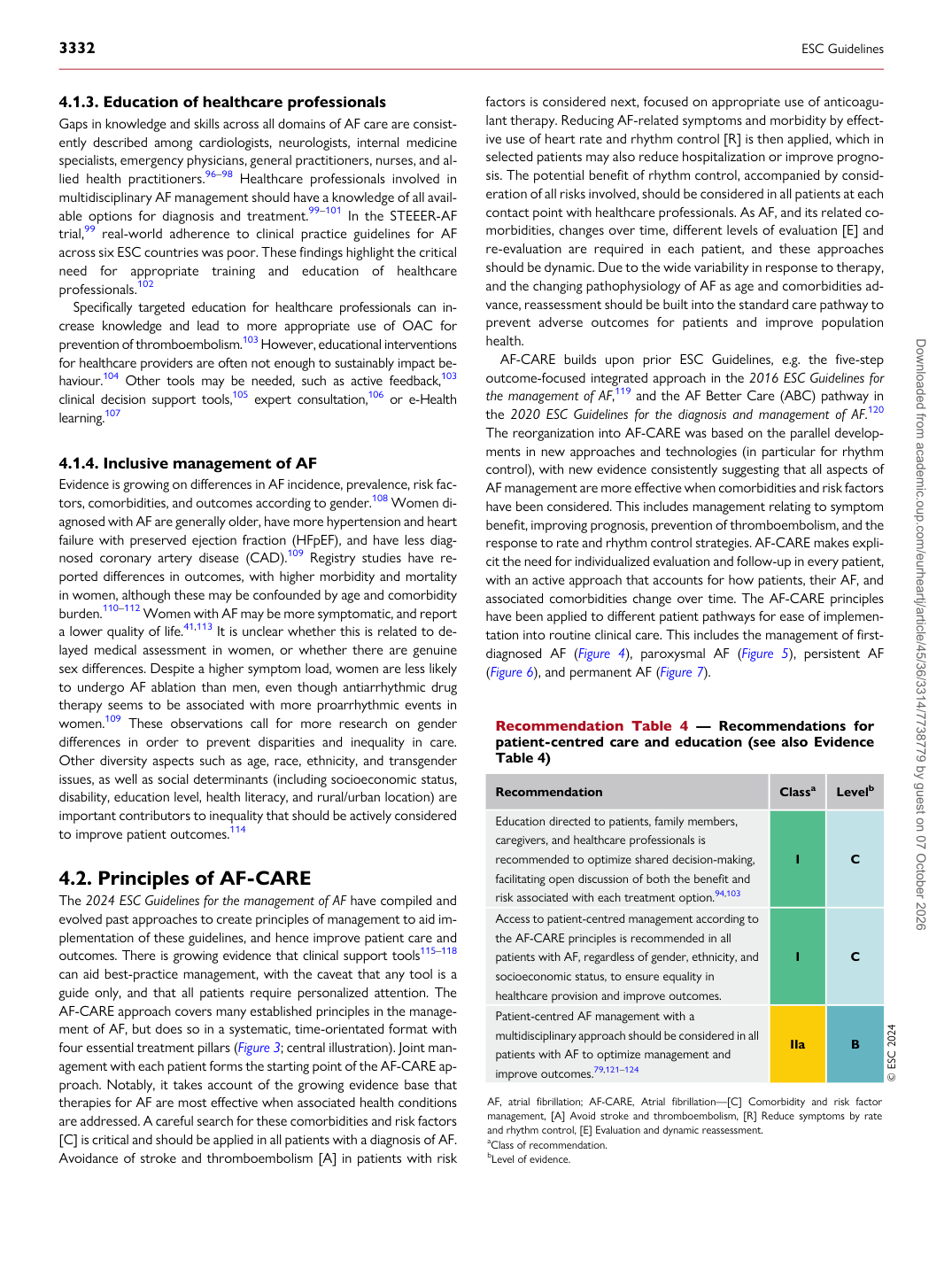
Recommendation Table 4 — Recommendations for patient-centred care and education (see also Evidence Table 4)

Recommendation Classa Levelb

Education directed to patients, family members, caregivers, and healthcare professionals is recommended to optimize shared decision-making, facilitating open discussion of both the benefit and risk associated with each treatment option.94,103 I C Access to patient-centred management according to the AF-CARE principles is recommended in all patients with AF, regardless of gender, ethnicity, and socioeconomic status, to ensure equality in healthcare provision and improve outcomes. I C Patient-centred AF management with a multidisciplinary approach should be considered in all patients with AF to optimize management and improve outcomes.79,121–124 IIa B © ESC 2024

AF, atrial fibrillation; AF-CARE, Atrial fibrillation—[C] Comorbidity and risk factor management, [A] Avoid stroke and thromboembolism, [R] Reduce symptoms by rate and rhythm control, [E] Evaluation and dynamic reassessment. aClass of recommendation. bLevel of evidence. Downloaded from academic.oup.com/eurheartj/article/45/36/3314/7738779 by guest on 07 October 2026