p.18 抽出テキスト
4.1.2 Education and shared decision-making

Clear advice about the rationale for treatments, the possibility of treatment modification, and shared decision-making can help patients live with AF (see Supplementary data online, Table S2).92 An open and effective relationship between the patient and the healthcare professional is critical, with shared decision-making found to improve outcomes for OAC and arrhythmia management.93,94 In using a shared approach, both the clinician and patient are involved in the decision-making process (to the extent that the patient prefers). Information is shared in both directions. Furthermore, both the clinician and the patient express their preferences and discuss the options. Of the potential treatment decisions, no treatment is also a possibility.95 There are several toolkits available to facilitate this, although most are focused on anticoagulation decisions. For example, the Shared Decision-Making Toolkit (http://afibguide.com, http://afibguide.com/clinician) and the Successful Intravenous Cardioversion for Atrial Fibrillation (SIC-AF) score have been shown to reduce decisional conflict compared with usual care in patients with AF.93,94 Patient-support organizations can also make an important contribution to providing understandable and actionable knowledge about AF and its treatments (e.g. local support groups and international charities, such as http://afa-international.org). As AF is a chronic or recurrent disease in most patients, education is central to empower patients, their families, and caregivers.

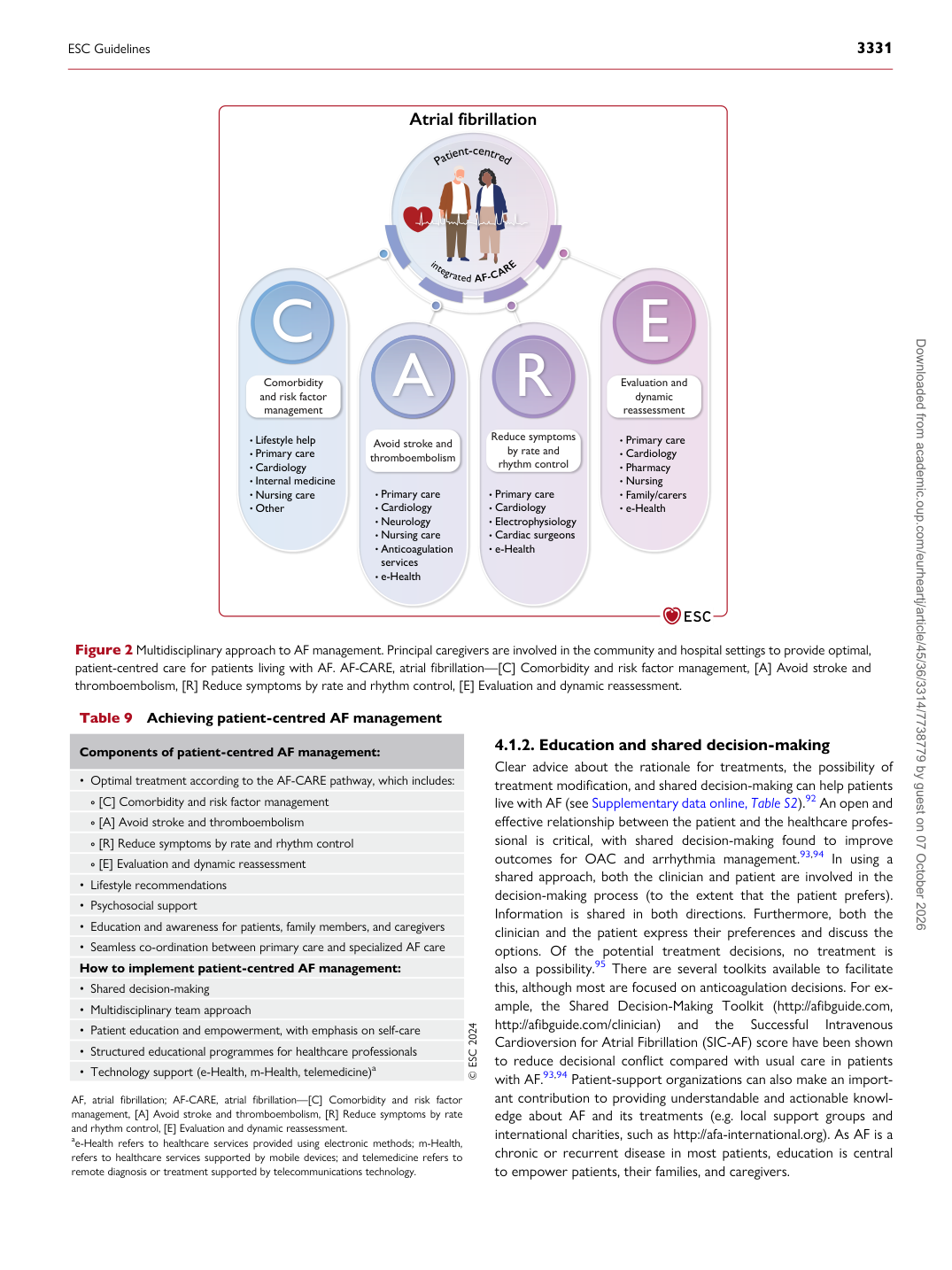
Atrial fibrillation

P

a t i e n t - c e n t r e

d

C A R E Comorbidity and risk factor management

Lifestyle help Primary care Cardiology Internal medicine Nursing care Other Avoid stroke and thromboembolism

Primary care Cardiology Neurology Nursing care Anticoagulation services e-Health Reduce symptoms

by rate and rhythm control Evaluation and

dynamic reassessment

Primary care Cardiology Pharmacy Nursing Family/carers e-Health Primary care Cardiology Electrophysiology Cardiac surgeons e-Health

i n t e g r a t e d A F - C A R

E

Figure 2 Multidisciplinary approach to AF management. Principal caregivers are involved in the community and hospital settings to provide optimal, patient-centred care for patients living with AF. AF-CARE, atrial fibrillation—[C] Comorbidity and risk factor management, [A] Avoid stroke and thromboembolism, [R] Reduce symptoms by rate and rhythm control, [E] Evaluation and dynamic reassessment.

Table 9 Achieving patient-centred AF management

Components of patient-centred AF management:

• Optimal treatment according to the AF-CARE pathway, which includes:

∘ [C] Comorbidity and risk factor management ∘ [A] Avoid stroke and thromboembolism ∘ [R] Reduce symptoms by rate and rhythm control ∘ [E] Evaluation and dynamic reassessment • Lifestyle recommendations • Psychosocial support • Education and awareness for patients, family members, and caregivers • Seamless co-ordination between primary care and specialized AF care How to implement patient-centred AF management: • Shared decision-making • Multidisciplinary team approach • Patient education and empowerment, with emphasis on self-care • Structured educational programmes for healthcare professionals • Technology support (e-Health, m-Health, telemedicine)a © ESC 2024

AF, atrial fibrillation; AF-CARE, atrial fibrillation—[C] Comorbidity and risk factor management, [A] Avoid stroke and thromboembolism, [R] Reduce symptoms by rate and rhythm control, [E] Evaluation and dynamic reassessment. ae-Health refers to healthcare services provided using electronic methods; m-Health, refers to healthcare services supported by mobile devices; and telemedicine refers to remote diagnosis or treatment supported by telecommunications technology.

ESC Guidelines                                                                                                                                                                                          3331

Downloaded from academic.oup.com/eurheartj/article/45/36/3314/7738779 by guest on 07 October 2026