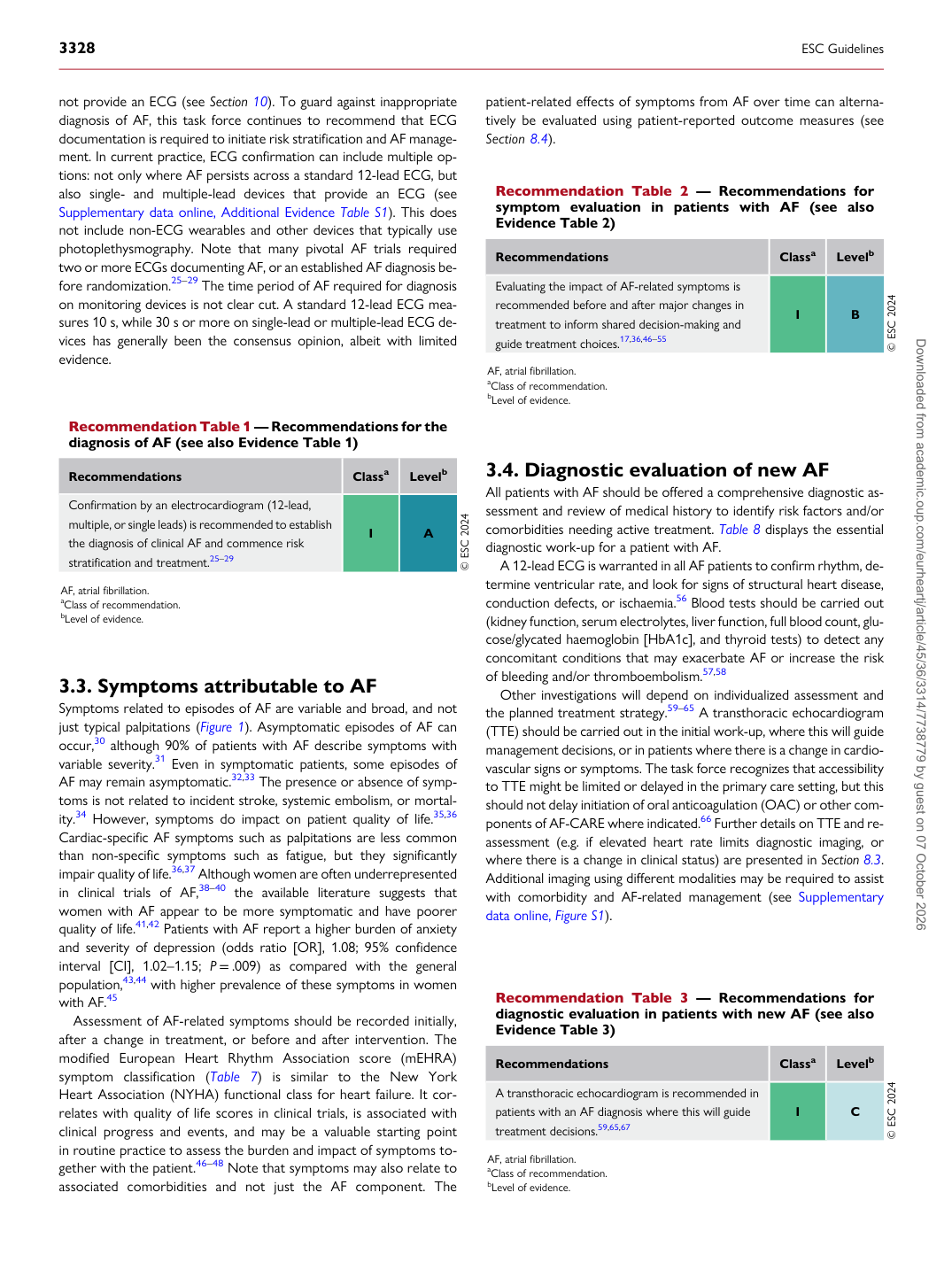
p.15 抽出テキスト
not provide an ECG (see Section 10). To guard against inappropriate diagnosis of AF, this task force continues to recommend that ECG documentation is required to initiate risk stratification and AF management. In current practice, ECG confirmation can include multiple options: not only where AF persists across a standard 12-lead ECG, but also single- and multiple-lead devices that provide an ECG (see Supplementary data online, Additional Evidence Table S1). This does not include non-ECG wearables and other devices that typically use photoplethysmography. Note that many pivotal AF trials required two or more ECGs documenting AF, or an established AF diagnosis before randomization.25–29 The time period of AF required for diagnosis on monitoring devices is not clear cut. A standard 12-lead ECG measures 10 s, while 30 s or more on single-lead or multiple-lead ECG devices has generally been the consensus opinion, albeit with limited evidence.

3.3 Symptoms attributable to AF

Symptoms related to episodes of AF are variable and broad, and not just typical palpitations (Figure 1). Asymptomatic episodes of AF can occur,30 although 90% of patients with AF describe symptoms with variable severity.31 Even in symptomatic patients, some episodes of AF may remain asymptomatic.32,33 The presence or absence of symptoms is not related to incident stroke, systemic embolism, or mortality.34 However, symptoms do impact on patient quality of life.35,36 Cardiac-specific AF symptoms such as palpitations are less common than non-specific symptoms such as fatigue, but they significantly impair quality of life.36,37 Although women are often underrepresented in clinical trials of AF,38–40 the available literature suggests that women with AF appear to be more symptomatic and have poorer quality of life.41,42 Patients with AF report a higher burden of anxiety and severity of depression (odds ratio [OR], 1.08; 95% confidence interval [CI], 1.02–1.15; P = .009) as compared with the general population,43,44 with higher prevalence of these symptoms in women with AF.45 Assessment of AF-related symptoms should be recorded initially, after a change in treatment, or before and after intervention. The modified European Heart Rhythm Association score (mEHRA) symptom classification (Table 7) is similar to the New York Heart Association (NYHA) functional class for heart failure. It correlates with quality of life scores in clinical trials, is associated with clinical progress and events, and may be a valuable starting point in routine practice to assess the burden and impact of symptoms together with the patient.46–48 Note that symptoms may also relate to associated comorbidities and not just the AF component. The patient-related effects of symptoms from AF over time can alternatively be evaluated using patient-reported outcome measures (see Section 8.4).

3.4 Diagnostic evaluation of new AF

All patients with AF should be offered a comprehensive diagnostic assessment and review of medical history to identify risk factors and/or comorbidities needing active treatment. Table 8 displays the essential diagnostic work-up for a patient with AF. A 12-lead ECG is warranted in all AF patients to confirm rhythm, determine ventricular rate, and look for signs of structural heart disease, conduction defects, or ischaemia.56 Blood tests should be carried out (kidney function, serum electrolytes, liver function, full blood count, glucose/glycated haemoglobin [HbA1c], and thyroid tests) to detect any concomitant conditions that may exacerbate AF or increase the risk of bleeding and/or thromboembolism.57,58 Other investigations will depend on individualized assessment and the planned treatment strategy.59–65 A transthoracic echocardiogram (TTE) should be carried out in the initial work-up, where this will guide management decisions, or in patients where there is a change in cardiovascular signs or symptoms. The task force recognizes that accessibility to TTE might be limited or delayed in the primary care setting, but this should not delay initiation of oral anticoagulation (OAC) or other components of AF-CARE where indicated.66 Further details on TTE and reassessment (e.g. if elevated heart rate limits diagnostic imaging, or where there is a change in clinical status) are presented in Section 8.3. Additional imaging using different modalities may be required to assist with comorbidity and AF-related management (see Supplementary data online, Figure S1).

Recommendation Table 1 — Recommendations for the diagnosis of AF (see also Evidence Table 1)

Recommendations Classa Levelb

Confirmation by an electrocardiogram (12-lead, multiple, or single leads) is recommended to establish the diagnosis of clinical AF and commence risk stratification and treatment.25–29 I A © ESC 2024

AF, atrial fibrillation. aClass of recommendation. bLevel of evidence. Recommendation Table 2 — Recommendations for symptom evaluation in patients with AF (see also Evidence Table 2)

Recommendations Classa Levelb

Evaluating the impact of AF-related symptoms is recommended before and after major changes in treatment to inform shared decision-making and guide treatment choices.17,36,46–55 I B © ESC 2024

AF, atrial fibrillation. aClass of recommendation. bLevel of evidence.

Recommendation Table 3 — Recommendations for diagnostic evaluation in patients with new AF (see also Evidence Table 3)

Recommendations Classa Levelb

A transthoracic echocardiogram is recommended in patients with an AF diagnosis where this will guide treatment decisions.59,65,67 I C © ESC 2024

AF, atrial fibrillation. aClass of recommendation. bLevel of evidence. Downloaded from academic.oup.com/eurheartj/article/45/36/3314/7738779 by guest on 07 October 2026